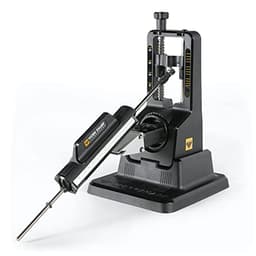
Buy the Elite if you sharpen a lot of knives, or knives in genuinely bad shape. Buy the standard Precision Adjust if you own a normal drawer of reasonably maintained knives — it reaches the same angles and the same edge for appreciably less money. That is the whole decision, and unusually for a step-up model, the differences between the two are all published rather than vague.
Work Sharp states the Elite’s specification plainly: “continuous angle adjustment from 15° to 30°” in 1 degree increments with an angle indicator; “Seven 1” x 6” sharpening abrasives 220, 320, 400, 600, & 800 grit diamond” plus a fine ceramic and a leather strop; two three-sided Tri-Brasivecarriers you “rotate… when sharpening to make it faster and easier”; a “Metal V-Block Clamp for secure and repeatable knife placement”; a “Clamp Stabilizing platform (Clamp Stabilizer) for increased stability when sharpening larger knives”; a ceramic rod for serrations; a carry case and a storage rack; and a three-year warranty.
We have not sharpened a hundred knives on one — we do not own it, and our methodology page says what we do instead. What follows is that published specification read against the standard kit, and against what a kitchen edge actually needs.
What the extra money actually buys
Four things, and only two of them affect the edge.
1. Five diamond grits instead of two.The standard kit gives you coarse diamond, fine diamond and a fine ceramic. The Elite gives you 220, 320, 400, 600 and 800 grit diamond plus the ceramic and a strop. On a knife that is merely dull this is irrelevant — you would use one or two grades and stop. On a knife with a rolled edge, a chip or a bevel that needs resetting, the progression is the difference between a smooth job and a crude one. A proper grit ladder also leaves a finer finished edge, because each step only has to remove the scratches left by the previous step.
2. A metal clamp and a stabilizer.The clamp is where every guided system lives or dies: if the blade shifts a degree mid-stroke, the dial on the front is decoration. A metal V-block held on a stabilizing platform is a firmer grip at lower pressure, which matters most on the two things clamps struggle with — long knives and thin hard blades.
3. Rotation instead of swapping. Three abrasives per carrier, rotated in place. It is a convenience feature rather than a performance one, but it is the convenience that decides whether you actually step through the grits or just use whichever one is already mounted.
4. A case. Which matters more than it sounds for a tool with loose diamond plates, a ceramic rod and a strop. Abrasives that live in a drawer get contaminated by whatever they rattle against.
The angle range is the part that matters for Japanese knives
Both Work Sharp kits adjust continuously from 15 to 30 degrees, and 15 is the number to look for. Shun publishes a 16 degree edge per side for its Classic line; ZWILLING publishes a 9.5 to 12 degree hand-honed edge on its Miyabi Koh knives; most VG10 gyutos sit near 15. Work Sharp’s own angle-guide product line frames the distinction as 20 degrees for Western edges and finer angles for Japanese ones, which is the right way round.
Two honest limits follow from that. First, 15 degrees is the floor — it reaches a Shun or a Tojiro, but it does not reach the most acute factory edges in this category, and a hand-honed 10 degree Miyabi edge would be thickened rather than restored by any clamped system we know of. Second, the coarse end of the abrasive range is genuinely aggressive. 220 grit diamond on a 60-plus HRC edge removes steel fast, and hard thin steel does not grow back. For maintenance, start at 400 or 600 and leave the coarse plates for damage. Our angle guide gives the number per knife type.
Precision Adjust Elite against the standard kit and a combination water stone, on published figures| | Precision Adjust Elite | Precision Adjust (standard) | 1000/6000 water stone |
|---|
| Angle control | 15°–30°, 1° increments, with indicator | 15°–30°, 1° increments | Your hands — no mechanical guide |
|---|
| Abrasives supplied | 220/320/400/600/800 diamond + fine ceramic + strop | Coarse diamond, fine diamond, fine ceramic | Two grits in one block |
|---|
| Clamp | Metal V-block + stabilizing platform | Clamp, no stabilizer stated | None |
|---|
| Serrated capability | Ceramic rod included for serrations | Not stated | No — a stone touches only the tooth tips |
|---|
| Repeatability for a beginner | High | High | Low until the motion is learned |
|---|
| Speed once skilled | Moderate | Moderate | Fastest |
|---|
| Warranty stated by maker | 3 years | Not stated on our source | n/a |
|---|
| Running cost | Replaceable peel-and-stick abrasives | Replaceable abrasives | The stone itself, plus a flattening plate |
|---|
What a clamped system still cannot do
The clamp defines the limits, and they are the same on both models. A very tall blade — a nakiri, a Chinese chef’s knife — may not sit in the jaws the way the geometry wants. A long slicer needs repositioning partway along, and every repositioning is a chance to introduce a facet. A single-bevel traditional knife should not go anywhere near a symmetric guided system; our single-bevel guide explains why. And nothing clamped will teach you to feel a burr, which is the skill that eventually makes a stone faster than any machine.
There is also a maintenance point specific to the hard Japanese steels this site mostly covers. Shun’s own FAQ warns against using a diamond steel for regular honing because it “will remove metal from your knife before it is necessary” — the same logic applies to reaching for a coarse diamond plate every time an edge feels tired. Between real sharpenings, a smooth ceramic rod is the correct tool, and sharpening vs honing covers the distinction.
Who should buy which
Buy the Eliteif you are the person in your family or neighborhood who sharpens everyone’s knives; if your drawer contains genuinely neglected edges that need resetting rather than refreshing; or if you want the finer finished edge a full grit ladder gives you and you will actually step through it.
Buy the standard Precision Adjust if you own a normal kitchen set, keep it roughly maintained, and want repeatable results without learning stone technique. It has the same angle range, the same working principle, and the edge it produces on a kitchen knife is one most people could not distinguish in use. Our review of the standard kit makes that case in full.
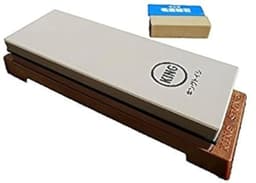
Buy a stone instead if your knives are Japanese, you have the patience for a weekend of practice, and you would rather own a skill than a fixture. A 1000/6000 combination stone costs a fraction of either machine, is gentler on hard thin steel, and handles every shape a clamp refuses. Our combination whetstone roundup is where to start, and how to sharpen a knife teaches the motion.
The verdict
The Elite is an honest step up rather than a marketing tier: every difference from the standard kit is a published, checkable specification, and two of them (the grit ladder and the metal clamp) genuinely affect the result. What Work Sharp does not claim, and we will not either, is that it makes a sharper kitchen knife than the cheaper model in ordinary use. It makes a wider range of repairs possible, more comfortably, on more knives. Price that against how many knives you actually sharpen, and the answer is usually clear.