Gyuto Club

DMT DuoSharp 8-Inch Review (W8FCNB)

The diamond plate we call the one to buy if you buy one — checked against DMT's own product page, its collection sheet and its FAQ. Two grits, one plate, no base, and a guarantee most makers would not put in writing.

By Stephen V.Last updated How we pick

How this is funded: we earn a commission if you buy through our links, at no extra cost to you. As an Amazon Associate we earn from qualifying purchases. It never changes which knife we recommend, and we’ll tell you when we’d skip one. Full disclosure.

This is the plate our diamond roundup calls “the diamond plate to buy if you are buying one,” and it has been recommended on four pages of this site without a review of its own. That is overdue, because a DMT plate is one of the few sharpening tools whose maker publishes almost everything you would want to know — the abrasive in microns and mesh, the plate’s dimensions to the hundredth of an inch, the break-in behavior, the care routine, the expected life and the guarantee — and a review that reads all of it is more useful than one that describes the feel of a plate we do not own. Two things about it are less than ideal, and both are in the model number.

What DMT actually publishes

The product page for the W8FCNB states two abrasive grades on one plate: “Coarse” at “45 micron / 325 mesh” and “Fine” at “25 micron / 600 mesh,” on a “micronized monocrystalline diamond surface.” It is described as a “precision flat, double surfaced sharpener guaranteed to provide consistent, even sharpening every time,” to be used “dry or with water,” and “Made in the USA.” DMT’s collection sheet gives the bare plate’s dimensions as 8 by 2.63 by 0.38 inches — about 203 by 67 by 10 mm — and lists the with-base version of the same plate, the W8FC-WB, at 12.125 by 4.625 by 2 inches overall.

Those micron figures are the reason to buy a diamond plate rather than a stone for the coarse end. A water stone’s grit number is a manufacturer’s label on a bonded abrasive that wears and dishes; a diamond plate’s micron figure describes particles fixed to a steel plate that does neither. DMT’s color-coded chart, reproduced by the specialist retailer we cite, puts the rest of the range around this plate: Extra-Coarse 60 µm / 220 mesh below it, Extra-Fine 9 µm / 1200 mesh above. The W8FC covers the middle two. What it does not cover is a finish — 600 mesh is the grit a kitchen edge is worked at, not polished at, and the registry card says so.

The interrupted surface, from DMT’s own mouth

The DuoSharp’s polka-dot face is its signature and the thing most buyers ask about. DMT’s FAQ explains it plainly: the dots are “slightly recessed,” so the steel debris (swarf) falls away from the working surface instead of building up on it; the continuous-surface Dia-Sharp line exists because a solid face is “perfect for small-pointed tools.” That is the whole trade-off in two sentences. An interrupted plate keeps cutting through a long session on a hard knife because it does not clog; a continuous plate is the safer surface for a very fine tip, which can drop into a hole on the interrupted plate. DMT also sells a DuoSharp Plus (WM8FC) that carries both an interrupted area and “an additional continuous diamond surface for sharpening small and pointed tools” on the same plate; it was listed as sold out on DMT’s store when we checked, as was the W8FCNB itself. Our diamond stone vs whetstone page has the wider argument.

Break-in, care and how long it lasts — DMT’s numbers, not ours

Three things about diamond plates that surprise first-time buyers are all answered on DMT’s FAQ, and they are worth quoting rather than paraphrasing.

  • It will feel too coarse at first.“When you first use your DMT sharpener, the diamond surface will seem aggressive in nature; the diamond sharpener will smooth after initial sharpening with no impact to long term performance. Your first few sharpenings are the break-in period.” Do those first few on a knife you do not care about.
  • Water or nothing.“DMT recommends you use DMT products dry or with water only.” Cleaning is “after each use with water and wipe dry,” and “after several sharpenings, use a mild kitchen abrasive cleanser and a nylon scrub brush.” No oil, ever.
  • It is not immortal.DMT’s own words: “When used properly, kept clean and stored dry, DMT diamond sharpeners will last a very long time. They do not last forever, but they last for several years.” That is more honest than the “lifetime” language most of the category uses. The plate never dishes and never needs flattening; what it eventually does is slow down.

And the guarantee, which is unusual enough to quote in full: “If your product fails to perform due to defects in materials or workmanship, we will replace it regardless of age.” Note what that does and does not cover — defects, not wear — but “regardless of age” is a phrase almost no one else in sharpening puts in writing.

One caution in DMT’s own advice

DMT’s FAQ says “We recommend sharpening at a 20-degree angle.” That is the right number for a German kitchen knife and the wrong number for a Japanese one, which arrives at 15–16° per side; on a gyuto, 20° puts a blunt secondary bevel on a thin edge. The FAQ’s next sentence is the one to keep: “sharpening at the proper angle is not as important as sharpening at a constant angle.” Hold whatever angle the knife came with, consistently. Our angle guide covers how, and the Japanese-knife sharpener page covers why the number matters more on hard steel.

The two problems, both in the model number

NB: no base. The listing we link is the bare plate. It is 8 by 2.63 inches of steel-backed diamond, 0.38 inches thick, and on a wet counter it moves. DMT sells the same plate with its bench-stone base as the W8FC-WB; the NB buyer needs a non-slip mat, a rubber-footed holder or a damp towel underneath, and should budget for one. It is a small omission with a large effect on how safe the plate is to use.

FC: Fine and Coarse, and nothing finer.600 mesh leaves a toothy, working edge. For a kitchen knife that is usable — it is roughly where a 1000-grit water stone leaves you — but it is not finished. A strop with compound, a 3000–6000 water stone, or DMT’s own Extra-Fine plate is the next step, and the strop roundup is the cheapest of the three.

How it compares

The three plates a buyer weighs this one against, on the figures each maker or listing publishes.

The DMT DuoSharp W8FCNB against the SHARPAL 162N, the DMT Dia-Sharp D8F and the Atoma 140
 DMT DuoSharp W8FCNBSHARPAL 162NDMT Dia-Sharp D8FAtoma #140
Grits (mesh / µm)325 / 45 and 600 / 25325 / 45 and 1200 / 12600 / 25 only#140 only
SurfaceInterrupted (polka-dot)ContinuousContinuousContinuous, replaceable sheet
Plate size8 x 2.63 x 0.38 in.8 x 3 in.8 x 3 x 0.38 in.Not published
Base includedNo (NB)Yes — case lidNoNo
Made inUSANot publishedUSANot published
Guarantee (as published)Replaced for defects regardless of ageNot publishedSame DMT guaranteeNot published
What it is forRepair plus routine sharpening, one plateSame, with a finer second sideRoutine sharpening on thin-tipped bladesFlattening stones; heavy repair

Who should buy it

Someone who wants one plate that will do edge repair and routine sharpening on hard and soft knives alike, that never needs flattening, and that comes from a maker with a decades-long record and a written guarantee. Someone who owns water stones and wants a coarse plate to flatten them — the 325 side does that job, though the Atoma does it faster. Someone who sharpens a lot and values a face that does not clog.

Who should not: anyone who wants a finished edge off one tool (buy the SHARPAL for its 1200 side, or add a strop); anyone with a fine-tipped Japanese blade who would rather not think about the holes (buy the Dia-Sharp); and anyone who will not buy a mat or holder to go under an NB plate.

How we reviewed this

We do not own this plate and have not sharpened on it. This review reads DMT’s own product page for the W8FCNB, its DuoSharp collection sheet (for the dimensions and the with-base and Plus variants) and its FAQ, against DMT’s color-coded grit chart as reproduced by the specialist retailer we cite, the general reference on why plates stay flat, and the figures already compiled for the other plates we list. Where DMT publishes something, we quote it; where it publishes nothing (a weight, a warranty period beyond “regardless of age”), we say so. The listing’s ASIN was re-verified live via the Amazon Creators API on the review date under the title “DMT (Diamond Machining Technology) 8-Inch DuoSharp Bench Stone Fine/Coarse, (W8FCNB).” No price appears in this text: prices on this site come only from the live daily check and carry the date they were pulled. Our methodology sets out the rules in full.
Our verdict

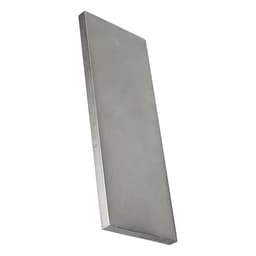
DMT DuoSharp 8-inch Bench Stone, Fine/Coarse (W8FCNB)

The diamond plate to buy if you are buying one. Coarse on one face, Fine on the other, on DMT's interrupted 'polka-dot' surface that clears swarf instead of clogging with it. It cuts hard Japanese steel faster than any water stone and it will still be dead flat in ten years.

Strengths

  • Two grits in one plate: Coarse 325 to reset an edge, Fine 600 to sharpen it
  • Never dishes and never needs flattening — the failure mode of every water stone
  • Interrupted surface clears steel swarf, so it keeps cutting on long sessions

Trade-offs

  • The NB suffix means no base — buy a non-slip mat or it will skate
  • Stops at Fine 600; you need a finishing stone or a strop for a polished edge
Grit(s)Coarse 325 mesh (45 µm) / Fine 600 mesh (25 µm)
MaterialMonocrystalline diamond on interrupted nickel surface
PrepDry or with water — no soaking
Base includedNo
Dimensions8 in. double-sided bench plate

Specs read from the manufacturer listing, on August 11, 2026. “Not published” means the maker does not state that figure.

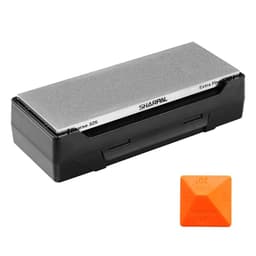
SHARPAL 162N Dual-Grit Diamond Whetstone 8 x 3 in.

If you want a finer second side and a base

SHARPAL 162N Dual-Grit Diamond Whetstone 8 x 3 in.

The value pick, and the one we would put in a beginner's hands. A full 8 x 3 inch face — wider than the DMT — at Coarse 325 and Extra Fine 1200, in a storage case whose lid doubles as a non-slip base. It even ships with an angle guide, which is the single thing beginners get wrong.

See the diamond roundup
$69.99 · View on Amazon

Price as of September 18, 2026. #ad How we’re funded

DMT D8F Dia-Sharp 8-inch Bench Stone, Fine

If your knives have fine, thin tips

DMT D8F Dia-Sharp 8-inch Bench Stone, Fine

The single-grit, continuous-surface plate — no holes, so nothing catches a thin blade tip on the way across. Fine 600 is the grit a kitchen knife actually lives at, and this is the version to buy if you want one plate that does the job properly rather than two that do it adequately.

See the diamond roundup
$65.29 · View on Amazon

Price as of September 18, 2026. #ad How we’re funded

Atoma Diamond Sharpener #140 (Coarse)

If what you actually need is a flattening plate

Atoma Diamond Sharpener #140 (Coarse)

Not really a sharpening stone — this is the flattening plate the Japanese stone world standardized on, and the tool that fixes the one problem every water stone develops. #140 is brutally coarse: it is for lapping stones flat and reprofiling wrecked edges, nothing else.

How to flatten a whetstone
$74.90 · View on Amazon

Price as of September 18, 2026. #ad How we’re funded

Frequently asked questions

Is the DMT DuoSharp worth it?

If you want one diamond plate that covers edge repair and routine sharpening and will still be flat in a decade, yes. DMT publishes Coarse at 45 micron / 325 mesh and Fine at 25 micron / 600 mesh on one 8 x 2.63 x 0.38 in. plate, made in the USA, and guarantees to replace it 'regardless of age' for defects. What it does not do is finish an edge — 600 mesh is a working grit — and the NB version ships without a base.

What does NB mean on the DMT W8FCNB?

No base. DMT sells the same 8-inch Fine/Coarse plate as W8FCNB (the bare plate, 8 x 2.63 x 0.38 in.) and W8FC-WB (with its bench-stone base, 12.125 x 4.625 x 2 in. overall). The listing we link is the NB. A bare steel-backed plate skates on a wet counter, so budget for a non-slip mat or a holder — it is the one thing missing from an otherwise complete tool.

What grit is the DMT DuoSharp Fine/Coarse?

DMT's own figures: Coarse is 45 micron / 325 mesh, Fine is 25 micron / 600 mesh. In water-stone terms that is roughly a coarse repair stone and a low-medium working stone; there is no finishing grade on this plate. DMT's Extra-Fine (9 micron / 1200 mesh) is on other DuoSharp combinations, not this one.

Why does a new DMT plate feel so rough?

Break-in, and DMT says so: 'the diamond surface will seem aggressive in nature; the diamond sharpener will smooth after initial sharpening with no impact to long term performance. Your first few sharpenings are the break-in period.' Do the first few sessions on a knife you do not mind scratching, not on a new gyuto.

Do you use water or oil on a DMT DuoSharp?

Water or nothing. DMT's FAQ is explicit: 'DMT recommends you use DMT products dry or with water only.' Never oil. After each use, DMT says to clean with water and wipe dry; after several sharpenings, a mild kitchen abrasive cleanser and a nylon scrub brush.

How long does a DMT diamond plate last?

DMT's own answer is honest rather than boastful: 'When used properly, kept clean and stored dry, DMT diamond sharpeners will last a very long time. They do not last forever, but they last for several years.' A diamond plate never dishes and never needs flattening, which is the failure mode of every water stone; what it does eventually do is slow down as diamonds wear.

DMT DuoSharp or SHARPAL 162N?

The DMT if you value the interrupted surface (swarf falls into the recessed dots instead of clogging the face on a long session), the longer track record and the replace-regardless-of-age guarantee. The SHARPAL if you want a wider 8 x 3 in. face, a finer second side (1200 mesh / 12 µm instead of 600 / 25 µm), and a case that doubles as a base, for less money. For a thin-tipped Japanese blade, DMT's continuous-surface Dia-Sharp avoids the holes altogether.

Can you sharpen Japanese knives on a DMT plate?

Yes — diamond cuts 60 HRC steel faster than a water stone, which is the point. Two cautions: the 325 side is a repair grit and removes a lot of steel from a thin blade quickly, so use the 600 side for routine work; and a very fine tip can catch in the interrupted surface's holes, which is the case for the continuous Dia-Sharp instead. Not for single-bevel knives.

Sources

  • 8-in. DuoSharp Bench Stone - Fine / Coarse (W8FCNB) — DMT Diamond SharpenersDMT's published spec for model W8FCNB: 'Coarse' at '45 micron / 325 mesh' and 'Fine' at '25 micron / 600 mesh', a 'micronized monocrystalline diamond surface', a 'precision flat, double surfaced sharpener guaranteed to provide consistent, even sharpening every time', 'Sharpen dry or with water', 'Made in the USA'. No base is mentioned. Listed at $128.99 and showing 'Sold out' on DMT's own store on the access date (accessed September 18, 2026)
  • DuoSharp Bench Stone collection — DMT Diamond SharpenersDMT's full DuoSharp range with SKUs and sizes: the 8-inch no-base plates (W8FCNB, W8EFNB, W8ECNB, W8CXNB) are '8" x 2.63" x 0.38"'; the with-base versions (W8FC-WB etc.) are '12.125" x 4.625" x 2"'; the 10-inch plates (W250 series) are '10" x 4" x 0.38"'. The range 'Employs DMT interrupted surface technology and in the PLUS model, a continuous surface as well' — the DuoSharp Plus (WM8FC) adds 'an additional continuous diamond surface for sharpening small and pointed tools' (accessed September 18, 2026)
  • DMT FAQ — DMT Diamond SharpenersDMT's own answers: on break-in, 'the diamond surface will seem aggressive in nature; the diamond sharpener will smooth after initial sharpening with no impact to long term performance. Your first few sharpenings are the break-in period'; 'DMT recommends you use DMT products dry or with water only'; care is to 'clean after each use with water and wipe dry' and 'After several sharpenings, use a mild kitchen abrasive cleanser and a nylon scrub brush'; on life, DMT sharpeners 'do not last forever, but they last for several years'; the polka-dot surfaces are 'slightly recessed' so debris falls away while Dia-Sharp's 'continuous diamond surface' suits 'small-pointed tools'; DMT recommends 'sharpening at a 20-degree angle' and notes 'sharpening at the proper angle is not as important as sharpening at a constant angle'; and the guarantee: 'If your product fails to perform due to defects in materials or workmanship, we will replace it regardless of age' (accessed September 18, 2026)
  • DMT Diamond and Ceramic Color-Coded Grit Chart — Sharpening SuppliesDMT's own color codes with the mesh and micron figure for each grade (Coarse 325/45 µm, Fine 600/25 µm, Extra-Fine 1200/9 µm) (accessed August 11, 2026)
  • Sharpening stone — WikipediaReference on water, oil and diamond stones: Japanese water-stone grit ranges, why stones dish in the middle with use, and why a diamond plate retains its flatness (accessed August 13, 2026)

Per-knife specs (steel, HRC, blade length, geometry) are read from each maker’s spec sheet or product listing and dated on the individual review cards above. “Not published” means the manufacturer does not state that figure — we flag it rather than guess.

Keep reading