The Easiest Knives to Sharpen
Softer steel, a plain double bevel, no bolster in the way. The four traits that make a knife forgiving on a stone — and the knives that have them.
How this is funded: we earn a commission if you buy through our links, at no extra cost to you. As an Amazon Associate we earn from qualifying purchases. It never changes which knife we recommend, and we’ll tell you when we’d skip one. Full disclosure.
“Easy to sharpen” is not a vague quality. It comes down to four specific traits, and once you know them you can look at any knife — yours or one you are considering — and predict how it will behave on a stone.
The four traits
1. Softer steel
This is the dominant factor. Steel at 55–58 HRC abrades far faster than steel at 60–62, which means fewer strokes to raise a burr and a much shorter first session. It also means quicker, clearer feedback: a beginner on soft steel feels the burr appear within a couple of minutes and learns what they are looking for. On a hard blade the same beginner is ten minutes in with nothing to feel and no idea whether they are doing it right.
The catch is symmetrical: soft steel is easy to sharpen because it is easy to abrade, and it is easy to abrade because it also dulls quickly in use. You will sharpen more often; each session will be shorter. Our steel and hardness guide covers the trade properly.
2. A plain, symmetrical double bevel
Both sides ground the same, at the same angle, with nothing clever going on. That means you can flip the knife over and repeat exactly what you just did — no handedness, no back-flattening, no compound grind to preserve.
The hard cases are single-bevel Japanese knives (usuba, yanagiba, deba), which need the flat back kept true as well as the bevel ground, and are handed. They are superb tools and a bad place to learn.
3. No bolster in the way
Stamped knives have no bolster, so the whole edge from heel to tip can lie flat on the stone. Many forged Western knives carry a bolster that runs down past the heel, blocking the last centimeter. Sharpen such a knife for a few years and the rest of the edge wears back while the blocked heel does not, leaving a visible step. It is fixable — sharpen the heel deliberately, or file the bolster back — but it is one more thing to think about.
4. A thin grind
Slightly counterintuitive: a thin blade has less metal to remove behind the edge, so re-establishing a bevel is faster even in harder steel. A thick, obtusely ground budget knife can be soft and still take forever, because you are grinding through a wedge. This is why a thin Japanese knife often sharpens more quickly than its hardness suggests.
Easiest to hardest, in practice
| Why | Verdict | |
|---|---|---|
| Soft stamped Western (Victorinox) | ~55-56 HRC, no bolster, thin, plain double bevel | Easiest — the knife to learn on |
| Forged budget Western (Mercer Genesis) | ~58 HRC, forgiving steel, but a bolster at the heel | Easy, with one obstacle |
| Forged premium Western (Wüsthof Classic) | ~58 HRC and thicker stock; half bolster blocks the heel | Moderate — more metal to move |
| Japanese clad gyuto (Tojiro DP) | ~60 HRC core but very thin; no bolster | Moderate — slower, but clean feedback |
| Hard Damascus (Shun, Miyabi) | ~60-61 HRC, fine edge worth preserving | Harder — unforgiving of a wandering angle |
| Single-bevel (usuba, yanagiba) | Handed, needs the flat back maintained too | Hardest — a separate skill |
| Serrated (bread knife) | Each scallop needs a tapered rod, not a stone | Different job — and rarely needed |
What to actually learn on
Buy a cheap soft-steel knife and a soft 1000/6000 stone and ruin the knife a few times. That sentence is the entire recommendation. Soft steel and a soft stone both give fast, obvious feedback, and there is nothing at stake.
The temptation is to practice on the good knife because it is the one you care about. Resist it. A hard, thin, expensive edge punishes exactly the mistakes a beginner makes — too much pressure, a drifting angle, over-polishing before the burr has formed — and it takes far longer to give you the feedback that tells you what went wrong. Learn the motion on a $45 knife, then apply it.
Once the motion is reliable, the hard knives stop being harder. If your angle is genuinely consistent, a 61 HRC blade holds it better against the stone than soft steel does, and the burr it raises is cleaner and easier to remove. The difficulty was never the steel; it was the hand.
If you want the shortcut
There is no shame in it. A guided sharpening system clamps the blade and fixes the angle mechanically, which removes the single variable that makes freehand sharpening hard. It works on hard and soft steel alike, it produces a repeatable result on the first attempt, and it is a completely reasonable choice for someone who wants sharp knives rather than a new hobby.
What it will not fix is a knife with a bolster blocking the heel, or a single-bevel Japanese blade. Those remain hand jobs. And if your knives are simply rolled rather than worn, the answer is not sharpening at all — it is ten seconds on a honing rod.
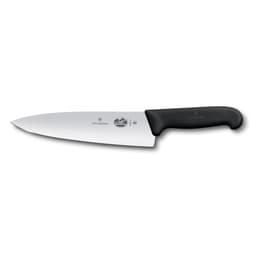
The easiest knife to learn on
Victorinox Fibrox Pro 8-inch Chef's Knife
The knife that wins nearly every budget test, and the one to buy if you buy only one. A soft, stamped X50CrMoV15 blade at ~55-56 HRC and a grippy, non-slip handle — it dulls sooner than a hard Japanese knife but takes an edge back in seconds.
Read the full reviewPrice as of October 19, 2026. #ad How we’re funded
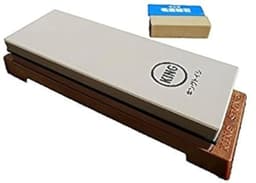
The most forgiving stone to learn on
King (Matsunaga) KW-65 1000/6000 Combination Whetstone
The stone that has taught more people to sharpen than any other. One side 1000-grit to set an edge, one side 6000-grit to polish it, made in Japan, for the price of a takeout dinner. Start here.
Read the full reviewThere is one blade material that sits outside this entire ranking, because an ordinary stone will not touch it: can you sharpen ceramic knives covers what a zirconia blade needs instead, and why a chipped one is usually finished.
Frequently asked questions
What is the easiest knife to sharpen?
A soft-steel, stamped, bolsterless Western knife with a plain double bevel — a Victorinox Fibrox is the archetype. Softer steel abrades quickly and raises a burr in far fewer strokes, a stamped blade has no bolster blocking the heel, and a simple symmetrical bevel means there is nothing special to learn.
Are Japanese knives harder to sharpen?
They take longer, because harder steel resists abrasion — expect more strokes to raise a burr. But they hold an angle better against the stone and produce a cleaner, more predictable burr, and their thin grind means less metal to remove. Many people find them easier once they can sharpen at all; it is the first few attempts that are harder.
Why is a bolster a problem when sharpening?
On many forged Western knives the bolster runs down past the heel, so the last centimeter or so of edge sits behind a shoulder of steel and cannot lie flat on the stone. Over years of sharpening the rest of the blade wears back while the heel does not, producing a visible step. You can work around it deliberately, or file the bolster back, which many professionals do.
Is a serrated knife hard to sharpen?
It is a different job. You cannot sharpen a serrated edge on a flat stone — each scallop needs a tapered round rod worked from the beveled side only. It is fiddly rather than difficult, and because the points of a serrated blade rarely touch the board, a bread knife often goes many years before it needs anything at all.
What should I practice sharpening on?
A cheap soft-steel knife you do not care about, on a soft 1000-grit stone. Soft steel gives fast feedback — you feel the burr appear within a couple of minutes — and if you ruin the edge, you have ruined nothing of value. Do not learn on the expensive Japanese knife you just bought.
Sources
- Rockwell hardness test — Wikipedia — Definition of the Rockwell C (HRC) scale used to state knife-steel hardness (accessed July 21, 2026)
- Knife sharpening — Wikipedia — Reference on edge angle, coarse-to-fine grit progression, and honing vs sharpening (accessed July 21, 2026)
- Japanese kitchen knife — Wikipedia — Reference on gyuto/santoku/nakiri, single- vs double-bevel (kataba/ryoba) and edge angles (accessed July 21, 2026)
Per-knife specs (steel, HRC, blade length, geometry) are read from each maker’s spec sheet or product listing and dated on the individual review cards above. “Not published” means the manufacturer does not state that figure — we flag it rather than guess.
Keep reading
Can You Sharpen a Ceramic Knife?
Where zirconia sits on this scale, and what it takes to put an edge back on.
Read the guideHow to Sharpen a Knife
The workflow to practice these traits with.
Learn the methodBest Whetstones for Beginners
The forgiving stones to learn on.
See the stonesBest Chef Knives for Beginners
Knives that suit a new cook and a new sharpener.
See the picksKnife Steel & Hardness Guide
Why hardness makes an edge last and a stone struggle.
Understand the steelHow Often to Sharpen a Knife
Easy to sharpen matters less if you hone weekly.
Read the guideWhetstone vs Electric Sharpener
If freehand is the barrier, this is the decision.
Compare themHow to Fix a Chipped Knife
What to do when a hard knife chips instead of rolling.
Read the how-to