How to Sharpen a Knife Without a Whetstone
An abrasive, one constant angle, and the burr stripped off at the end. Any method that delivers all three sharpens a knife — and most of the kitchen tricks on the internet deliver none of them.
How this is funded: we earn a commission if you buy through our links, at no extra cost to you. As an Amazon Associate we earn from qualifying purchases. It never changes which knife we recommend, and we’ll tell you when we’d skip one. Full disclosure.
The best answer is a guided clamp system: the blade clamps, the angle sets by knob, and the one variable beginners cannot control — holding a consistent angle — stops being your problem. The best genuinely improvised answer is wet-or-dry sandpaper taped to a piece of float glass, which is a whetstone in everything but name. Almost everything else you will read about — mug bottoms, car windows, the back of another knife — removes metal without controlling the angle, which is how you end up with a rounded bevel that cuts worse than the dull knife you started with.
It helps to be clear about what sharpening is, because once you state it the options sort themselves. Sharpening is grinding two bevels until they intersect in a clean apex, and it needs exactly three things:
- An abrasive harder than the steel.Stone, diamond, ceramic, aluminium oxide paper, carbide — all qualify.
- A constant angle. Not a textbook angle; a constantone. DMT’s own FAQ puts it better than we could: it recommends “sharpening at a 20-degree angle” but adds that “sharpening at the proper angle is not as important as sharpening at a constant angle.” Every bevel you grind at a different angle is wasted work.
- Burr removal at the end. The wire edge that forms as you grind feels sharp and has no strength. Leave it on and the knife dies in minutes.
A whetstone is simply the most common way to supply all three. It is not the only one.
Option 1: a guided clamp system — the one we would actually buy
A guided system holds the knife and the abrasive in a fixed geometric relationship, which means the angle is set by the machine rather than by your wrist. The Work Sharp Precision Adjust is the example in our registry: the blade clamps, the angle sets continuously from 15° to 30° in one-degree increments, and a rotating handle carries coarse diamond, fine diamond and a fine ceramic abrasive in one tool.
That is the whole no-stone problem solved properly. You get a real abrasive progression, a repeatable angle you can write down and return to next time, and the ability to set 15° for a gyuto and 20° for a German chef’s knife rather than imposing one on both. The costs are honest ones: it is slower than a stone once you can actually use a stone, and an overtightened clamp marks soft handles. See Precision Adjust vs Lansky for the head-to-head and the Elite review for the upgraded version.
Option 2: an electric sharpener with a selectable angle
If you want the job done in thirty seconds and you accept the trade, this is the route. The trade is steel: a motor-driven abrasive removes real metal every time, which is fine a few times a year and ruinous monthly.
The specification that matters is angle selection. EdgeCraft — which makes the Chef’sChoice machines — publishes the distinction on its own site: Euro and American knives are “sharpened with sturdy 20 degree facets (40 degree total angle)” while Asian knives use “the more delicate 15 degree facets (30 degree total angle),” and it names the Trizor XV as the model that converts a 20° edge to 15°. That conversion is a feature if you want it and a problem if you did not: a machine that imposes 15° on a German knife has reground your knife, not sharpened it. A selectable 15°/20° machine lets a mixed drawer keep its geometry. Our electric roundup covers the field and the 15XV review covers the conversion machine in detail.
Option 3: a diamond plate, if your objection is the stone’s upkeep
Plenty of people who say “I don’t want a whetstone” mean they do not want to soak something for ten minutes, keep it flat, or deal with grey slurry. A diamond plate removes all three objections while keeping the freehand technique: DMT says to use its products “dry or with water only,” and its Dia-Sharp bench stones are “guaranteed not to hollow or groove,” with a “continuous diamond surface” that suits fine-tipped tools.
Two things to know. First, the grit scales are not comparable across systems: DMT’s published chart puts its Fine at 600 mesh / 25 micron and its Extra-Fine at 1200 mesh / 9 micron, which are not the same numbers as a 1000-grit water stone. Second, DMT’s own FAQ says the surface “will seem aggressive in nature” at first and “will smooth after initial sharpening” — your first few sessions are the break-in period, not a defect. Our diamond vs whetstone page covers the choice.
Option 4: sandpaper on glass — the real improvised method
If you want to spend nothing and still get a properly sharp knife, this is it. Wet-or-dry abrasive paper taped to float glass, a granite offcut or a thick flat tile is a flat surface carrying a graded abrasive, which is the definition of a bench stone. Work 400 to 800 to 1500 and up, keep the angle constant, deburr at the end, and you will produce an edge that genuinely slices paper.
Its limits are practical rather than theoretical: the paper wears out quickly, so a badly damaged edge chews through sheets; the grit numbering is a different scale again from water stones; and a soft or curved backing will round your bevel, which is why the flatness of what you tape it to is not optional. The step-by-step method is in the instructions above.
Option 5: a carbide pull-through, named honestly
We include this because it is what most people actually own. A carbide slot scrapes metal away fast and will make a beaten supermarket knife cut again in seconds; the ceramic slot tidies up after it. It is also the crudest tool in our registry: it tears metal rather than grinding it, leaves a rough and short-lived edge, removes more steel than the knife needed, and sets the angle by the slot so you have no say in it.
Use it on cheap knives you do not care about. Never put a hard Japanese blade through one — at the 60-61 HRC Shun publishes for VG10 and VG-MAX, a carbide slot chips the edge rather than reshaping it.
What does not work, and why
| Abrasive? | Constant angle? | Verdict | |
|---|---|---|---|
| Wet-or-dry sandpaper on glass | Yes, graded | Freehand, but on a flat surface | Works — the one to use |
| Unglazed ring on a mug | Yes, coarse | No — narrow and curved | Emergency only; rounds the bevel |
| The spine or edge of another knife | Barely | No | Steeling at best, two chipped edges at worst |
| Car window glass | No — smooth glass | No | Burnishes; does not sharpen |
| Concrete, brick or a flagstone | Yes, very coarse | No | Removes a lot of steel, leaves a torn edge |
| Leather belt with no compound | No | n/a | Strops a burr off; cannot form an apex |
The pattern is the same throughout: the methods that fail are not failing for lack of abrasive. They fail because they cannot hold an angle, and an edge ground at twenty different angles has no apex at any of them.
When nothing you own will do the job
If the edge is chipped, badly rolled or has been rounded over by years of pull-through use, none of the above is a shortcut — it needs coarse abrasive and real time, and the usual answer is either a coarse plate or a professional service. Our chipped-knife guide covers the repair and professional sharpening covers what it costs, argued from two published rate cards.
And if the knife will not take an edge no matter what you do, the problem may not be the method: why your knife won’t get sharp works through the causes, most of which are a burr that was never removed or an apex that was never formed.
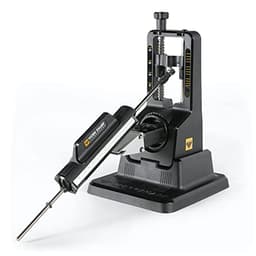
Best no-stone option overall
Work Sharp Precision Adjust Knife Sharpener
The guided system to buy if a whetstone has beaten you. The blade clamps, the angle sets by knob anywhere from 15 to 30 degrees in one-degree steps, and a rotating handle carries coarse diamond, fine diamond and a fine ceramic. It removes the one variable beginners cannot control: holding a consistent angle.
Read the Precision Adjust reviewPrice as of October 17, 2026. #ad How we’re funded
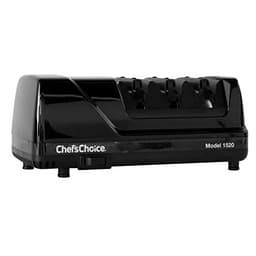
If you want it done by a motor, with the angle respected
Chef'sChoice AngleSelect 2-Stage Electric Sharpener (15° / 20°)
The Chef'sChoice for a mixed drawer. The 15XV converts everything to 15 degrees whether you wanted that or not; the AngleSelect lets you pick — 15 degrees for the Japanese knives, 20 for the German ones — and handles serrated blades in the same machine.
See it against the electric fieldPrice as of October 17, 2026. #ad How we’re funded
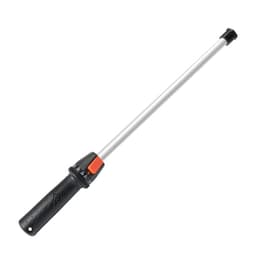
If the edge only needs maintaining, not rebuilding
SHARPAL 111H RODALL Ceramic Sharpening Rod, Angle Adjustable
The rod to own if your knives are Japanese. A grooved steel rod is too aggressive for a 60+ HRC edge; a ceramic rod abrades a whisker of metal instead of bending the edge back, which is what hard steel actually needs between stone sessions. This one is the rare rod that publishes an angle — a guide adjustable from 14° to 25°, which covers the 15–16° a Japanese edge is ground to.
Read the ceramic rod reviewPrice as of October 17, 2026. #ad How we’re funded
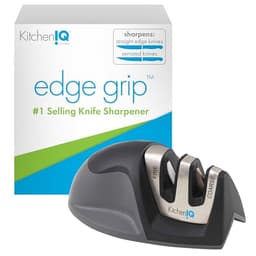
The crude rescue tool, named honestly
KitchenIQ 50009 Edge Grip 2-Stage Sharpener
We include this because it is what most people actually buy, and you should know what you are getting. A carbide slot scrapes metal off fast to make a dull knife cut again; a ceramic slot tidies the result. It works, it costs almost nothing, and it is the crudest thing on this page.
See where it sits in the fieldPrice as of October 17, 2026. #ad How we’re funded
Frequently asked questions
How do you sharpen a knife without a whetstone?
Pick a method that supplies an abrasive, a repeatable angle and a way to remove the burr. In order of results: a guided clamp system, an electric sharpener with a selectable angle, a diamond plate (which needs no soaking and no flattening), or wet-or-dry sandpaper taped to float glass. A ceramic rod maintains an edge but will not rebuild one, and a carbide pull-through will revive a cheap knife crudely.
Can you really sharpen a knife with sandpaper?
Yes, and it is the only improvised method we would recommend. Tape wet-or-dry paper to something genuinely flat, work from around 400 grit up through 800, 1500 and finer at a constant angle, then deburr. It is slower than a stone and the paper wears out, but the mechanism is identical — a hard flat surface carrying a graded abrasive.
Does sharpening a knife on a coffee mug work?
It abrades steel, so technically something happens. The unglazed ring on the bottom of a mug is coarse ceramic, and dragging an edge along it removes metal. What it cannot do is hold an angle — you are freehanding against a curved, narrow surface — so you end up with a rounded, scratched bevel that cuts worse than before. Use it to get through dinner, not as a method.
Can you sharpen a knife with another knife?
Not really. Running two blades against each other is steeling, not sharpening: at best it realigns a rolled edge in the way a rod does, and the general reference notes that even smooth ceramic and ribbed steel 'are able to remove small amounts of metal via adhesive wear'. At worst you chip both edges. If you want the realigning effect, use an actual rod.
Is a diamond plate a whetstone?
Not in the sense most people mean. It is a flat steel plate with diamond abrasive bonded to it, so there is no soaking, no dishing and no flattening — DMT's own guidance is to 'use DMT products dry or with water only', and its Dia-Sharp plates are 'guaranteed not to hollow or groove'. If your objection to whetstones is the soaking, the mess or the maintenance, a diamond plate removes all three and keeps the technique.
What angle should I sharpen at without a guide?
About 15 degrees per side for a Japanese knife and about 20 for a Western one — EdgeCraft publishes exactly that split, describing Euro/American knives as 'sharpened with sturdy 20 degree facets (40 degree total angle)' and Asian knives as using 'the more delicate 15 degree facets'. But DMT's own FAQ makes the more useful point: 'sharpening at the proper angle is not as important as sharpening at a constant angle.' Consistency beats precision.
Will an electric sharpener ruin my knives?
A bad one will, and a fixed-angle one will reshape your edges whether you asked it to or not. The thing to look for is a selectable angle so a Japanese knife keeps its 15 degrees and a German knife keeps its 20, and to accept that every motorised pass removes real steel. Used a few times a year on kitchen knives, a decent electric is fine; used monthly, it eats the blade.
Can a honing rod sharpen a dull knife?
No — it is the wrong tool for a worn edge. A rod realigns steel that has rolled over, which restores a knife that only feels dull. A ceramic rod does abrade very lightly, so it extends the time between real sharpenings, but it cannot form a new apex. Shun's FAQ also asks owners not to use a diamond steel for routine honing, since 'diamond steels are for sharpening and will remove metal from your knife before it is necessary'.
What is the cheapest way to get a genuinely sharp knife?
Sandpaper and a piece of glass you already own, if you are willing to learn the motion. If you want a tool: a carbide-and-ceramic pull-through costs about as much as a sandwich and will make a beaten supermarket knife cut again, at the price of a rough edge and more steel removed than necessary. Never put a hard Japanese blade through one.
Sources
- Knife sharpening — Wikipedia — Reference on edge angle, coarse-to-fine grit progression, and honing vs sharpening (accessed July 21, 2026)
- DMT FAQ — DMT Diamond Sharpeners — DMT's own answers: on break-in, 'the diamond surface will seem aggressive in nature; the diamond sharpener will smooth after initial sharpening with no impact to long term performance. Your first few sharpenings are the break-in period'; 'DMT recommends you use DMT products dry or with water only'; care is to 'clean after each use with water and wipe dry' and 'After several sharpenings, use a mild kitchen abrasive cleanser and a nylon scrub brush'; on life, DMT sharpeners 'do not last forever, but they last for several years'; the polka-dot surfaces are 'slightly recessed' so debris falls away while Dia-Sharp's 'continuous diamond surface' suits 'small-pointed tools'; DMT recommends 'sharpening at a 20-degree angle' and notes 'sharpening at the proper angle is not as important as sharpening at a constant angle'; and the guarantee: 'If your product fails to perform due to defects in materials or workmanship, we will replace it regardless of age' (accessed September 18, 2026)
- DMT Diamond and Ceramic Color-Coded Grit Chart — Sharpening Supplies — DMT's own color codes with the mesh and micron figure for each grade (Coarse 325/45 µm, Fine 600/25 µm, Extra-Fine 1200/9 µm) (accessed August 11, 2026)
- Understanding Euro/American and Asian Style Knives - Chef's Choice by EdgeCraft — EdgeCraft's own figures: Euro/American knives are 'sharpened with sturdy 20 degree facets (40 degree total angle)' while Asian knives use 'the more delicate 15 degree facets (30 degree total angle)'; its 15° sharpeners create 'the 15 degree edge with a multi-bevel gothic arch geometry which provides more metal support for the edge, therefore making it more durable'; traditional single-bevel Japanese knives have a primary blade bevel 'ground, commonly at about 10-11 degrees' under 'a very small single cutting edge facet of about 15 degree', and 'Always sharpen this style knife at 15 degree (Asian style)'. The Trizor XV Model 15 is the model it names for converting a 20° edge to 15° (accessed August 28, 2026)
- 20° & 25° Angle Guides for Whetstone Sharpeners — Work Sharp — Tool-maker reference for common Western (20°) vs finer (Japanese) sharpening angles (accessed July 21, 2026)
- Honing steel — Wikipedia — Reference on rod types and what they do: 'The steel and ceramic honing steels may have longitudinal ridges, whereas the diamond-coated steels are smooth but embedded with abrasive diamond particles'; 'Non-abrasive honing rods such as smooth ceramic or ribbed steel are able to remove small amounts of metal via adhesive wear'; 'It is often recommended that steeling be performed immediately before or after using a knife and can be done daily'; and, on hard blades, 'In East Asia, notably Japan, harder knives are preferred, so there is little need for steeling intra-day, as the edge does not deform as much. Instead, the blade is honed as needed on a waterstone' (accessed September 1, 2026)
- Shun Knives FAQ — Shun Cutlery (Kai USA) — Shun's own answers: 'Shun hardens VG10 and VG-Max steel to 60-61 Rockwell and SG2 to 61-62', 'Shun knives, for example, are sharpened to a 16 degree angle on each side of the blade', and on rods, 'Please do not use a diamond steel for regular honing. Diamond steels are for sharpening and will remove metal from your knife before it is necessary' (accessed August 28, 2026)
- Knife Care 101: A Guide To Maintaining Your Knife — Benchmade — Benchmade's published factory edge spec — 'most Benchmade knives are sharpened at 30-35° inclusive (about 17-20° per side)' — plus its coarse-to-fine grit and stropping guidance (accessed August 13, 2026)
Per-knife specs (steel, HRC, blade length, geometry) are read from each maker’s spec sheet or product listing and dated on the individual review cards above. “Not published” means the manufacturer does not state that figure — we flag it rather than guess.
Keep reading
Best Knife Sharpening Systems
Guided, clamped and electric options compared on angle control.
See the picksWhetstone vs Electric Sharpener
What a motor buys you, and what it costs in steel.
Compare themBest Diamond Sharpening Stones
No soaking, no dishing, no flattening — the stone that is not a stone.
See the picksHow to Sharpen a Knife
The stone method, if you decide to learn it after all.
Learn the methodKnife Sharpening Angle Guide
Which angle belongs on which knife, with the makers' own figures.
Read the guideWhy Knives Get Dull So Fast
Before you sharpen anything, check it is not just rolled.
Read the guide