VG10 Steel Guide
The stainless steel behind more first Japanese knives than any other. What it is, the hardness it is actually run at, and where the marketing overstates it.
How this is funded: we earn a commission if you buy through our links, at no extra cost to you. As an Amazon Associate we earn from qualifying purchases. It never changes which knife we recommend, and we’ll tell you when we’d skip one. Full disclosure.
VG10 is a Japanese stainless cutlery steel, and if you have bought a Japanese kitchen knife in the last twenty years there is a good chance it is what you own. It is not exotic, it is not new, and it is not the hardest steel on any shelf. It is the one that got the balance right, which is a duller virtue and a much more useful one.
The reason it dominates is that it lands in the band where a kitchen knife actually wants to be: hard enough that the maker can grind it thin and acute without the edge folding, soft enough that you can bring it back on a stone without a fight, and stainless enough that a busy kitchen will not punish you for it. Tojiro publishes ~60 HRC for its DP line; Enso publishes 61 HRC for its HD line. Both are VG10-cored, and both sit exactly in the 59-61 HRC band that defines a modern Japanese stainless knife.
What VG10 is made of, in practical terms
VG10 is a high-carbon stainless with roughly 1% carbon, about 15% chromium, plus molybdenum, vanadium and a little cobalt. You do not need the chemistry; you need what each part buys:
- The carbon is what lets it be hardened to 60 HRC at all. Without it you have a soft stainless that never holds an edge.
- The chromiumis what makes it stainless — the same element that means you can wash it, dry it casually, and never think about it again.
- The vanadium refines the carbide structure, which is the technical way of saying the edge can be finished finer before it starts to crumble. This is why VG10 takes a keener edge than a German steel run at the same hardness would.
Almost every VG10 kitchen knife is clad: the VG10 is a thin core welded between two layers of softer stainless. That is not cost-cutting. The soft jacket adds toughness and corrosion resistance around a hard, brittle center, so the knife survives the drawer while the edge stays hard. When that cladding is patterned it gets sold as Damascus, which is decorative — the cutting is done by the core either way.
VG10 against the steels you will see next to it
| VG10 | VG-MAX | FC61 | X50CrMoV15 | |
|---|---|---|---|---|
| Typical hardness | ~60-61 HRC | ~60-61 HRC | ~60 HRC | ~55-58 HRC |
| Type | Stainless | Stainless | Fine-carbide stainless | Stainless |
| Typical edge angle | ~15° per side | ~16° per side | ~9.5-12° per side | ~20° per side |
| Edge retention | Long | Long | Long | Short |
| Toughness | Moderate | Moderate | Moderate | High |
| Honing rod? | Ceramic only | Ceramic only | Ceramic only | Yes, steel rod |
| Found on | Tojiro DP, Enso HD, Yoshihiro | Shun Classic | Miyabi Kaizen II | Wüsthof, Mercer, Victorinox |
The honest read of that table: VG10, VG-MAX and FC61 are the same proposition.All three are hard stainless cores in the 60-61 HRC band, all three want stones rather than a steel rod, and all three will feel like a different species from an X50CrMoV15 knife. What separates them on the shelf is cladding, handle, finishing and brand — not cutting performance. If someone asks whether FC61 beats VG10, the useful answer is that the grind angle Miyabi puts on FC61 matters far more than the alloy difference does.
What VG10 is like to live with
Sharp for a long time, and then suddenly noticeably not. That is the characteristic pattern of a hard steel: it holds a keen edge through weeks of work with very little decline, and then falls off a shelf when the edge finally goes. A German knife degrades gently and constantly, which is why honing it every few days feels productive. A VG10 knife rewards you by not needing anything for a long time and then needing a stone.
The failure mode is chipping, not rolling. Twist a VG10 edge sideways out of a stuck butternut squash, use it on a chicken bone, or let it hit a ceramic plate in the sink, and you will get a small crescent missing rather than a folded edge. That is recoverable — a chip grinds out on a coarse stone — but it costs blade height, and it is the reason we say a hard knife is a maintenance contract rather than an upgrade.
Sharpening a VG10 knife
A 1000-grit stone raises the edge and a 3000-6000 refines it; a 1000/6000 combination stone does the whole job in one block, which is why it is the standard first purchase. Hold about 15° per side — the factory angle — and resist the urge to widen it because a jig makes 20° easier. Widening the bevel on a VG10 knife throws away exactly the property you paid for.
Between sharpenings, a ceramic rod or a strop. A traditional steel rod is the one genuinely wrong tool here: the whole mechanism of a steel rod is bending a rolled edge back, and a 60 HRC edge does not bend. The difference between the two is laid out in honing steel vs sharpening steel, which is a more confusing pair of names than it needs to be.
Is VG10 worth paying for?
Yes, at the Tojiro price. That is the honest shape of the answer. A VG10 core in a plain clad body, on a plain handle, is one of the few genuine bargains in kitchen cutlery: the same cutting steel as knives costing three times more, with the pattern and the pakkawood removed. Whether the pattern and the pakkawood are worth their premium is a real question with a legitimate yes in it, but it is a question about furniture, not about steel.
Where VG10 is notthe answer: if you know you will never use a stone, buy German steel at 58 HRC and a rod, and you will be happier. If you already sharpen well and want conspicuously longer edge retention, powder steels at 63-64 HRC exist and VG10 will feel ordinary next to them. For everyone in between — which is most people — it remains the default for a reason. Our Japanese knife buying guide walks the rest of the decision.
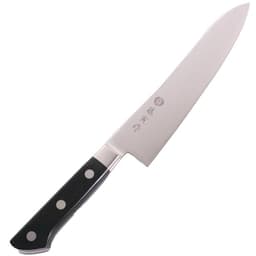
The VG10 benchmark
Tojiro DP Gyuto 210 mm
The knife the internet has recommended to first-time gyuto buyers for a decade, and the numbers explain why: a real VG10 core at ~60 HRC for a fraction of the boutique price. Buy this before you spend three times as much.
Read the full reviewPrice as of October 20, 2026. #ad How we’re funded
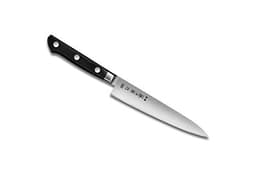
The same steel, in the second knife
Tojiro DP Petty 150 mm (F-802)
The DP gyuto's little brother, and the petty we would buy. Same VG10 core, same stainless cladding, same ~60 HRC — shrunk to the size where a big knife stops being useful. If you already own a Tojiro gyuto, this is the knife that fills the gap under it.
See the petty knives comparedPrice as of October 20, 2026. #ad How we’re funded
Frequently asked questions
What hardness is VG10 steel?
In kitchen knives, about 60 to 61 HRC. Tojiro publishes ~60 HRC for its DP line and Enso publishes 61 HRC for its HD line — both VG10-cored. That band is the point of the steel: hard enough to hold a thin, acute edge far longer than German stainless, not so hard that it chips on ordinary board work.
Is VG10 a good knife steel?
For a kitchen knife, it is arguably the best-balanced stainless available at a sane price. It takes a keener edge than German steel, holds it several times longer, resists rust well enough for a wet kitchen, and still sharpens back on an ordinary 1000/6000 whetstone. Harder powder steels beat it on edge retention and lose to it on price, toughness and ease of sharpening.
Does VG10 rust?
It is a stainless steel with around 15% chromium, so it resists rust well in normal use. It is not rustproof: leave it wet overnight, or sitting in lemon juice or a salty brine, and you can get spotting. Wipe it dry after washing and it will look new for years. Compared with a carbon steel like White #2, the difference in upkeep is enormous.
VG10 vs VG-MAX — what is the difference?
VG-MAX is Shun's proprietary relative of VG10, with slightly different alloying and run a touch harder at around 60-61 HRC. In use the difference is marginal and much smaller than the difference in price between a Tojiro DP and a Shun Classic. You are mostly paying for the Damascus cladding, the handle and the brand, not for a materially better cutting core.
What angle should a VG10 knife be sharpened at?
Around 15° per side, which is what most VG10 knives ship with. The steel is hard enough to support that geometry without the edge rolling. You can go finer if you are careful with the knife, but going wider than about 17° throws away the reason you bought hard steel in the first place.
Can you use a honing steel on VG10?
Not a traditional steel rod. At ~60 HRC the edge will not bend back into line — it breaks off in microscopic pieces instead. Use a fine ceramic rod or a leather strop between sharpenings, and a 1000/6000 whetstone when the edge genuinely needs metal removed.
Sources
- Rockwell hardness test — Wikipedia — Definition of the Rockwell C (HRC) scale used to state knife-steel hardness (accessed July 21, 2026)
- Enso Knives — Japanese Crafted HD, Hizashi, SG2, Hachi (Cutlery and More) — Published Enso HD line spec: 'VG10 stainless steel core. 61 Rockwell.', '37-layer Damascus with a hammered tsuchime finish', a triple-riveted canvas micarta handle, made in Seki, Japan (accessed August 18, 2026)
- Japanese kitchen knife — Wikipedia — Reference on gyuto/santoku/nakiri, single- vs double-bevel (kataba/ryoba) and edge angles (accessed July 21, 2026)
Per-knife specs (steel, HRC, blade length, geometry) are read from each maker’s spec sheet or product listing and dated on the individual review cards above. “Not published” means the manufacturer does not state that figure — we flag it rather than guess.
Keep reading
FC61 vs VG10
The Japanese standard against Miyabi's fine-carbide steel, on published and measured figures.
Read the comparisonKnife Steel & Hardness Guide
Every common kitchen steel side by side, not just this one.
See all the steelsKnife Hardness Chart (HRC)
What 58, 60 and 63 HRC mean band by band.
Read the hardness chartTojiro DP Gyuto Review
The VG10 knife most people meet first, examined in full.
Read the reviewBest Japanese Chef Knives
Five gyutos compared, several of them VG10-cored.
See the roundup