FC61 vs VG10
Two stainless steels at the same hardness, from two very different families. One has a published recipe and sixty years of history; the other has a trade name, a hardness target and a maker that will not say what it is. The edge behaves differently, and here is why.
How this is funded: we earn a commission if you buy through our links, at no extra cost to you. As an Amazon Associate we earn from qualifying purchases. It never changes which knife we recommend, and we’ll tell you when we’d skip one. Full disclosure.
Every Miyabi in our registry has “FC61” in its steel cell; every Tojiro, Enso and Yoshihiro has “VG10.” Both are stainless, both run at about 60–61 HRC, and both sit under Damascus cladding on knives from the same Japanese city. So a buyer choosing between a Kaizen II and a Tojiro DP, or between the Koh sujihiki and the Yoshihiro, reasonably asks what the steel names actually mean. The answer is that they belong to two different families of stainless steel — one built around a lot of carbide, one built around very little — and the difference shows up in exactly the two places a cook notices: how the edge sharpens, and how long it lasts.
One rule for this page. We separate what the steel makers publish from what independent metallurgists have measured from what is widely reported but unconfirmed, and we label each. VG10 is easy: its maker prints the recipe. FC61 is not: ZWILLING prints a trade name and a hardness and nothing else, and the most important claim about it — what alloy it is — comes from outside ZWILLING. We will tell you that claim. We will not tell you it is fact.
The decision table
| FC61 | VG10 | |
|---|---|---|
| Who makes the steel | Not published by ZWILLING (trade name) | Takefu Special Steel (maker's site) |
| Published composition | None from ZWILLING | C 1.00, Cr 15.00, Mo 1.00, V 0.25, Co 1.55 (Takefu) |
| Maker's hardness figure | 61 HRC (Koh page); 60-62 HRC (Kaizen II page) | 60 HRC and above (Takefu); 61 HRC on the Enso HD |
| Reported identity (unconfirmed) | Sandvik 13C26 / Uddeholm AEB-L — a fine-carbide razor steel | Not applicable — composition is published |
| Carbide structure (independent) | If AEB-L: carbides of 1 µm or less | Chromium carbide, 12-16% by volume, no vanadium carbide |
| Toughness (independent tests) | If AEB-L: at 62.2 Rc matches CPM-154 at 59.8 Rc | 5.8 ft-lbs — 'in line with other high carbide stainless steels' |
| Edge retention (independent tests) | If AEB-L: ~55% of 440C's slicing retention | 'A small notch below 440C' |
| Factory edge on the knives we list | 9.5-12° per side (Miyabi) | ~15° per side (Tojiro); Enso, Yoshihiro not published |
| Registry knives | Miyabi Kaizen II 8-in., nakiri, bunka; Miyabi Koh sujihiki | Tojiro DP gyuto, santoku, petty; Enso HD bunka; Yoshihiro nakiri, sujihiki |
VG10: a published recipe and a lot of carbide
Takefu Special Steel publishes VG10’s composition on its own site: 1.00% carbon, 15.00% chromium, 1.00% molybdenum, 0.25% vanadium and 1.55% cobalt, hardened to “HRC60≦” — 60 and above. Takefu’s own explanation is that the chromium, molybdenum and cobalt “all strengthen the matrix, yielding high hardness, in addition to maintaining a long-lasting sharp edge.” That is the maker’s claim and it is a fair one.
Independent testing fills in what the recipe implies. Knife Steel Nerds measured VG10 at about 60.7 Rc, found its carbide structure to be chromium carbide with “no vanadium carbide,” somewhere in “the 12–16% carbide volume range,” and put its toughness at an average of 5.8 ft-lbs, “in line with other high carbide stainless steels.” Its edge retention tested “a small notch below 440C.” The same source dates the steel to “over 60 years ago” and suggests the cobalt was “likely added to increase tempering resistance” for high-temperature coatings rather than for the edge. In plain terms: VG10 is a high-carbide stainless. The carbides resist wear, which is why a Tojiro DP stays usable for weeks, and they are large and numerous, which is why the burr on VG10 can be stubborn and why makers stop at about 15° rather than going finer. Our VG10 guide goes deeper on the steel alone.
FC61: a trade name, a hardness, and a claim ZWILLING will not confirm
Here is everything ZWILLING publishes about FC61 on the Miyabi Koh page: “Crafted from revolutionary FC61 fine carbide stainless steel,” “Blade hardness (HRC): 61 HRC,” an “Ice-hardened FRIODURx2 blade for exceptional durability,” a “9.5–12° edge angle” from a “Hand-honed, 3-step Honbazuke blade,” and “Handcrafted in Seki, Japan.” The Kaizen II page gives the hardness as 60–62 HRC. No composition. No alloy. No steel maker. ZWILLING does not state what FC61 is.
What is widely reported is that FC61 is a trade name for Sandvik 13C26, which is essentially identical to Uddeholm AEB-L, and that “FC” stands for fine carbide and “61” for the hardness target. The Culinary Knife Bible states this directly; it does not cite ZWILLING for it, and neither can we. The claim is plausible — the “fine carbide” name, the 61 HRC target and the very acute factory edge all fit a razor steel — and it is unconfirmed, and this page treats it as both.
If it is true, the independent metallurgy on AEB-L tells you what to expect. AEB-L is a low-carbon (0.65–0.7%) stainless with 13.5% chromium, developed by Uddeholm in the 1960s as a razor-blade steel, with “carbides of one micron or less” against 440C’s “carbides over 10 microns.” Its toughness at 62.2 Rc “matches the toughness of 59.8 Rc CPM-154.” Its edge retention is “55% of the slicing edge retention of 440C at 59 Rc” — ordinary among stainless steels. It is “not a good choice ... in very corrosive environments like salt water.” That source does not mention FC61 or Miyabi at all; we cite it for what a fine-carbide razor steel measures at, not as proof of what FC61 is.
What the difference means at the edge
Sharpening.Small carbides let a steel take a finer, cleaner apex: there is nothing large at the edge to tear out, and the burr breaks away rather than folding. That is consistent with ZWILLING honing FC61 to 9.5–12° per side — an angle at which a coarse-carbide steel would crumble — where VG10 knives ship at about 15–16°. On a stone, a fine-carbide steel is the easier of the two to get genuinely sharp; VG10 gets there too, with more attention to the burr. Neither needs anything exotic; a 1000-grit water stone handles both, and the Japanese-knife sharpener page covers the tools.
Edge retention.This is where VG10’s carbide volume pays. More hard carbide in the steel means the edge abrades more slowly, and the independent figures — VG10 just under 440C, AEB-L at about 55% of 440C — point the same way. A Miyabi’s edge feels sharp for a long time because it starts extraordinarily sharp; it is nonetheless wearing faster than a Tojiro’s. If you sharpen rarely, that matters. If you sharpen monthly, it does not.
Toughness.The metallurgy favors the fine-carbide steel, and by a wide margin at the same hardness. But toughness is the steel’s property, and chipping is the knife’s: Miyabi spends that toughness on a 9.5–12° edge, and any steel at that angle is more fragile than the same steel at 16°. In practice both knives chip when twisted through a bone; the more acute one chips first. Our chipped-knife how-to is the repair.
Corrosion.VG10’s 15% chromium is a point and a half more than a 13.5% razor steel, and Takefu lists corrosion resistance among its properties. Both are stainless in the kitchen sense; neither should live wet.
The hardness figures are the same, and that is worth saying
Buyers see “61” on the Miyabi and “~60” on the Tojiro and conclude the Miyabi is harder. It is not, meaningfully: Takefu’s own figure for VG10 is 60 and above, the Enso HD publishes 61 for its VG10 core, and ZWILLING gives 60–62 for the Kaizen II. Both steels live in the same one-point band on the hardness chart. What differs is not how hard they are but what they are made of at that hardness, which is the whole point of this page.
Which to buy
Buy FC61if you sharpen regularly, want the keenest edge a production kitchen knife ships with, and value a steel that is easy to bring to a clean apex and forgiving of a hard steel’s usual brittleness. Accept that you are trusting a trade name, that ZWILLING will not tell you the alloy, and that the edge wears faster than it feels like it does.
Buy VG10 if you sharpen rarely, want the longer-wearing edge, and prefer a steel whose maker publishes the recipe so you know exactly what you own. Accept a slightly less acute factory edge and a burr that wants a little more care on the stone.
And if the decision is really between a Kaizen II and a Shun rather than between two steels, the Shun vs Miyabi page compares the finished knives, where the edge angle and the warranty terms end up mattering more than the alloy.
How we compared these
We do not own these knives and have not tested either steel. This page reads Takefu’s own VG10 page and ZWILLING’s own Miyabi Koh and Kaizen II pages for what each maker publishes; two Knife Steel Nerds articles for independent measurements of VG10 and of AEB-L; and the Culinary Knife Bible for the reported FC61 identity, which ZWILLING has not confirmed and which we label unconfirmed wherever it appears. Every AEB-L figure on this page is conditional on that identity and is marked “if AEB-L.” No price appears in this text; prices come only from the live daily check on each pick. Our methodology sets out the rules in full.
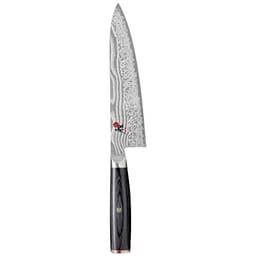
FC61 — the chef's knife
Miyabi Kaizen II 8-inch Chef's Knife
Miyabi is Zwilling's Japan-made line, and the Kaizen II pairs an FC61 core at ~60 HRC with a 48-layer Damascus jacket and a comfortable D-handle. A polished alternative to the Shun Classic at a similar price.
Read the Kaizen II review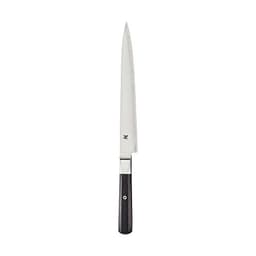
FC61 — the plain-blade slicer with the published 61 HRC
Miyabi Koh 4000FC Sujihiki 240 mm
Miyabi's plainest line doing the slicer, and the only one at this length that puts a hardness number on the page: an ice-hardened FC61 blade at a published 61 HRC, hand-honed to 9.5-12° and left mirror-polished with no cladding and no Damascus. Buy it when you want the Seki grind and the figure, not the decoration.
Read the sujihiki guidePrice as of September 18, 2026. #ad How we’re funded
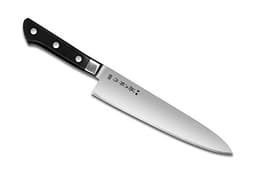
VG10 — the value gyuto
Tojiro DP Gyuto 210 mm
The knife the internet has recommended to first-time gyuto buyers for a decade, and the numbers explain why: a real VG10 core at ~60 HRC for a fraction of the boutique price. Buy this before you spend three times as much.
Read the Tojiro reviewPrice as of September 18, 2026. #ad How we’re funded
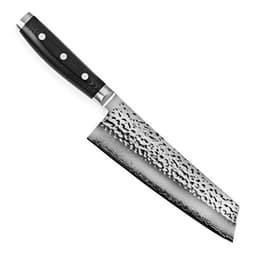
VG10 — with a published 61 HRC
Enso HD 7-inch Bunka
The bunka that actually publishes its numbers: a VG10 core at 61 HRC under 37 hammered Damascus layers, made in Seki. The reverse-tanto tip is the whole point of the shape, and this is the cheapest way to own one from a maker that states the hardness.
Read the bunka guidePrice as of September 18, 2026. #ad How we’re funded
Frequently asked questions
Is FC61 better than VG10?
Neither is better across the board; they trade different things. Both run at about 60-61 HRC. VG10 (per Takefu, its maker) is a 1% carbon, 15% chromium, cobalt-bearing steel with a large volume of chromium carbides, which gives it strong wear resistance. FC61 is described by ZWILLING only as 'fine carbide stainless' at 61 HRC; the widely reported (unconfirmed) identity is a low-carbon razor steel whose tiny carbides give it more toughness and an easier, cleaner-sharpening edge at the cost of some wear resistance.
What is FC61 steel?
ZWILLING's trade name for the steel in its Miyabi Kaizen II, Koh and Evolution lines, which it describes as 'FC61 fine carbide stainless steel' at a published 61 HRC (60-62 on the Kaizen II page), ice-hardened by its FRIODUR process. ZWILLING does not state what alloy it is. Independent sources report it as Sandvik 13C26, essentially Uddeholm AEB-L, a fine-carbide razor steel; ZWILLING has not confirmed that, and we report it as unconfirmed.
What is VG10 steel?
A Japanese stainless made by Takefu Special Steel, which publishes its composition as C 1.00, Cr 15.00, Mo 1.00, V 0.25, Co 1.55 (percent) and a hardness of 60 HRC and above. Independent testing puts it around 60.7 Rc with a chromium-carbide volume in the 12-16% range and no vanadium carbide. It is the core steel in the Tojiro DP, Enso HD and Yoshihiro knives on this site, and the most common named steel in Japanese kitchen knives.
Which is easier to sharpen, FC61 or VG10?
By the metallurgy, a fine-carbide steel — if FC61 is what it is reported to be, carbides of a micron or less against VG10's coarser chromium carbides. Small carbides mean the apex can be taken finer and the burr breaks off more cleanly; large carbides can tear out at a very acute edge. That is consistent with ZWILLING honing FC61 to 9.5-12° where VG10 knives typically ship at 15-16°. Both sharpen fine on an ordinary 1000-grit water stone.
Which holds an edge longer, FC61 or VG10?
On wear resistance alone, VG10: more carbide volume means the edge abrades more slowly. Independent testing places VG10's edge retention a small notch below 440C, while a fine-carbide razor steel like AEB-L rates around 55% of 440C's slicing retention. In practice a thinner, more acute FC61 edge can feel sharp for a long time because it starts sharper, but it is wearing faster. If you rarely sharpen, VG10's advantage is real.
Is FC61 the same as AEB-L or 13C26?
That is the widely reported identity — 'FC61 is Zwilling's trade name for Sandvik 13C26, which is in turn essentially identical to Uddeholm AEB-L' — and the 'fine carbide' name and 61 HRC target fit it. But ZWILLING has never published the alloy, and no source we cite has ZWILLING confirming it. We treat it as plausible and unconfirmed, and we say so on this page rather than stating it as fact.
Does FC61 chip more easily than VG10?
The metallurgy says the opposite, with a caveat. Fine-carbide steels test tougher at a given hardness — AEB-L at 62 Rc matches the toughness of CPM-154 at 59.8 — while VG10 tests 'in line with other high carbide stainless steels' at 5.8 ft-lbs. The caveat is geometry: Miyabi hones FC61 to 9.5-12° per side, and any steel at that angle is more fragile than the same steel at 16°. A twisted cut chips either knife; it chips the more acute one first.
Sources
- VG10 — TAKEFU SPECIAL STEEL CO., LTD. — The steel maker's own published composition for VG10: 'C: 1.00, Cr: 15.00, Mo: 1.00, V: 0.25, Co: 1.55' (percent), a hardness of 'HRC60≦' (60 HRC and above), and the maker's own explanation that '15% chromium (Cr), 1% molybdenum (Mo), and 1.5% cobalt (Co) which all strengthen the matrix, yielding high hardness, in addition to maintaining a long-lasting sharp edge'. Intended uses listed as kitchen knives, general-purpose knives and machine blades (accessed September 18, 2026)
- MIYABI KOH 4000FC 8-inch Chef's Knife — ZWILLING — ZWILLING's own description of the steel: 'Crafted from revolutionary FC61 fine carbide stainless steel', 'Blade hardness (HRC): 61 HRC', an 'Ice-hardened FRIODURx2 blade for exceptional durability', a '9.5-12° edge angle' from a 'Hand-honed, 3-step Honbazuke blade', 'Handcrafted in Seki, Japan', 7.87-inch blade, 0.62 lb. ZWILLING does NOT state what alloy FC61 is on this page — it names it only as 'FC61 fine carbide stainless steel' (accessed September 18, 2026)
- MIYABI Kaizen II 5000FCD 8-inch Chef's Knife — ZWILLING — Zwilling's published spec for the line: an 'FC61' core with fine carbide distribution at '60-62 HRC', '48 layers of stainless steel' Damascus over the core (49 total), an edge 'hand-honed using the historic Honbazuke method to an exceptionally sharp 9.5 to 12 degrees', a 'double ice-hardened FRIODUR' blade, a 'thicker and rounded bolster for increased comfort and balance', a black Pakkawood D-shaped handle, a 7.87 in blade at 0.44 lbs, handcrafted in Seki, Japan (accessed August 28, 2026)
- VG10 and Super Gold 2 - Takefu Stainless Steel Properties and History — Knife Steel Nerds — Independent metallurgist's tests and history: VG10 was 'developed for knives over 60 years ago'; the cobalt was 'likely added to increase tempering resistance so that VG10 can be used with coatings that must be applied at high temperatures'; tested hardness of about 60.7 Rc; toughness 'averaging 5.8 ft-lbs', 'in line with other high carbide stainless steels'; edge retention 'a small notch below 440C'; and the carbide structure is chromium carbide, 'no vanadium carbide', in 'the 12-16% carbide volume range'. The article does not mention AEB-L, 13C26 or FC61 (accessed September 18, 2026)
- All About AEB-L — Knife Steel Nerds — Independent metallurgist's account of the fine-carbide razor steel: '0.65-0.7% C' with '13.5% chromium', developed by Uddeholm in the 1960s with Sandvik's 'identical' 13C26 following; 'carbides of one micron or less' against 440C's 'carbides over 10 microns'; at 62.2 Rc it 'matches the toughness of 59.8 Rc CPM-154'; slicing edge retention about '55% of ... 440C at 59 Rc'; hardenable to '63+ Rc'; 'not a good choice ... in very corrosive environments like salt water'. FC61 and Miyabi are NOT mentioned in this source — it is cited for what a fine-carbide razor steel measures at, not as proof of what FC61 is (accessed September 18, 2026)
- FC61 · Steel Deep Dive — The Culinary Knife Bible — The most-cited third-party account of FC61: 'FC61 is Zwilling's trade name for Sandvik 13C26, which is in turn essentially identical to Uddeholm AEB-L'; composition given as 0.68% C, 13% Cr, 0.7% Mn, 0.4% Si; hardness 60-62 HRC with a target of 61; used in the 'Evolution, Kaizen II, Koh lines'; and ''FC' stands for Fine Carbide; '61' refers to the hardness target'. The page does not cite ZWILLING for the equivalence, and ZWILLING has not confirmed it — which is exactly how our comparison page reports it (accessed September 18, 2026)
- Enso Knives — Japanese Crafted HD, Hizashi, SG2, Hachi (Cutlery and More) — Published Enso HD line spec: 'VG10 stainless steel core. 61 Rockwell.', '37-layer Damascus with a hammered tsuchime finish', a triple-riveted canvas micarta handle, made in Seki, Japan (accessed August 18, 2026)
- Rockwell hardness test — Wikipedia — Definition of the Rockwell C (HRC) scale used to state knife-steel hardness (accessed July 21, 2026)
Per-knife specs (steel, HRC, blade length, geometry) are read from each maker’s spec sheet or product listing and dated on the individual review cards above. “Not published” means the manufacturer does not state that figure — we flag it rather than guess.
Keep reading
VG10 Steel Guide
The most-cited steel in the registry, on its own page.
Read the guideShun vs Miyabi
VG-MAX against FC61 in two finished knives from the same city.
Compare the knivesKnife Hardness Chart
Why 60 and 61 HRC are the same band, and what that band means.
Read the chartKnife Steel & Hardness Guide
The reference the whole spec method rests on.
Read the steel guideMiyabi Kaizen II Review
The FC61 chef's knife, examined.
Read the reviewTojiro DP Gyuto Review
The VG10 knife most people should buy first.
Read the review