Damascus Steel Explained
The most misunderstood spec in kitchen knives. What the layers are, what they do, what they don't do, and how to spot a pattern that was printed on.
How this is funded: we earn a commission if you buy through our links, at no extra cost to you. As an Amazon Associate we earn from qualifying purchases. It never changes which knife we recommend, and we’ll tell you when we’d skip one. Full disclosure.
Damascus is the spec that sells the most knives and explains the least about them. A wavy pattern down the blade looks like evidence of craftsmanship, and on a well-made knife it genuinely is — but it tells you almost nothing about how the knife will cut, because on a modern kitchen knife the Damascus is not the part that touches the food.
This page is what the layers actually are, what they do, and how to tell the real thing from a pattern that was etched onto plain steel with a stencil.
What it is on a modern kitchen knife
Almost every Damascus kitchen knife sold today is a san-mai or laminated construction: a single hard steel core sandwiched between softer stainless cladding, with the cladding built from many alternating layers that are forge-welded, ground and then acid-etched so the layer boundaries show as a pattern.
The core is the knife. It is the only steel that reaches the cutting edge, and it is the only steel whose hardness and alloy appear in the specification — VG10 on a Tojiro, VG-MAX on a Shun, FC61 on a Miyabi. The cladding never touches the food. Its job is structural: hard steel around 60 HRC is brittle, and wrapping it in something more ductile makes the blade as a whole far tougher than a monosteel of the same hardness would be.
Here is the part that matters. Cladding is functional. Patterned cladding is cosmetic. The plain three-layer stainless jacket on a Tojiro DP does the identical structural job as thirty-four patterned layers on a Shun Classic. The layer count is a finish specification, not a performance one, and a knife with more layers is not tougher, sharper or longer-lasting than one with fewer.
What the layer count means (and does not)
| What it does | What it does not do | |
|---|---|---|
| Core steel | Forms the edge; sets hardness and edge retention | Nothing about appearance |
| Cladding (any kind) | Adds toughness around a brittle core | Does not reach the edge or affect sharpness |
| Damascus pattern | Appearance; slight surface texture | No effect on edge, hardness or retention |
| Layer count (34, 48, 67...) | Changes how fine the pattern looks | Not a measure of quality or performance |
| Acid etch | Reveals the layers by attacking one alloy faster | Adds no strength; can be faked entirely |
Sixty-seven layers is not twice as good as thirty-four. It is a different-looking pattern, and it usually appears in listings from makers who have worked out that a bigger number sells. When a knife’s listing leads with its layer count and never names its core steel or hardness, that ordering is telling you what the maker thinks it is selling. What we look for instead is set out on our methodology page.
How to spot a fake
A great many budget “Damascus” knives are plain steel with a pattern applied chemically. Four checks, in order of usefulness:
1. Look at the spine. This is the giveaway. On a genuinely laminated blade the layers run through the thickness of the steel, so looking down at the spine you can see the boundaries as fine lines across it. A printed pattern exists only on the flat faces and stops dead at the spine, which will be a uniform gray.
2. Check the choil.Same principle at the other end. The cross-section where the edge stops shows the core sandwiched between cladding on a real san-mai blade — often as a visibly different-colored wedge in the middle.
3. Compare both faces. Real pattern-welding produces two sides that are related but not identical, because they are different cross-sections through the same billet. A stenciled pattern is frequently mirrored or repeated exactly.
4. Read what the listing does not say.Any maker with real lamination will name the core steel, because it is the expensive part. A listing that says “67-layer Damascus high carbon steel” and names no grade and no hardness is describing a finish and hoping you read it as a specification.
An etched pattern on an honest budget knife is one thing; a counterfeit of a real Damascus knife is another, and Shun’s own guidance is that no single visual feature can confirm authenticity. That makes the seller the check rather than the photograph — where to buy a Japanese chef knife covers which channels carry the risk and what it costs you in warranty cover.
Hammered, dimpled and other finishes
Damascus often gets confused with two other surface treatments that do different things:
Tsuchime (hammered).Dimpled hammer marks along the blade face. These genuinely help with food release — the recesses break the vacuum that makes a wet potato slice cling — and the effect is more noticeable than an etched Damascus surface produces.
Granton / kullenschliff dimples. Oval scallops ground into the blade near the edge, for the same suction-breaking reason. Also modestly effective, also nothing to do with sharpness. Common on santokus.
Kasumi. A traditional Japanese finish where a soft-iron cladding is left matte against a polished hard core. Structurally the same laminated idea as Damascus, finished differently. Defined along with the rest of the vocabulary in our glossary.
Should you pay for it?
Yes, if you want a knife you enjoy looking at, and you know that is what you are buying. Cooking happens most days, tools you like using get used, and there is nothing irrational about paying for something beautiful. A Shun Classic and a Miyabi Kaizen II are both excellent knives that happen to also be handsome objects.
No, if you are buying on performance per dollar. The plain-clad knives — Tojiro DP above all — put the same class of core steel behind the edge for a fraction of the money, and the difference in the finished cut is nil. That comparison, with both spec sheets side by side, is in Tojiro vs Shun.
And never, if the Damascus is the onlything the listing tells you. Under about $60, a Damascus pattern with no named core steel is a strong signal that the money went into appearance and not into the edge — which is exactly why our under $50 roundup contains no Damascus knives at all.
One practical consequence of all those layers turns up the first time a Damascus knife needs a stone: the pattern is cladding, and the edge you are sharpening is the core. Sharpening a Damascus knife covers how to keep the bevel honest without scrubbing the face you paid for.
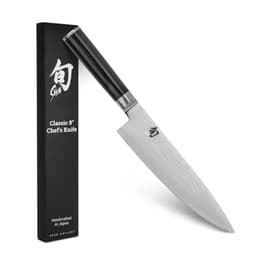
Damascus done properly
Shun Classic 8-inch Chef's Knife
The knife most people picture when they think 'nice Japanese knife': a VG-MAX core at ~61 HRC under 34 layers of Damascus cladding, with a slim D-shaped handle. You pay for the finish, but the steel is genuinely hard.
Read the full Shun Classic reviewPrice as of October 20, 2026. #ad How we’re funded
Frequently asked questions
Does Damascus steel make a knife sharper?
No. On a modern kitchen knife, the Damascus is cladding — softer stainless layers wrapped around a hard core — and the core steel does all the cutting. A plain three-layer jacket does exactly the same structural job as thirty-four patterned ones. The pattern is a finish, and it has no effect on the edge.
What is Damascus steel on a kitchen knife?
Pattern-welded steel: alternating layers of two stainless alloys forge-welded together, then ground and acid-etched so the layers show as a wavy pattern. On almost every Damascus kitchen knife it is cladding around a separate hard core such as VG10, VG-MAX or FC61 — which is the steel that reaches the edge.
Is Damascus steel worth the money?
Only for how it looks. If two knives have the same core steel at the same hardness and one has Damascus cladding, the clad one will not cut better — you are paying for appearance, and that is a legitimate thing to want. If you are buying purely on cutting performance per dollar, plain-clad knives such as the Tojiro DP are the better value.
How can you tell if Damascus steel is real?
Look at the spine and the choil. Real lamination shows the layers running through the thickness of the blade, visible as lines on the spine's edge, and the pattern continues logically around every curve. A printed or acid-stenciled fake sits only on the flat faces, often repeats identically on both sides, and stops abruptly at the spine.
Why do makers use Damascus cladding at all?
Cladding itself is genuinely functional: hard steel is brittle, and wrapping it in softer, more ductile stainless makes the blade as a whole tougher than a monosteel of the same hardness would be. That is standard san-mai construction. Making the cladding patterned is the cosmetic step layered on top of a structural one.
Does Damascus cladding stop food sticking?
Barely. The etched surface is slightly textured, which can marginally reduce suction on wet slices, but the effect is far smaller than a hammered tsuchime finish or granton dimples produce — and smaller again than simply having a thin blade. Do not buy Damascus for food release.
Sources
- Japanese kitchen knife — Wikipedia — Reference on gyuto/santoku/nakiri, single- vs double-bevel (kataba/ryoba) and edge angles (accessed July 21, 2026)
- Rockwell hardness test — Wikipedia — Definition of the Rockwell C (HRC) scale used to state knife-steel hardness (accessed July 21, 2026)
- Rockwell Hardness — an overview (ScienceDirect Topics) — Reference overview of Rockwell indentation hardness measurement (accessed July 21, 2026)
Per-knife specs (steel, HRC, blade length, geometry) are read from each maker’s spec sheet or product listing and dated on the individual review cards above. “Not published” means the manufacturer does not state that figure — we flag it rather than guess.
Keep reading
Sharpening a Damascus Knife
Why the stone never touches the pattern, and the mistake that does wreck it.
Read the guideKnife Steel & Hardness Guide
The core steels that actually do the cutting.
Read the guideTojiro vs Shun
Same steel class, plain cladding against 34 layers.
Compare themCarbon vs Stainless Knives
The other steel decision, settled on published facts.
Compare themKnife Anatomy
Which parts of a knife change how it cuts.
Read the guide