Tojiro vs Shun
Two Japanese knives with hard stainless cores at almost identical hardness, separated by a large amount of money. Here is exactly what that money buys.
How this is funded: we earn a commission if you buy through our links, at no extra cost to you. As an Amazon Associate we earn from qualifying purchases. It never changes which knife we recommend, and we’ll tell you when we’d skip one. Full disclosure.
This is the most common cross-shop in Japanese kitchen knives, and it is unusual because the two knives are much closer on the specifications that determine performance than their prices suggest. Both are stainless-clad blades with a hard stainless core at around 60–61 HRC. Both are ground more acutely than any German knife. Both are made in Japan by established makers who publish what they are selling.
The Shun costs substantially more, and the honest summary is that the difference goes into finish, handle and factory edgerather than into the part that cuts. That is not a criticism — those things are real, and plenty of people are correct to pay for them. But it is worth knowing what you are buying before you decide.
The decision table
| Tojiro DP | Shun Classic | |
|---|---|---|
| Core steel | VG10 | VG-MAX |
| Hardness | ~60 HRC | ~60-61 HRC |
| Edge angle | ~15° per side | ~16° per side |
| Blade length | 210 mm | 203 mm |
| Cladding | Plain 3-layer stainless | 34-layer Damascus |
| Handle | Composite, symmetrical Western | Pakkawood, right-handed D |
| Left-hand friendly | Yes | Separate model needed |
| Upkeep | Whetstone | Whetstone |
| Bought for | Performance per dollar | Finish and feel |
Where the money actually goes
The cladding. Both knives are san-mai construction: a hard core sandwiched between softer stainless. That layering is structural, because hard steel is brittle and cladding it in something more ductile makes the blade tougher overall. Tojiro does it with three plain layers. Shun does it with thirty-four, patterned into Damascus. Structurally these are the same idea; visually they are not remotely the same object. We explain what the pattern is and is not in Damascus steel explained.
The handle.This is the difference you feel every day. Shun’s contoured pakkawood D-handle is genuinely lovely and genuinely right-handed — it either fits you beautifully or annoys you constantly. Tojiro’s composite Western handle is symmetrical, competent and completely without charm. Which of those is worth money is personal, and it is the single most personal variable in the comparison.
The factory edge. Shun finishes more finely and at a slightly different angle, so a new Shun feels sharper than a new Tojiro. That advantage lasts exactly until the first time you sharpen either knife yourself, after which the edge is whatever your stone produced.
Where Tojiro wins outright
Length.The DP gyuto is 210 mm against the Shun’s 203 mm. Small, but the DP is the true Japanese standard length and the extra reach is useful on a big board.
Left-handers. The symmetrical handle means one model works for everybody. With Shun you need to find the left-handed version, and it is not made for every knife in the range.
Anxiety. This one is real and rarely mentioned. A knife you paid a lot for is a knife you worry about, and worrying about a kitchen tool makes you use it less. A DP is cheap enough to be a knife rather than an heirloom, which for many people means it actually gets used.
Where Shun wins
It is a nicer object. That sounds like faint praise and is not meant as such. Cooking is something you do most days, and a tool that gives you pleasure to pick up changes the experience. If the Damascus and the pakkawood matter to you, they matter, and no amount of spec-sheet arithmetic makes that irrational.
Range and support.Shun’s Classic line covers santoku, nakiri, utility, paring, bread and slicing knives that all match, plus a wide service network. Building a coherent set is easier. Tojiro’s DP line covers the main shapes but with less availability.
Resale and gifting. Shun is a name people recognize. As a gift, that counts for something the spec sheet cannot capture.
The verdict
Buy the Tojiro DPif this is your first hard-steel Japanese knife, if you are left-handed, if you would rather spend the difference on a whetstone and a second knife, or if the phrase “performance per dollar” describes how you buy things. It is the knife we recommend most often on this site.
Buy the Shun Classic if you have used a good Japanese knife already and know you want the next one to be beautiful, if the D-handle fits your right hand well, or if you are buying something to keep for twenty years and want it to look like it. Just do it knowing that the extra money is buying an experience, not sharpness.
Buy neither if you will not sharpen on a stone. Both are 60 HRC knives that a grooved honing rod can chip, and a neglected hard knife cuts worse than a maintained soft one. In that case, the honest recommendation is a forgiving German knife and a rod on the counter.
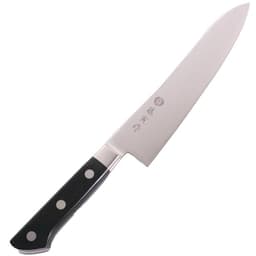
The value answer
Tojiro DP Gyuto 210 mm
The knife the internet has recommended to first-time gyuto buyers for a decade, and the numbers explain why: a real VG10 core at ~60 HRC for a fraction of the boutique price. Buy this before you spend three times as much.
Read the full Tojiro DP reviewPrice as of October 20, 2026. #ad How we’re funded
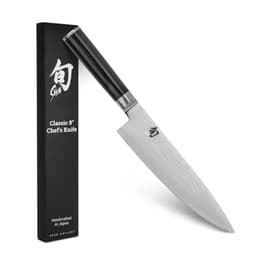
The finish answer
Shun Classic 8-inch Chef's Knife
The knife most people picture when they think 'nice Japanese knife': a VG-MAX core at ~61 HRC under 34 layers of Damascus cladding, with a slim D-shaped handle. You pay for the finish, but the steel is genuinely hard.
Read the full Shun Classic reviewPrice as of October 20, 2026. #ad How we’re funded
Frequently asked questions
Is Shun better than Tojiro?
Better finished, not better at cutting. Both use a hard stainless core at around 60 HRC — VG-MAX in the Shun, VG10 in the Tojiro — so edge retention is in the same class. The Shun adds 34-layer Damascus cladding, a contoured pakkawood D-handle and a more refined factory edge. If you want cutting performance per dollar, Tojiro wins outright.
What is the difference between VG10 and VG-MAX?
Both are Japanese hard stainless steels in the same performance class, hardened to roughly 60-61 HRC. VG-MAX is Kai's proprietary variant, and Shun describes it as having a slightly different alloy balance. In practice the difference between them is far smaller than the difference in price, cladding and handle between the two knives.
Is Tojiro DP good for beginners?
It is a good first Japanese knife, not a good first knife. A 60 HRC edge is hard and comparatively brittle — twist it, hit bone, or put it in a dishwasher and you will chip it. If you already cook carefully and want to step up from soft German steel, the DP is the least expensive way to find out whether hard Japanese steel suits you.
Does Damascus cladding make a knife sharper?
No. Cladding is the softer stainless wrapped around the hard core, and it exists to make a brittle core tougher — the plain three-layer jacket on a Tojiro does exactly the same structural job as 34 patterned layers on a Shun. The pattern is a finish. The core steel does all the cutting.
Is the Shun D-handle a problem for left-handers?
For the standard Classic, yes. The handle is contoured with a ridge shaped for a right hand, and in a left hand the ridge sits in the wrong place. Shun sells a separate left-handed version of some models. The Tojiro DP's symmetrical Western handle sidesteps the issue entirely, which is a real advantage if you are left-handed.
Which one holds an edge longer?
Effectively a tie. Both cores are hardened to about 60-61 HRC and edge retention is dominated by hardness and carbide structure, which are closely matched here. What differs is the factory edge: Shun ships at roughly 16 degrees per side with a finer finish, so it feels keener out of the box even though the steel behaves the same over months.
Sources
- Japanese kitchen knife — Wikipedia — Reference on gyuto/santoku/nakiri, single- vs double-bevel (kataba/ryoba) and edge angles (accessed July 21, 2026)
- Rockwell hardness test — Wikipedia — Definition of the Rockwell C (HRC) scale used to state knife-steel hardness (accessed July 21, 2026)
- Knife sharpening — Wikipedia — Reference on edge angle, coarse-to-fine grit progression, and honing vs sharpening (accessed July 21, 2026)
Per-knife specs (steel, HRC, blade length, geometry) are read from each maker’s spec sheet or product listing and dated on the individual review cards above. “Not published” means the manufacturer does not state that figure — we flag it rather than guess.
Keep reading
Best Shun Knives
Which Classic to buy, on the shape and the published weight - the only two things that differ across the line.
See the roundupTojiro DP Gyuto Review
The full write-up on the value benchmark.
Read the reviewShun Classic 8-inch Review
The same analysis from the premium side.
Read the reviewKitchen Knife Brands Explained
Who makes what, and the house steel behind each name.
See the brandsBest Japanese Chef Knives
Both knives in the context of the whole field.
See the picksShun vs Wüsthof
Shun against the German benchmark instead of the Japanese one.
Compare themBest Tojiro Knives
If Tojiro wins for you, this is which one to buy.
See the range