Shun vs Wüsthof
The two names most people choose between when they finally buy a proper knife. They are not competing versions of the same thing — they are opposite answers to how much maintenance you want to do.
How this is funded: we earn a commission if you buy through our links, at no extra cost to you. As an Amazon Associate we earn from qualifying purchases. It never changes which knife we recommend, and we’ll tell you when we’d skip one. Full disclosure.
These are the two names most people land on when they decide to stop buying supermarket knives. They sit at similar prices, they both have a strong claim to being the definitive knife of their tradition, and they are almost never compared honestly — because the honest comparison does not produce a winner.
What it produces is a question about you: would you rather sharpen more often, or be more careful? Every difference below is downstream of that.
The decision table
| Shun Classic | Wüsthof Classic | |
|---|---|---|
| Steel | VG-MAX (stainless core) | X50CrMoV15 |
| Hardness | ~60-61 HRC | ~58 HRC |
| Factory edge | ~16° per side | ~14° per side |
| Construction | VG-MAX core, 34-layer Damascus cladding | Forged, full tang, half bolster |
| Blade length | 203 mm | 203 mm |
| Handle | Pakkawood, D-shape | POM, triple-riveted, symmetrical |
| Weight | Light | Heavy |
| Maintenance rod | Ceramic or strop only | Steel rod, before most sessions |
| Fails by | Chipping | Rolling — recoverable in seconds |
The hardness gap is the whole story
Two or three Rockwell points does not sound like much. In practice it changes every interaction you have with the knife.
At ~60-61 HRC, the Shun’s edge steel resists deformation strongly enough that it can be ground thin and acute without folding over in use. That is what people are describing when they say a Japanese knife feels different: it is not a sharper version of the same edge, it is a more acute geometry that softer steel could not physically support. And because the edge is not deforming, it stays keen for months of home cooking rather than weeks.
At ~58 HRC, the Wüsthof’s edge does deform — which is a feature as much as a limitation. A rolled edge is fixable in ten seconds with a steel rod, and a knife that rolls does not chip. Every mistake a hard knife punishes permanently, a soft knife absorbs. The full mechanism is in the hardness chart.
Weight, and which one your hands prefer
A forged Wüsthof carries real mass, and the design intent is that the blade’s own momentum carries it through dense food. Rock-chopping a pile of carrots with one is genuinely less effort. The Shun is light and thin, and works by sharpness rather than by weight — steer it and it goes.
Neither is correct. Cooks who do long prep sessions of fine work usually prefer the lighter knife; cooks doing heavy root-vegetable work usually prefer the heft. This is the one variable in the whole comparison that is best resolved by holding both, and it is worth doing if you have a shop nearby.
The handles are genuinely different
Wüsthof’s triple-riveted POM handle is symmetrical, hard-wearing, easy to clean, and completely unremarkable to hold. It works in either hand and it works wet.
Shun’s pakkawood D-handle is contoured for a right palm. It is more pleasant in the hand for a right-handed cook and less so for a left-handed one, though a pinch grip on the blade barely loads the shaped part — the nuances are in left-handed Japanese knives. Shun does make left-handed Classic knives as separate products.
What the Damascus is and is not
The 34-layer pattern on a Shun is cladding: soft stainless wrapped around the VG-MAX cutting core. It adds a little corrosion resistance and a lot of visual appeal. It does not sharpen the knife, harden it, or help it hold an edge — the core does all of that, and a plain-clad knife with the same core cuts the same. Damascus steel explained takes it apart properly.
This matters for the price comparison. If you want VG10-class steel without the pattern, a plain-clad Japanese knife costs a fraction of a Shun — the case laid out in Tojiro vs Shun. The Shun premium is for the object, and there is nothing dishonest about wanting the object.
Buying and warranty
Both brands are heavily counterfeited and both tie warranty service to purchase channel. Shun’s own guidance is blunt: no single visual feature confirms authenticity, not every seller on a trusted marketplace is authorized, and only knives bought from an authorized dealer are eligible for warranty service. Wüsthof’s published warranty terms exclude chipped blades, bent tips and customary wear — worth reading before assuming a lifetime warranty covers a dropped knife.
Practical upshot: buy from an authorized seller and keep the receipt. The channels are compared in where to buy a Japanese chef knife.
Which one to buy
Buy the Shun if you want the keenest edge you can get from a mainstream brand; you are willing to own a whetstone and use a ceramic rod or a strop instead of a steel one; you cut on wood or soft plastic and never through bone; and you want a knife you enjoy looking at. Our Japanese roundup has the alternatives.
Buy the Wüsthof if you want weight and momentum; you want a knife that shrugs off mistakes; you are happy honing before you cook and sharpening a couple of times a year; you are left-handed and want a symmetrical handle; or you are buying for a household where the knife will not be treated preciously. Once that is settled, which Wüsthof to buy is a question about shape rather than quality — the forged Classic line runs one steel and one published hardness figure all the way through.
Buy neither if the budget is tight. Both are premium-priced, and the honest observation is that a Tojiro DP and a good stone, or a Mercer Genesis and a rod, will get you 90% of either experience for a fraction of the money.
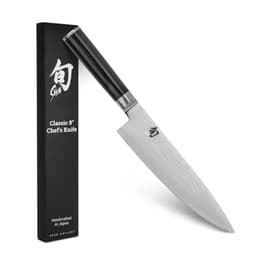
If the answer is Shun
Shun Classic 8-inch Chef's Knife
The knife most people picture when they think 'nice Japanese knife': a VG-MAX core at ~61 HRC under 34 layers of Damascus cladding, with a slim D-shaped handle. You pay for the finish, but the steel is genuinely hard.
Read the full Shun reviewPrice as of October 19, 2026. #ad How we’re funded
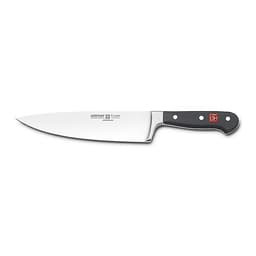
If the answer is Wüsthof
Wüsthof Classic 8-inch Chef's Knife
The benchmark forged German chef's knife: a full-tang X50CrMoV15 blade at ~58 HRC with a bolster and heft that many cooks prefer for rock-chopping. Heavier and softer than a gyuto, and built to last decades.
Read the full Wüsthof reviewPrice as of October 19, 2026. #ad How we’re funded
Frequently asked questions
Is Shun better than Wüsthof?
Neither is better; they are built on opposite priorities. Shun uses a harder VG-MAX core at ~60-61 HRC ground to about 16° per side, so it cuts more keenly and holds an edge longer but chips if mistreated and cannot be honed on a steel rod. Wüsthof is forged X50CrMoV15 at ~58 HRC, tougher and more forgiving, dulling sooner and restored in seconds with a rod.
Which is sharper, Shun or Wüsthof?
Shun, out of the box and for longer afterwards. The Classic line's 16° per side edge is finer than Wüsthof's factory grind, and the harder VG-MAX core supports that geometry without rolling. A well-sharpened Wüsthof can be taken to a similar angle, but it will not hold it for anything like as long.
Do Shun knives chip easily?
They chip in situations where a Wüsthof would roll. At ~60-61 HRC the steel does not bend out of the way, so bone contact, frozen food, twisting a stuck blade or a fall onto a tiled floor can take a small crescent out of the edge. Used on a wooden or soft plastic board with no lateral force, they are perfectly durable.
Can you use a honing steel on a Shun?
Not a traditional steel rod. At ~60-61 HRC the edge fractures rather than realigns, so a steel rod damages it. Use a fine ceramic rod or a leather strop between sharpenings and a 1000/6000 whetstone when the edge genuinely needs metal removed. A Wüsthof, by contrast, wants a steel rod before most sessions.
Is the Shun D-handle a problem for left-handers?
It can be less comfortable rather than unusable — the flat of the D sits against your fingers instead of your palm. Shun makes left-handed versions of some Classic knives as separate products. A Wüsthof's symmetrical triple-riveted handle is fully ambidextrous, which is a genuine point in its favor for a left-handed cook.
Which lasts longer, a Shun or a Wüsthof?
A Wüsthof, in the sense of surviving abuse — softer steel and a heavier forged blade tolerate mistakes a hard thin one will not. Both carry long warranties, and Wüsthof's published terms exclude chipped blades and bent tips, which is exactly the failure mode a hard knife is prone to. In careful hands both will outlive their owner.
Sources
- Rockwell hardness test — Wikipedia — Definition of the Rockwell C (HRC) scale used to state knife-steel hardness (accessed July 21, 2026)
- The Difference Between WÜSTHOF Forged and Stamped Kitchen Knives — WÜSTHOF — Wüsthof's own account of both processes: forged blades start as a single piece of steel heated to over 2000°F and take 'over fifty-four manufacturing steps', hardened to '58 Rockwell'; non-forged blades are 'cut from a high-quality steel sheet using a precision laser' in 'thirty-five manufacturing steps' and run 'between 55 and 57 Rockwell' (accessed August 18, 2026)
- Limited Lifetime Warranty Policy Details — WÜSTHOF — Wüsthof's published warranty terms: cover for the initial purchaser or gift recipient, and the exclusions (bent tips, chipped blades, honing steels, customary wear, commercial or educational use) (accessed August 13, 2026)
- How to Spot a Fake Shun Knife — Shun Cutlery — Shun's own statement that no single visual feature confirms authenticity, that not all sellers on a trusted marketplace are authorized, and that only knives bought from an authorized dealer are eligible for warranty service (accessed August 13, 2026)
Per-knife specs (steel, HRC, blade length, geometry) are read from each maker’s spec sheet or product listing and dated on the individual review cards above. “Not published” means the manufacturer does not state that figure — we flag it rather than guess.
Keep reading
Japanese vs German Knives
The general version of this argument, without the brand names.
Read the comparisonShun Classic 8-inch Review
The Japanese half of this pairing, in full.
Read the reviewWüsthof Classic 8-inch Review
The German half of this pairing, in full.
Read the reviewTojiro vs Shun
What the Shun premium buys against an identical class of steel.
Compare themShun vs Miyabi
If you have already ruled out German steel, this is the next question.
Compare them