Where to Buy a Japanese Chef Knife
Four channels sell you the same knife at four different prices, with four different levels of protection if it turns out not to be the knife you thought. Here is what separates them.
How this is funded: we earn a commission if you buy through our links, at no extra cost to you. As an Amazon Associate we earn from qualifying purchases. It never changes which knife we recommend, and we’ll tell you when we’d skip one. Full disclosure.
Choosing the knife is the part everyone researches. Choosing where to buy it is the part that decides whether you get the knife you researched, what you pay, and whether anyone will help you when the tip snaps off in eighteen months.
Four channels sell Japanese kitchen knives to buyers in the United States: the big marketplaces, the brands’ own stores and their authorized dealers, independent specialist knife retailers, and sellers in Japan shipping direct. They are not four prices for the same transaction. They differ on authenticity risk, on whether a warranty will actually be honored, on how much of the total lands on your card at checkout, and on whether there is a human who can tell you what you are buying.
A disclosure that belongs at the top rather than the bottom of a page like this: the buy links on this site go to Amazon, and we earn a commission when you use them. That is exactly why the sections below spell out what a marketplace listing does and does not guarantee. If the honest answer for a particular knife is “buy it from the brand,” that is what this page says.
The four channels, side by side
| Marketplace | Brand / authorized dealer | Specialist retailer | Direct from Japan | |
|---|---|---|---|---|
| Typical price | Lowest on mainstream models | List, with sale cycles | List or slightly under | Low sticker, variable landed |
| Authenticity | Depends on the seller | Guaranteed | Effectively guaranteed | Reputable shops: yes |
| Warranty position | Read the maker's terms | Strongest | Usually authorized | Often shop-handled, not maker |
| Range beyond the mainstream | Narrow | That brand only | Widest | Widest, incl. small makers |
| Advice before you buy | None | Brand-limited | Best | Varies |
| Returns | Easiest | Straightforward | Reasonable | Slow and costly |
| Duties and taxes | In the price | In the price | In the price | Payable on import |
| Best for | Mainstream models | Premium and gifts | Unusual or first-time | Small makers, carbon steel |
Marketplaces: the seller matters more than the site
The mistake people make with a marketplace is treating the product page as the seller. It is not. A single listing for a well-known knife can be fulfilled by the brand itself, by the platform, or by a third-party merchant with no relationship to the maker at all — and the photographs, the title and the specifications are the same in every case.
Shun addresses this directly in its own guidance on counterfeits, and the wording is worth taking seriously because it comes from the maker rather than from a review site: not all sellers on a trusted platform are authorized, and if a seller is not on the official dealer locator, authenticity cannot be guaranteed. The company also says that no single visual feature can definitively confirm authenticity, which is the part that should change your behavior. You are not going to catch a good fake by squinting at the product photo.
So do the one check that works. Before you buy, read the “Sold by” line, which is separate from “Ships from.” A knife that ships from the platform’s warehouse can still be sold by a third party who put it there. Sold by the brand is best; sold by the platform is fine; sold by a merchant you have never heard of, on a premium knife, at a price well under everyone else’s, is the combination to walk away from.
None of this makes marketplaces a bad channel. For a mainstream knife from a maker with no meaningful counterfeit market — a Victorinox, a Mercer, a Tojiro DP — the marketplace is simply the cheapest way to buy the real thing, and the return policy is the most generous of any channel. The risk concentrates almost entirely in premium knives with high brand recognition, because those are the only ones worth faking.
What the warranty actually says
“Lifetime warranty” is printed on a great many knife boxes and means something different on each one. Two examples from makers this site covers, taken from their own published terms rather than from a summary:
Shun ties eligibility to the dealer. Its guidance states that only knives purchased through a Shun authorized dealer are eligible for warranty service and support, and that counterfeit knives are not eligible at all. If you buy a Shun from an unlisted marketplace seller and the handle later separates, you may have bought a knife with no maker behind it.
Wüsthofwrites its limited lifetime warranty around the person rather than the shop: cover runs to the consumer or entity who is the initial purchaser, or, in the case of a gift, to the initial recipient. Its published warranty details page does not state an authorized-dealer requirement. What it does exclude is a longer list than most people expect — bent tips, chipped or broken blades and melted handles arising from misuse, cutting frozen food or bone, opening jars or cans, the wooden parts of a product, sharpening tools and honing steels, ordinary wear such as a dull or scratched blade, and any product used in a commercial or educational setting.
Read that last clause again, because it is the one that catches people: a honing steel bought from the same brand at the same time may not be covered by the same warranty as the knife, and a dull blade is never a warranty claim — it is a sharpening job. The practical rule is to look up the warranty page for the specific brand before you buy anything expensive, and to keep the receipt, because every claims process starts with proof of purchase.
Buying direct from Japan
Japanese retailers ship worldwide and carry knives that never appear on a US marketplace: single-bevel yanagiba and deba, carbon-steel gyutos from small forges, sizes and handle shapes the big brands do not export. For a specific knife from a specific maker, this is often the only channel that has it.
The arithmetic has changed, though, and stale advice is still circulating. US Customs and Border Protection guidance confirms that from 12:01 a.m. on 29 August 2025 goods of all countries lost the administrative exemption from duty, so a parcel is no longer waved through free simply because it is worth $800 or less. Low-value shipments now need an appropriate entry filed along with payment of all applicable duties, taxes and fees. In practice that means one of two things at your end: the seller quotes a delivered-duty-paid total at checkout, or the carrier contacts you for payment before it will release the parcel.
Compare landed totals, not sticker prices. Factor in that a return to Japan costs more than most knives are worth, that a warranty claim will be handled by the shop rather than by a US service center, and that lead times run to weeks. Then decide. For a knife you cannot get otherwise, it is worth all of that. For a Shun Classic, it is not.
Reading a listing before you click buy
Whichever channel you use, the listing itself tells you more than the reviews do, provided you know which words carry information and which are decoration.
A named alloy is a specification. A vibe is not.“VG10 core,” “AUS-10,” “White #2,” “X50CrMoV15” — these are checkable claims, and our steel guide says what each one buys. “Japanese steel,” “high-carbon stainless,” “premium German steel” and “professional grade” are compatible with almost any metal and tell you nothing.
A hardness figure is a good sign even when it is unimpressive.A maker that publishes “58 HRC” is a maker prepared to be held to a number. A maker that publishes a layer count and a blade length but no hardness usually has a reason.
Layer counts are cosmetic.“67-layer Damascus” describes the cladding wrapped around the core, not the steel that meets the food. It is the core that cuts. The full argument is in Damascus steel explained, including how to spot a pattern that was acid-etched onto plain steel rather than forged in.
Check the length in millimeters.Marketplace titles are written for search, not accuracy, and “8 inch chef knife” is applied to blades from 195 to 215 mm. If you care about the difference, our size guide explains what it changes.
Be suspicious of a brand with no history. A great many knives are sold under names that exist only as a marketplace storefront, with stock photography, an unnamed steel and a five-figure review count. Some are perfectly serviceable. None of them have a warranty department. Our brands reference covers who actually makes what.
Which channel for which knife
Under about $60, buy from the marketplace. At this price there is no counterfeit incentive, the products are commodities, and the return policy is the best protection available. This is the tier our under-$50 roundup covers.
$60 to $150, buy from whoever is cheapest among reputable sellers. The Tojiro DP sits here, and so does most of the under-$100 field. Fakes exist at this level but the margin is thin enough that they are rare. Check the seller line, then buy on price.
Above about $150, buy from the brand or a listed dealer.This is where counterfeits become worth someone’s while and where the warranty is worth having. The difference between the marketplace price and the dealer price on a premium knife is usually small; the difference in what happens when something goes wrong is not.
Anything unusual, buy from a specialist or from Japan.Single bevel, carbon steel, 240 mm, a left-handed grind, a maker with one forge — the mainstream channels do not stock it, and the specialists exist precisely for this.
One last piece of advice that saves more money than any of the above: whatever you buy and wherever you buy it, spend part of the budget on a stone. A mid-priced knife you keep sharp will out-cut a premium knife you do not, and no purchasing channel can sell you around that.
If the marketplace is where you are going to buy anyway — which, for most people, it is — then the seller checks matter more than the brand does. Best chef knives on Amazon applies the whole checklist above to five specific knives, including the model-number and warranty traps.
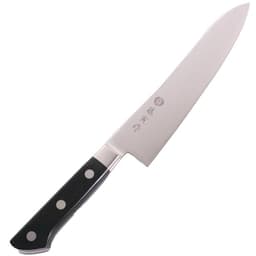
Widely stocked, hard to fake profitably
Tojiro DP Gyuto 210 mm
The knife the internet has recommended to first-time gyuto buyers for a decade, and the numbers explain why: a real VG10 core at ~60 HRC for a fraction of the boutique price. Buy this before you spend three times as much.
Read the full Tojiro reviewPrice as of October 19, 2026. #ad How we’re funded
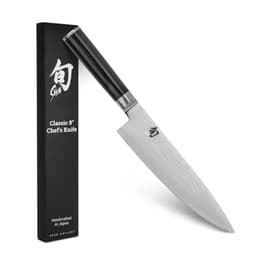
The one to check the seller on
Shun Classic 8-inch Chef's Knife
The knife most people picture when they think 'nice Japanese knife': a VG-MAX core at ~61 HRC under 34 layers of Damascus cladding, with a slim D-shaped handle. You pay for the finish, but the steel is genuinely hard.
Read the full Shun reviewPrice as of October 19, 2026. #ad How we’re funded
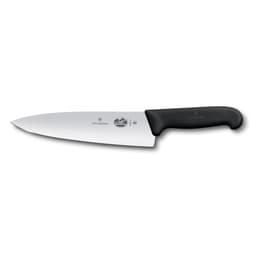
No counterfeit market to worry about
Victorinox Fibrox Pro 8-inch Chef's Knife
The knife that wins nearly every budget test, and the one to buy if you buy only one. A soft, stamped X50CrMoV15 blade at ~55-56 HRC and a grippy, non-slip handle — it dulls sooner than a hard Japanese knife but takes an edge back in seconds.
Read the full Victorinox reviewPrice as of October 19, 2026. #ad How we’re funded
Frequently asked questions
Is it safe to buy a Japanese knife on Amazon?
Usually, with one check. The risk on a marketplace is not the platform, it is the seller: the same product page can be fulfilled by the brand, by Amazon itself, or by a third party nobody has vetted. Read the 'Sold by' line before you buy, and prefer listings sold by the brand or by Amazon. Shun states plainly that not all sellers on a trusted platform are authorized and that authenticity cannot be guaranteed from a seller who is not on its dealer list.
Does buying from an unauthorized seller void the warranty?
It depends on the maker, and you have to read each one. Shun is explicit that only knives purchased through an authorized dealer are eligible for warranty service and support. Wusthof's published warranty is written around the initial purchaser or gift recipient and does not state an authorized-dealer requirement, but it does exclude commercial and educational use, honing steels, and customary wear such as a dull or scratched blade. Check the actual warranty page for the brand you are buying, not a forum summary.
How can I tell if a Shun or Wusthof knife is fake?
You often cannot from a photograph, and Shun says so directly: no single visual feature can definitively confirm authenticity. The warning signs it lists are rough finishing, gaps between handle and blade, poor balance, an inconsistent grind, substandard packaging, and a price significantly below typical retail. Price is the most reliable of those. A 40% discount on a current-line premium knife from a seller you have never heard of is the tell.
Is it cheaper to buy knives directly from Japan?
Less often than it used to be. The sticker price can still be lower, but since 12:01 a.m. on 29 August 2025 the United States has suspended duty-free de minimis treatment for goods of all countries, so shipments that previously cleared free under the $800 threshold now require an entry filing and payment of applicable duties, taxes and fees. Budget for that before you compare totals, and check whether the seller ships duties-prepaid or leaves you to settle with the carrier.
What does 'Japanese steel' on a listing actually mean?
Frequently nothing useful. It is a marketing phrase, not a specification, and it is compatible with a knife made anywhere from a generic stainless of unstated grade. A real specification names the alloy — VG10, VG-MAX, AUS-10, SG2, White #2 — and usually states a hardness figure in HRC. If a listing says 'Japanese steel' and nothing else, treat the steel as unknown.
Should I buy from a specialist knife retailer instead?
For anything unusual, yes. Specialists carry single-bevel knives, carbon steel, sizes outside 8 inches and small makers that never reach a marketplace, and their staff can tell you what a knife actually is. You generally pay more and wait longer. For a mainstream knife that a marketplace stocks by the pallet, the specialist's advantage is advice rather than product.
Sources
- How to Spot a Fake Shun Knife — Shun Cutlery — Shun's own statement that no single visual feature confirms authenticity, that not all sellers on a trusted marketplace are authorized, and that only knives bought from an authorized dealer are eligible for warranty service (accessed August 13, 2026)
- Limited Lifetime Warranty Policy Details — WÜSTHOF — Wüsthof's published warranty terms: cover for the initial purchaser or gift recipient, and the exclusions (bent tips, chipped blades, honing steels, customary wear, commercial or educational use) (accessed August 13, 2026)
- CSMS # 66065494 — Suspension of Duty-Free De Minimis Treatment for All Countries (U.S. Customs and Border Protection) — Official CBP guidance: from 12:01 a.m. on August 29, 2025 goods of all countries lost the administrative duty exemption, so low-value imports now require an entry filing and payment of applicable duties, taxes and fees (accessed August 13, 2026)
- Japanese kitchen knife — Wikipedia — Reference on gyuto/santoku/nakiri, single- vs double-bevel (kataba/ryoba) and edge angles (accessed July 21, 2026)
Per-knife specs (steel, HRC, blade length, geometry) are read from each maker’s spec sheet or product listing and dated on the individual review cards above. “Not published” means the manufacturer does not state that figure — we flag it rather than guess.
Keep reading
Best Chef Knives on Amazon
Five worth buying there, and the four checks that protect your warranty.
See the picksHow to Tell If a Japanese Knife Is Good Quality
What a good maker puts in writing, and the tells of a 'Japanese' knife that is not.
Read the checklistJapanese Knife Buying Guide
What to optimize for at each budget, before you choose a seller.
Read the guideKitchen Knife Brands Explained
Who actually makes what, and the house steel behind each name.
Read the guideDamascus Steel Explained
How to spot a pattern that was etched on rather than forged in.
Read the guideBest Japanese Chef Knives
The field itself, ranked on steel, hardness and geometry.
See the picks