Is Professional Knife Sharpening Worth It?
Using published rate cards rather than guesses: what a service actually charges, what it does better than you can, and the point at which a stone pays for itself.
How this is funded: we earn a commission if you buy through our links, at no extra cost to you. As an Amazon Associate we earn from qualifying purchases. It never changes which knife we recommend, and we’ll tell you when we’d skip one. Full disclosure.
Every argument about professional sharpening founders on the same missing information: nobody quotes what it actually costs. So here are two published rate cards, quoted rather than estimated.
One local service lists standard knives up to 7 inches at $7 each and over 7 inches at $9 each, with a separate whetstone service for Japanese high-end knives at $2.50 per inch — which it notes works out at “$12-$14 Each Average.” Chip or damage repair carries “a $5.00 fee in addition to sharpening.” A mail-in service publishes a $45.00 base pricefor standard kitchen knives, which “includes; our expert level sharpening and covers the cost for shipping your knives back to you.”
Those are two data points rather than a national average, and rates vary by region and by service. But they are real published numbers, and they are enough to do the arithmetic that decides this.
The arithmetic
Take an ordinary kitchen: a chef’s knife, a santoku or a second chef’s knife, a paring knife, a utility knife and a bread knife. Sharpen the four straight-edged ones twice a year at the $7-$9 band, and you are spending somewhere around $60-$70 annually. If two of them are Japanese and go to the per-inch whetstone service instead, it climbs further.
A 1000/6000 combination whetstone costs about what sharpening three or four knives once costs, and it does not expire. Sharpen the same five knives twice a year on your own stone and the second year is free, and so is the tenth.
This is not a close call on money. If cost is the deciding factor, buy the stone. The reasons to use a service are real, and they are not financial.
What a service does genuinely better
- Repairs and reprofiling.Grinding a deep chip out by hand is slow, tedious and easy to do unevenly — and a published $5 surcharge for chip repair is remarkable value against half an hour of your own careful work on a coarse stone. If a knife needs its bevel completely reset, a service with a belt grinder will do it better than you will.
- Consistency, if you are a beginner. A jig holds an angle more reliably than an untrained hand. A first attempt on a stone frequently produces a knife that is less sharp than it started, and a service does not have that failure mode.
- Volume.Twelve knives before a holiday, or a professional kitchen’s worth, is a genuinely different proposition from four knives on a Sunday afternoon.
- Serrated and specialist edges. Serrated knives need a tapered rod and patience, and single-bevel Japanese knives punish mistakes permanently. Both are reasonable things to hand to a specialist.
What can go wrong
The main risk is metal removal. Powered belt and wheel systems cut fast, and a service working through a queue has an incentive to be quick. Sharpening always costs blade height; a hurried machine sharpening can cost noticeably more of it than a hand sharpening would, and you only notice after a few years of it.
The second risk is angle, and it matters most for Japanese knives. A hard, thin blade ground to 15° per side, run through a machine set to a Western 20°, comes back with the geometry you paid a premium for ground away. It will feel durable and it will not feel keen. The tell is a rate card: a service that lists whetstone work for Japanese knives separately, at a higher price, understands the distinction. A single flat rate for every knife in the world does not.
The third is more mundane. You are without your knives for anything from a day to two weeks, which for a mail-in service is the whole point of the price.
The three-way comparison
Professional sharpening is not competing only with a whetstone. The realistic options are:
- A whetstone. Cheapest over time, best results in trained hands, most control over angle, and the steepest learning curve. An afternoon gets you to competent; the process is in how to sharpen a knife on a whetstone.
- An electric sharpener.Fast, consistent, no skill required, and the hungriest for steel of any method — it sets its own angle regardless of what your knife was ground to. The honest assessment is in best electric knife sharpeners.
- A service.No skill, no equipment, no learning, no failure mode — at a recurring cost, with a wait, and with the angle decision handed to somebody else.
Who should use a service
Use one if you have a genuinely damaged knife that needs a chip ground out or a bevel reset; if you have a large number of knives to do at once; if you own a single-bevel or serrated knife you do not want to learn to maintain; if you have tried a stone and disliked it; or if you simply do not want this to be a hobby. That last one is a completely legitimate answer.
Do not use one if cost matters, if you want the knife sharpened the way you cut rather than the way a jig is set, if you would rather not be without your main knife for a week, or if you own hard Japanese knives and cannot find a service that sharpens them on stones.
And the middle path most people end up on: own a stone for routine sharpening, keep a rod or a strop for maintenance between sessions, and send a knife out on the rare occasion it needs real repair. That combination costs very little, keeps every knife in the drawer usable, and puts the professional where their equipment actually has an advantage.
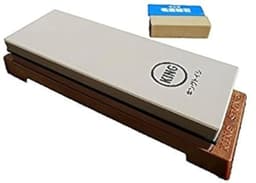
The stone that ends the maths
King (Matsunaga) KW-65 1000/6000 Combination Whetstone
The stone that has taught more people to sharpen than any other. One side 1000-grit to set an edge, one side 6000-grit to polish it, made in Japan, for the price of a takeout dinner. Start here.
Read the full review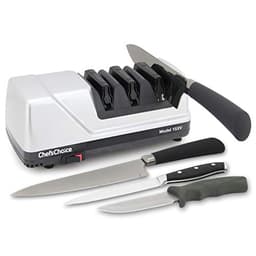
If you want speed without learning a stone
Chef'sChoice 15XV EdgeSelect Electric Sharpener
The electric sharpener people who hate sharpening actually keep using. Three stages, diamond abrasives in the first two, and a jig that converts a 20-degree Western edge to a 15-degree one. It is fast and consistent — and it eats far more steel than a stone ever would.
See the electric sharpeners comparedPrice as of October 20, 2026. #ad How we’re funded
Frequently asked questions
How much does professional knife sharpening cost?
Published rates vary by service and by knife. One service's rate card lists standard knives up to 7 inches at $7 each and over 7 inches at $9 each, with whetstone service for Japanese high-end knives at $2.50 per inch — which it notes averages $12 to $14 per knife. Mail-in services bundle differently: one publishes a $45 base price for standard kitchen knives including return shipping.
Is it cheaper to sharpen knives yourself?
Over any reasonable timeframe, yes. A combination whetstone costs about the same as sharpening three or four knives professionally, and it never runs out. If you own five kitchen knives and sharpen them twice a year, a service costs roughly the price of a new stone every single year while the stone is a one-off.
Is professional sharpening better than doing it yourself?
Better than a beginner, and not necessarily better than someone competent. A good service has belt grinders and jigs that hold an angle more consistently than a human hand, which matters most for repairs and reprofiling. What a service cannot do is sharpen your knife on the evening you need it, and it will not match your knife to how you cut.
Do professional sharpeners remove too much metal?
Some do. Powered belt and wheel systems work fast, and a service under time pressure can take noticeably more steel than a hand sharpening would. Ask what method they use: hand-finished whetstone service is gentler and costs more, which is exactly why rate cards list it separately at a higher price.
Should I send Japanese knives out to be sharpened?
Only to somebody who states they sharpen Japanese knives on stones. A hard, thin Japanese knife ground on a coarse belt at a Western 20-degree angle comes back durable and dull-feeling, because the acute geometry you paid for has been ground away. Rate cards that list whetstone service separately are a good sign; ones that quote a single flat rate for everything are not.
How much does chip repair cost?
It is usually a surcharge on top of sharpening rather than a separate service — one published rate card lists a $5.00 fee in addition to sharpening for chip or damage repair. That is often the best-value professional work available, because grinding a deep chip out by hand is slow, tedious, and easy to do unevenly.
Sources
- Pricing — Birchwood Knife — A sharpening service's published rate card: standard knives up to 7 inches at '$7/each' and over 7 inches at '$9/each', whetstone service for Japanese high-end knives at '$2.50/Inch ($12-$14 Each Average)', and a '$5.00 fee in addition to sharpening' for chip or damage repair (accessed August 18, 2026)
- Knife Sharpening Pricing for Home & Commercial — Mr. Sharpe — A mail-in service's published base price of '$45.00' for standard kitchen knives, which 'includes; our expert level sharpening and covers the cost for shipping your knives back to you' (accessed August 18, 2026)
- Knife sharpening — Wikipedia — Reference on edge angle, coarse-to-fine grit progression, and honing vs sharpening (accessed July 21, 2026)
- Rockwell hardness test — Wikipedia — Definition of the Rockwell C (HRC) scale used to state knife-steel hardness (accessed July 21, 2026)
Per-knife specs (steel, HRC, blade length, geometry) are read from each maker’s spec sheet or product listing and dated on the individual review cards above. “Not published” means the manufacturer does not state that figure — we flag it rather than guess.
Keep reading
Best Combination Whetstones
The one-off purchase a service is being compared against.
See the stonesHow to Sharpen a Knife on a Whetstone
The skill that makes the comparison moot.
Learn the techniqueHow to Fix a Chipped Knife
The repair most worth paying somebody else to do.
Read the how-toBest Electric Knife Sharpeners
The third option — fast, consistent, and hungry for steel.
See the roundup