How to Flatten a Whetstone
A hollow stone grinds a curve into your edge. Here's the two-minute pencil-grid method, the three tools that work, and how often it's actually needed.
How this is funded: we earn a commission if you buy through our links, at no extra cost to you. As an Amazon Associate we earn from qualifying purchases. It never changes which knife we recommend, and we’ll tell you when we’d skip one. Full disclosure.
Sharpening stones wear where you use them, and you use the middle. Over time the working face becomes shallowly concave — “dished” — and that is not cosmetic. A concave stone grinds a convex bevel. The effective angle changes as the blade travels along the surface, the two bevels never meet cleanly, and you can grind for half an hour without producing an edge.
Flattening fixes it in about two minutes. It is the most-skipped and highest-return piece of maintenance in sharpening, and if you have ever concluded that you “can’t sharpen”, there is a decent chance this was the actual problem.
How to tell if your stone is dished
The pencil grid.Draw a grid of pencil lines across the whole working face — three or four each way. Take a few passes with a flattening plate. Graphite sits in the low spots and is removed from the high spots, so what remains is a map of your stone’s hollow. If the lines vanish at the ends and survive in the middle, it is dished.
The ruler test. Lay a steel rule on edge across the stone, hold it up to a window, and look for a gap of light underneath. Fast, and only catches obvious dishing.
The symptom test. You have been sharpening properly for a while and suddenly cannot raise a burr near the heel or the tip, or the edge comes out keen in the middle and dull at the ends. That is a dished stone until proven otherwise.
What to flatten with
A dedicated flattening stone. A coarse, hard block sold for the purpose, often with grooves cut into it to clear slurry. Cheap and entirely adequate for soft and medium water stones. It also wears, so rotate it.
A coarse diamond plate. The best option, and the only realistic one for a hard ceramic stone like a Shapton, which will laugh at sandpaper. A diamond plate cuts fast, stays flat itself, and doubles as a coarse sharpening surface for repair work. It is the most expensive of the three and the one to buy if you sharpen regularly.
Wet-and-dry sandpaper on a flat surface.Around 120–220 grit, taped down to something genuinely flat — thick float glass, a granite surface plate, a good quality tile. The failure mode here is the backing: a kitchen worktop, a concrete slab or a warped chopping board are not flat, and you will faithfully copy their shape into your stone.
The method
- Prepare the stone as if to sharpen.Soak a soaking stone for 5–10 minutes; wet a splash-and-go stone under the tap. Never flatten dry — it produces fine airborne dust and clogs the abrasive.
- Draw the pencil grid across the whole face.
- Work the plate across the stone in overlapping circles or figure-of-eights, keeping everything wet. Do not just push back and forth in one track, or you will wear a new hollow. Rotate the plate regularly so it wears evenly too.
- Check the grid. Rinse, look. Pencil left in the middle means keep going. Work until every trace is gone.
- Chamfer the edges. Run the plate lightly along the four top edges to knock the sharp corners off. Square corners chip easily and can catch a blade mid-stroke; a small chamfer solves both.
- Rinse and dry. Wash off the coarse slurry so it does not contaminate your next session, then let the stone dry before storing it.
How often, realistically
This is entirely a function of how soft the binder is.
- Soft water stones (King and similar): check every few sessions. The softness that makes them cut fast and forgive a wobbly angle is exactly what makes them dish. This is the trade you accepted when you bought one.
- Medium stones (Naniwa combination and similar): check every few weeks of regular use.
- Hard ceramic stones(Shapton GlassStone and similar): months of home use between flattenings. The glass backing does not help here — it is the hard ceramic binder that resists wear — but it does guarantee the reference surface underneath is flat.
The better habit is not a schedule but a twenty-second check: pencil grid, three passes, look. Do it before you sharpen and you will never again spend an evening fighting a stone instead of a knife. Our whetstone roundup flags which stones dish fastest, and the grit guide explains why coarse stones wear faster than fine ones.
Two things not to do
Do not use a knife to “flatten” a stone. Sharpening on the hollow to wear it out is how you got here.
Do not store a soft water stone permanently submerged.It is a common shortcut for skipping the soak, and prolonged saturation can degrade a soft binder over months. In an unheated space, a waterlogged stone can also crack if it freezes. Soak before use, dry afterwards — soaking a whetstone covers how long is long enough, and which stones should never go in the water at all.
One reframe worth carrying away from this page: flattening is the thing that consumes a stone, so how you flatten decides how long it lasts. How long a whetstone lasts puts published abrasive thicknesses next to that arithmetic — and explains why little-and-often costs a fraction of what one heavy correction does.
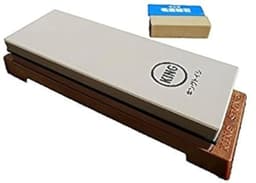
The soft stone this matters most for
King (Matsunaga) KW-65 1000/6000 Combination Whetstone
The stone that has taught more people to sharpen than any other. One side 1000-grit to set an edge, one side 6000-grit to polish it, made in Japan, for the price of a takeout dinner. Start here.
Read the full review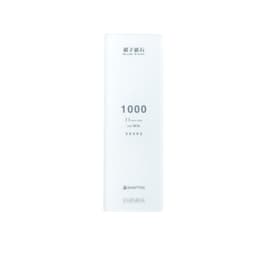
The hard stone that barely dishes
Shapton GlassStone 1000
The upgrade once you know you're sticking with sharpening: a thin, hard ceramic layer bonded to glass. It's splash-and-go (no soaking), stays dead flat far longer than a soft stone, and cuts fast. You'll pay for it.
Read the full reviewPrice as of October 19, 2026. #ad How we’re funded
Frequently asked questions
How do I know if my whetstone needs flattening?
Draw a pencil grid on the surface and take a few passes with a flattening plate. If the graphite disappears from the ends but survives in the middle, the stone is dished. You can also lay a steel ruler across it and look for light underneath, or simply notice that your edges have stopped coming out well despite good technique.
How often should you flatten a whetstone?
It depends entirely on the binder. A soft stone like a King wants checking every few sessions. A hard ceramic like a Shapton GlassStone can go months of home use. The right habit is to check with a pencil grid before you sharpen rather than to flatten on a schedule — checking takes twenty seconds.
What can I use to flatten a whetstone?
Three things work: a dedicated flattening stone (cheap, made for the job), a coarse diamond plate (fast, doubles as a coarse sharpening surface, and the only realistic option for hard ceramic stones), or wet-and-dry sandpaper taped to a genuinely flat surface such as thick float glass or a granite tile. Concrete paving slabs are a common improvisation and are rarely flat enough.
Can you flatten a whetstone with sandpaper?
Yes, for soft and medium stones. Tape coarse wet-and-dry paper (around 120-220 grit) to a surface you have verified is flat, wet everything, and work the stone over it in figure-of-eight passes. It is slow on hard ceramic stones and the paper clogs quickly, so a diamond plate is worth buying if you own a Shapton or similar.
Why does a dished stone matter?
Because a concave surface grinds a convex bevel, and the effective sharpening angle changes as you move the blade along the stone. The two bevels never converge cleanly, so the edge does not come together no matter how long you work. It is one of the most common hidden reasons a knife will not get sharp.
Sources
- How to Sharpen a Knife With a Whetstone — Montana Knife Company — Master-bladesmith walkthrough of whetstone angle, grit progression and deburring (accessed July 21, 2026)
- Knife sharpening — Wikipedia — Reference on edge angle, coarse-to-fine grit progression, and honing vs sharpening (accessed July 21, 2026)
Per-knife specs (steel, HRC, blade length, geometry) are read from each maker’s spec sheet or product listing and dated on the individual review cards above. “Not published” means the manufacturer does not state that figure — we flag it rather than guess.
Keep reading
How to Tell the Grit of a Stone
Flatness first, then grit: how to place an unmarked stone in a band.
Run the testsDMT DuoSharp 8-Inch Review
The two-grit plate whose coarse side doubles as a flattening surface.
Read the reviewWhy Your Knife Won't Get Sharp
A dished stone is cause number three of six.
Troubleshoot itHow to Sharpen a Knife
The full whetstone workflow.
Learn the methodKing KW-65 Review
The soft stone that makes this skill essential.
Read the reviewBest Whetstones
Which stones dish fast and which stay flat.
See the stonesBest Diamond Sharpening Stones
The coarse plate this job exists for.
See the platesHow Often to Sharpen a Knife
How often a stone actually gets used, and dished.
Read the guideDiamond Stone vs Whetstone
The maintenance job a diamond plate never needs.
Read the comparison