Sharpening vs Honing
They sound interchangeable and aren't. One removes metal to make a new edge; the other just realigns the edge you have.
How this is funded: we earn a commission if you buy through our links, at no extra cost to you. As an Amazon Associate we earn from qualifying purchases. It never changes which knife we recommend, and we’ll tell you when we’d skip one. Full disclosure.
The one-sentence version: sharpening removes metal to grind a brand-new edge (you do it on a whetstone, occasionally); honing removes almost no metal and just straightens the edge you already have (you do it on a rod, routinely). Confusing the two is the single most common reason people “can’t get their knife sharp” — they run a dull knife along a honing steel every day and wonder why it never actually gets sharper. A honing steel can’t sharpen. Only a stone can.
| Sharpening | Honing | |
|---|---|---|
| What it does | Grinds a new edge | Realigns the existing edge |
| Removes metal? | Yes | Almost none |
| Tool | Whetstone | Honing rod (steel) |
| How often | Every 1-2 months | Before most cooking |
| Fixes a dull knife? | Yes | No |
Why an edge needs both
A knife edge is a very thin strip of steel. As you cut, that strip rolls over microscopically to one side — the knife still has plenty of edge, it’s just no longer pointing straight. Honing flicks that rolled edge back into alignment, which restores most of the bite in a few seconds. But every roll-and-realign cycle fatigues the steel a little, and eventually the edge wears down or breaks off rather than rolling. At that point there’s no aligned edge left to straighten, and you need to grind a new one — that’s sharpening, on a stone.
This is why the routine is “hone often, sharpen rarely.” Honing before you cook keeps a soft Western edge performing between sharpenings; a stone session every month or two rebuilds the edge when honing stops helping. For the how-to, see our step-by-step sharpening guide.
Not every rod hones
“Honing steel” is a name three different tools now share, and they do not do the same job. Wikipedia’s reference draws the line cleanly: steel and ceramic rods may carry longitudinal ridges, while diamond-coated rods are smooth but embedded with abrasive particles. The ridged steel one realigns; the diamond one grinds. Buying the second while intending the first is one of the quietest ways people wear a knife out.
| Grooved steel rod | Ceramic rod | Diamond rod | |
|---|---|---|---|
| What it does | Realigns a rolled edge | Realigns, and lightly refines | Abrades — this is sharpening |
| Metal removed | Very little | Very little | Real amounts, every pass |
| Use it | Before most cooking | Weekly, or on harder steel | Rarely, and deliberately |
| Safe on a 60+ HRC edge | Cautiously, with light pressure | Yes — this is the one | Not for routine use |
On the diamond rod the makers agree with us. Shun’s own FAQ asks owners not to use a diamond steel for regular honing, because “diamond steels are for sharpening and will remove metal from your knife before it is necessary.” It is a legitimate tool; it simply is not a honing tool. The naming confusion in full is in honing steel vs sharpening steel.
The angle is the part people get wrong
A rod only works if you hold the blade at roughly the angle its edge was ground to. Too shallow and the rod skates across the bevel without ever touching the apex; too steep and you roll the very tip of the edge over rather than straightening it, which is why some people find their knife cuts worse after honing.
Wüsthof publishes real numbers for its own knives, which is more than most makers do: a 14.5° angle between the blade and the steel for its Western knives and 10° for Asian ones, running the blade from heel to tip and repeating “6-8 times while alternating sides.” Its Australian how-to gives 14° and adds that a fairly sharp knife may need only two or three repetitions. The motion matters more than the count — you are drawing the edge along the rod, not sawing at it.
The same source gives the sizing rule almost nobody checks before buying: the rod should be at least as long as the blade you are honing. A rod shorter than the knife means part of the edge never contacts it in one pass, which produces exactly the knife people complain about — sharp at the heel, dull toward the tip. The full motion is in how to hone a knife.
How often, by knife
There is no universal schedule, because the answer depends on how readily your steel deforms. Softer steel rolls more and rewards frequent honing; harder steel barely rolls, so honing does less and the stone does more.
| German, ~56-58 HRC | Japanese, ~60-62 HRC | Serrated | |
|---|---|---|---|
| Hone | Before most cooking sessions | Occasionally, on ceramic, lightly | Never — nothing to realign |
| Sharpen | Every month or two | When a sharpness test fails | Rarely, with a tapered rod |
| Rod to use | Grooved steel | Ceramic, or skip the rod | Tapered rod, one side only |
| Usual failure mode | The edge rolls over | The edge wears, or chips | The tips of the teeth flatten |
Wikipedia’s reference makes the same point about the right-hand end of that table: harder knives are preferred in East Asia, “so there is little need for steeling intra-day, as the edge does not deform as much. Instead, the blade is honed as needed on a waterstone.” If you have just bought a hard Japanese knife and cannot work out why the rod that served your old knives feels useless, that is why. The cadence question on its own is in how often to sharpen a knife.
Four signs honing has stopped working
The moment to reach for a stone is not on a calendar; it is when honing stops producing a result. These are the four signals, roughly in the order they appear:
- The improvement does not last the session. A honed edge should hold through a whole prep session. If it fades in ten minutes, the steel at the apex is fatigued rather than merely bent.
- It slides off a tomato skin. The classic test, and a fair one: a rolled edge that has been straightened will start the cut; a worn one will not.
- You can see the edge. Hold the knife edge-up under a light. A truly sharp apex is too thin to reflect anything, so a bright line running along it is flattened or rolled steel catching the light.
- It catches on paper instead of slicing. Tearing rather than gliding usually means damage a rod cannot address.
More tests, and what each one tells you about which part of your sharpening went wrong, are in how to test knife sharpness.
When it needs the stone
At that point nothing substitutes for grinding a new edge, and one combination whetstone covers the whole job: the 1000 face cuts a fresh apex and raises a burr along the full length of the edge, the fine face refines the scratch pattern that leaves behind, and a few light passes remove the burr. That is sharpening, and it is the only thing described on this page that makes a dull knife sharp.
Where a pull-through sharpener fits
Mostly, it does not. A carbide pull-through does neither job properly: it is far too aggressive to be honing, and it grinds at whatever fixed angle the slot was built with rather than at your knife’s angle — so it can reshape a 15° Japanese edge into a Western one over a few uses without telling you. It will make a very dull knife cut again, quickly, at a real cost in steel. If that trade suits your kitchen, the honest version of the comparison is in whetstone vs electric sharpener.
A note on hard Japanese knives
The hone-often advice is really about softer Western steel, which rolls readily. Very hard Japanese edges (60+ HRC) barely roll, so they need honing far less — and a coarse steel rod can actually micro-chip a hard, brittle edge. For those knives, skip the aggressive steel and give the edge a light touch-up on a fine whetstone when it stops biting.
If you do want a honing rod
For a soft Western knife, a simple fine-cut steel is all you need. Match the rod to the knife: a soft-steel rod for soft German knives; leave the very hard Japanese edges to the stone.

A solid honing rod for Western knives
Wüsthof 9-inch Honing Steel
A honing rod does not sharpen — it realigns a rolled edge between sharpenings. This 9-inch forged steel rod from Wüsthof is the standard for keeping a German knife feeling keen day to day.
Read the full reviewPrice as of October 19, 2026. #ad How we’re funded
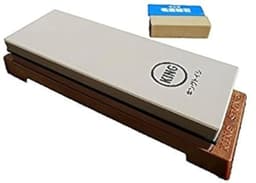
And the stone that does the sharpening half
King (Matsunaga) KW-65 1000/6000 Combination Whetstone
The stone that has taught more people to sharpen than any other. One side 1000-grit to set an edge, one side 6000-grit to polish it, made in Japan, for the price of a takeout dinner. Start here.
Compare five combination stonesFrequently asked questions
What is the difference between sharpening and honing?
Sharpening removes metal from the blade to grind a fresh, new cutting edge — you do it on a whetstone every month or two. Honing removes almost no metal; it realigns an edge that has rolled over microscopically during use, using a honing rod (a 'sharpening steel'). Honing keeps a sharp knife feeling sharp between sharpenings; it cannot fix a genuinely dull one.
Do you sharpen or hone first?
You sharpen first (on a stone) to create the edge, then hone regularly to maintain it. Once the edge is too dull for honing to restore, you go back to the stone. Think of sharpening as occasional and honing as routine — hone often, sharpen rarely.
Does a honing steel actually sharpen a knife?
No. A standard honing steel (a smooth or fine-cut rod) realigns the edge rather than grinding a new one — it removes negligible metal. A knife that feels dull after honing needs sharpening on a stone. Some 'diamond' rods do abrade a little and blur the line, but a true sharpening job still belongs on a whetstone.
How often should I hone my knife?
For a soft Western knife used daily, a few passes on a honing rod before most cooking sessions keeps the edge true. Wüsthof's own how-to says a fairly sharp knife may need only 2-3 repetitions, and Wikipedia's reference notes that steeling is often recommended immediately before or after using a knife and can be done daily. Harder Japanese knives roll less and need honing far less often — and a coarse rod can micro-chip a very hard edge, so those prefer a light touch-up on a fine stone instead.
What angle do you hold a knife against a honing steel?
Roughly the angle the edge was ground at — a rod held too steeply rounds the apex off instead of straightening it. Wüsthof publishes 14.5 degrees between blade and steel for its Western knives and 10 degrees for Asian ones, and says to run the blade from heel to tip and repeat 6-8 times while alternating sides. If you cannot judge it, lay the blade flat against the rod and lift the spine a couple of millimeters.
Does honing remove any metal at all?
A little, but not the way sharpening does. Wikipedia's honing-steel reference notes that non-abrasive rods — smooth ceramic or ribbed steel — remove small amounts of metal through adhesive wear. Diamond-coated rods are a different tool that genuinely abrades: Shun's own FAQ asks owners not to use a diamond steel for regular honing because it 'will remove metal from your knife before it is necessary'.
How long should a honing steel be?
At least as long as the blade you are honing — that is Wüsthof's own published rule. A 9-inch rod covers a standard 8-inch chef's knife with room to work. A rod shorter than the blade means part of the edge never touches it in a single pass, which produces exactly the knife people complain about: sharp at the heel, dull toward the tip.
Can a honing rod fix a chipped knife?
No, and trying makes it worse. A chip is missing steel, and the only repair is grinding the rest of the edge down to meet it on a coarse stone. Honing straightens steel that is still there; nothing about a rod puts metal back.
Sources
- Knife sharpening — Wikipedia — Reference on edge angle, coarse-to-fine grit progression, and honing vs sharpening (accessed July 21, 2026)
- Honing steel — Wikipedia — Reference on rod types and what they do: 'The steel and ceramic honing steels may have longitudinal ridges, whereas the diamond-coated steels are smooth but embedded with abrasive diamond particles'; 'Non-abrasive honing rods such as smooth ceramic or ribbed steel are able to remove small amounts of metal via adhesive wear'; 'It is often recommended that steeling be performed immediately before or after using a knife and can be done daily'; and, on hard blades, 'In East Asia, notably Japan, harder knives are preferred, so there is little need for steeling intra-day, as the edge does not deform as much. Instead, the blade is honed as needed on a waterstone' (accessed September 1, 2026)
- How To Sharpen Your WÜSTHOF Knives — The Chef's Table, WÜSTHOF — Wüsthof's published honing procedure and the distinction it draws: honing 'realigns the microscopic teeth on the edge of the blade and prolongs your knife's lifespan', while sharpening 'takes a small amount of steel off the blade, creating a new edge'. It gives a '14.5-degree angle between the edge of the blade and the honing steel' for Western knives and a '10-degree angle' for Asian knives, and says to run the blade 'from the "heel" to the "tip" of the knife' and 'Repeat this process 6-8 times while alternating sides' (accessed September 1, 2026)
- Using a Steel — WÜSTHOF Australia — Wüsthof's own how-to: 'Tilt the knife so that there is a 14 degree angle between the knife and the steel', 'A fairly sharp knife may only need 2-3 repetitions, while a dull knife will need more', 'Honing re-aligns the microscopic teeth in the blade', a honing steel 'should be used regularly' and even 'after each use', and the sizing rule — 'You want to make sure the steel is at least as long as the blade you are either honing or sharpening' (accessed September 1, 2026)
- Shun Knives FAQ — Shun Cutlery (Kai USA) — Shun's own answers: 'Shun hardens VG10 and VG-Max steel to 60-61 Rockwell and SG2 to 61-62', 'Shun knives, for example, are sharpened to a 16 degree angle on each side of the blade', and on rods, 'Please do not use a diamond steel for regular honing. Diamond steels are for sharpening and will remove metal from your knife before it is necessary' (accessed August 28, 2026)
- How to Sharpen a Knife With a Whetstone — Montana Knife Company — Master-bladesmith walkthrough of whetstone angle, grit progression and deburring (accessed July 21, 2026)
Per-knife specs (steel, HRC, blade length, geometry) are read from each maker’s spec sheet or product listing and dated on the individual review cards above. “Not published” means the manufacturer does not state that figure — we flag it rather than guess.
Keep reading
How to Sharpen a Knife
The full whetstone workflow, when honing isn't enough.
Learn to sharpenBest Whetstones
The stones that actually sharpen, with live prices.
See the stonesWhetstone Grit Guide
Which grits do the sharpening.
Understand gritBest Chef Knives
Soft Western edges hone well; hard ones prefer a stone.
See the knivesBest Honing Steels & Rods
Six rods compared, and which your knives can take.
See the rodsKnife Care & Storage
The habits that dull knives faster than cutting does.
Read the care guideHow to Hone a Knife
The safe vertical method, step by step.
Read the how-toHow to Strop a Knife
The third job in this trio, done on leather.
Read the how-toHoning Steel vs Sharpening Steel
Two names, usually one tool — and the one that genuinely differs.
Sort out the namesYour First Japanese Knife
Why a hard Japanese edge changes the maintenance story entirely.
See the buying pathDo Japanese Knives Need Honing?
What changes when the steel is 60 HRC instead of 58.
Read the answer