Honing Steel vs Sharpening Steel
Two names, usually one tool, and a genuine second tool hiding among them. Sorting out which is which decides whether you are maintaining your knife or slowly grinding it away.
How this is funded: we earn a commission if you buy through our links, at no extra cost to you. As an Amazon Associate we earn from qualifying purchases. It never changes which knife we recommend, and we’ll tell you when we’d skip one. Full disclosure.
This is a naming problem more than a tool problem. The long metal rod that comes in a knife block is sold as a honing steel, a sharpening steel, a honing rod, a steeling rod and a butcher’s steel. In the overwhelming majority of cases all five phrases describe the same object doing the same thing.
The reason it matters is that one of those names is actively wrong. A “sharpening steel” does not sharpen. Believing it does is why a lot of people run a rod over a genuinely worn-out knife for a minute, get no result, and conclude the knife is finished when it needs ten minutes on a stone.
What a rod does to an edge
The cutting edge of a knife is a very thin strip of steel — a few microns wide at the apex. Under normal board work it does not usually wear away first; it folds. Microscopic sections roll over to one side, and a rolled edge presents a curved surface to the food instead of a point. The knife feels dull. It has not lost any metal.
A smooth or fine-cut steel rod is harder than the blade and slightly harder than the folded steel wants to be. Drawn along the edge at the right angle, it pushes those folds back into line. That is realignment, and it is what “honing” means in a kitchen. Sharpening is a different operation entirely: removing metal on an abrasive until a new, unworn apex exists. The distinction is set out in full in sharpening vs honing.
The four rods you will actually meet
| Smooth / fine-cut steel | Ridged steel | Ceramic | Diamond-coated | |
|---|---|---|---|---|
| What it does | Realigns only | Realigns, abrades a little | Realigns and lightly abrades | Abrades — it sharpens |
| Removes metal? | Almost none | A little | A little | Yes, noticeably |
| Safe on 55-58 HRC | Yes | Yes | Yes | Yes, but sparingly |
| Safe on 60+ HRC | No | No | Yes | Sparingly |
| How often | Before most sessions | Weekly | Every few weeks | Rarely — it is a sharpener |
| Fails by | Doing nothing once the edge is worn | Scratching a fine edge | Shattering if dropped | Quietly eating your blade |
The one that genuinely is different
A diamond-coated rod is not a honing tool with a different surface. It is a sharpening tool in a rod shape. Industrial diamond is far harder than any knife steel and cuts it freely, so every pass removes metal — which is exactly what you want from a stone and exactly what you do not want from something you use before every meal.
Used deliberately, a few times a year, on a knife that has actually gone dull, a diamond rod is a legitimate quick sharpener. Used the way people use a honing steel — daily, briskly, without much attention to angle — it will take visible height off a blade over a few years and round the edge while doing it. If you own one, know which category it is in.
Which rod your knives can take
The deciding number is hardness. A rod works by bending steel; hard steel does not bend. Somewhere around 60 HRC the edge stops folding under a steel rod and starts fracturing instead, so each pass chips microscopic pieces off the apex — the opposite of maintenance.
- 55-58 HRC (Victorinox, Mercer, Wüsthof, Zwilling): a smooth or fine-cut steel rod is the correct tool and the best ten seconds you can spend on these knives.
- 59-61 HRC (Tojiro DP, Shun Classic, Miyabi, Enso, MAC): a fine ceramic rod or a leather strop. No steel rod.
- 62 HRC and above (powder steels, hard carbon): a strop, and stones when it needs work. Nothing else.
If you are not sure where your knives sit, the hardness chart lists the common lines by band.
Technique matters more than the rod
Two things go wrong far more often than tool choice. The first is angle: a rod held at a random angle rolls the edge in a new direction rather than straightening it, which is why some people find honing makes their knife worse. Match the angle the knife was ground at — roughly 20° for a German knife, 15° for a Japanese one.
The second is force. Honing is a light contact, not a scrape. The showy cross-armed flourish you see on cooking programs is speed for an audience and is the least accurate way to do it. The safe, accurate method is vertical, tip down, rod resting on a board, blade drawn down and toward you — described step by step in how to hone a knife.
What to buy
If your knives are German or budget stainless, buy a smooth or fine-cut steel rod at least as long as your longest blade — a 9- or 10-inch rod covers an 8-inch chef’s knife with room to work, and the default in that class is examined in full in our Wüsthof 9-inch honing steel review. If your knives are Japanese and hard, buy a fine ceramic rod, or skip the rod entirely and buy a strop, which does the same job more gently and cannot chip anything.
Buy a diamond rod only if you specifically want a fast, portable sharpener and will treat it as one. The whole field, with live prices, is in best honing steels and rods — and if what you actually need is to remove metal, that is a whetstone conversation, not a rod one.

If your knives are German steel
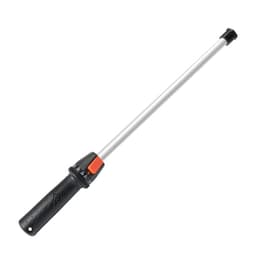
Wüsthof 9-inch Honing Steel
A honing rod does not sharpen — it realigns a rolled edge between sharpenings. This 9-inch forged steel rod from Wüsthof is the standard for keeping a German knife feeling keen day to day.
Read the full reviewPrice as of October 20, 2026. #ad How we’re funded
If your knives are hard Japanese steel
SHARPAL 111H RODALL Ceramic Sharpening Rod, Angle Adjustable
The rod to own if your knives are Japanese. A grooved steel rod is too aggressive for a 60+ HRC edge; a ceramic rod abrades a whisker of metal instead of bending the edge back, which is what hard steel actually needs between stone sessions. This one is the rare rod that publishes an angle — a guide adjustable from 14° to 25°, which covers the 15–16° a Japanese edge is ground to.
See all six rods comparedPrice as of October 20, 2026. #ad How we’re funded
Frequently asked questions
Is a honing steel the same as a sharpening steel?
Usually yes — both names are used for the same smooth or fine-cut steel rod that realigns a rolled edge without removing meaningful metal. 'Sharpening steel' is the older and more misleading of the two names, because the tool does not sharpen. The exception is a diamond-coated or coarse ceramic rod, which genuinely abrades steel and is a sharpening tool wearing the same shape.
Does a honing rod actually sharpen a knife?
No. A dull knife is one whose very edge has folded over to one side; a honing rod pushes that fold back into line, which restores the feeling of sharpness without creating any new edge. Once the edge has actually worn away or chipped, no amount of honing helps and the knife needs a stone.
What is the difference between a steel rod and a ceramic rod?
A steel rod realigns and abrades almost nothing; a ceramic rod is harder than the blade and lightly abrades as well as realigning. That makes ceramic the right choice for hard Japanese knives at 60 HRC and above, where a steel rod would break the edge rather than bend it. Ceramic rods are also brittle and will shatter if dropped on a tile floor.
How often should you hone a knife?
A soft German knife at 55-58 HRC benefits from a few passes before most cooking sessions — it takes ten seconds and it is why professional kitchens keep a rod on the bench. A hard Japanese knife at 60 HRC or above should not go near a steel rod at all, and wants a ceramic rod or a strop every few weeks instead.
Can you use a honing steel on a Japanese knife?
Not a traditional steel rod. The whole mechanism depends on the edge steel bending back into alignment, and hard Japanese steel does not bend — it fractures, taking microscopic pieces of your edge with it. Use a fine ceramic rod or a leather strop instead, and go to a whetstone when the edge genuinely needs metal removed.
Do you need a honing rod if you have a whetstone?
If your knives are hard Japanese steel, no — a strop does the between-sharpenings job better. If your knives are soft German steel, yes, and it is the single highest-value ten seconds in the kitchen: honing keeps that edge usable for weeks between stone sessions rather than days.
Sources
- Knife sharpening — Wikipedia — Reference on edge angle, coarse-to-fine grit progression, and honing vs sharpening (accessed July 21, 2026)
- Rockwell hardness test — Wikipedia — Definition of the Rockwell C (HRC) scale used to state knife-steel hardness (accessed July 21, 2026)
- DMT Diamond and Ceramic Color-Coded Grit Chart — Sharpening Supplies — DMT's own color codes with the mesh and micron figure for each grade (Coarse 325/45 µm, Fine 600/25 µm, Extra-Fine 1200/9 µm) (accessed August 11, 2026)
Per-knife specs (steel, HRC, blade length, geometry) are read from each maker’s spec sheet or product listing and dated on the individual review cards above. “Not published” means the manufacturer does not state that figure — we flag it rather than guess.
Keep reading
SHARPAL 111H Ceramic Rod Review
The ceramic rod for hard Japanese steel, on the adjustable angle its maker publishes and the grit figure it does not.
Read the reviewSharpening vs Honing
The processes rather than the tools — what each one does to steel.
Read the explainerBest Honing Steels & Rods
Six rods compared — steel, ceramic and combination.
See the roundupHow to Hone a Knife
The safe vertical method, step by step.
Learn the techniqueKnife Hardness Chart (HRC)
The number that decides whether a steel rod is safe on your knife.
Read the chart