Gyuto Club

The Best Knives for Culinary School

The kit that survives two semesters of a shared sink, a steel table and somebody else's hands: grippy when wet, fast to re-sharpen, cheap enough to replace.

By Stephen V.Last updated How we pick

Buy the Mercer Culinary Genesis 8-inch chef’s knife. It is forged, full-tang and bolstered like a knife three times the price, the Santoprene handle holds grip when your hands are wet, and it costs little enough that losing it in week six is an annoyance rather than a disaster — which is exactly why it is the knife that turns up on culinary-school kit lists in the first place. If your school hands you a list requiring paring, utility, boning and bread knives, the Genesis 6-piece block set covers all of them in the same line. If you want the cheapest blade here that a chef would still respect, the Victorinox Fibrox Pro is it.

A culinary-school kit is not a “best knives” list with a student discount. The job is different, so the criteria are different. Your knives will be carried in a roll, used on steel tables, washed in a communal sink by people in a hurry, picked up by classmates, and sharpened far more often than a home knife ever is. Under those conditions the premium properties stop mattering and three unglamorous ones take over: does the handle grip when wet, does the edge come back quickly on a stone, and what does it cost to replace.

There is also a documented reason not to bring the expensive German knife your family wants to buy you. Wüsthof’s published warranty terms cover the initial purchaser or gift recipient and exclude — in its own list — bent tips, chipped blades, honing steels, customary wear, and commercial or educational use. Culinary school is educational use. The lifetime warranty on a $180 knife is void the day you take it to class, and the damage a student knife actually suffers (a bent tip, a chip) is excluded anyway. Our page on what working kitchens buy reaches the same conclusion from the other direction.

How this is funded: we earn a commission if you buy through our links, at no extra cost to you. As an Amazon Associate we earn from qualifying purchases. It never changes which knife we recommend, and we’ll tell you when we’d skip one. Full disclosure.

Quick picks

Ranked on steel, hardness, geometry and buyer fit. Select a row to jump to the full write-up. We have not cut with every one of these — here is exactly how we compared them instead.

#KnifeBest forPrice
1
Mercer Culinary Genesis 8-inch Chef's Knife

Mercer Culinary Genesis 8-inch Chef's Knife

A fully forged German-steel knife at a stamped-knife price. It is the culinary-school standby for a reason — you get bolster, full tang and a grippy Santoprene handle for around the cost of a decent stamped blade.

Best overall
$40.89 · View on Amazon

Price as of October 17, 2026. #ad How we’re funded

2
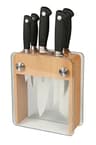
Mercer Culinary Genesis 6-Piece Forged Block Set

Mercer Culinary Genesis 6-Piece Forged Block Set

The best-value real knife set: the forged Genesis chef's knife you'd buy on its own, plus the four other blades you actually reach for, in a beech-and-tempered-glass block. The listing describes 'German stainless steel blades with thick bolsters and full tangs' across the set — not the stamped filler most cheap blocks pad the count with.

Best for a full kit list
$199.99 · View on Amazon

Price as of October 17, 2026. #ad How we’re funded

3
Victorinox Fibrox Pro 8-inch Chef's Knife

Victorinox Fibrox Pro 8-inch Chef's Knife

The knife that wins nearly every budget test, and the one to buy if you buy only one. A soft, stamped X50CrMoV15 blade at ~55-56 HRC and a grippy, non-slip handle — it dulls sooner than a hard Japanese knife but takes an edge back in seconds.

Best cheapest respectable blade
$47.00 · View on Amazon

Price as of October 17, 2026. #ad How we’re funded

4
Mercer Culinary Genesis 5-inch Utility Knife (M20405)

Mercer Culinary Genesis 5-inch Utility Knife (M20405)

A forged, full-tang, bolstered utility knife for about the price of a takeaway. Nothing here is exciting and nothing is wrong: soft German steel, a grippy handle, and a 127 mm blade that does the small jobs a chef's knife is clumsy at.

Best second knife
$22.89 · View on Amazon

$24.296% off

Price as of October 17, 2026. #ad How we’re funded

5
Victorinox Classic Honing Steel 25 cm / 10-inch (7.8303)

Victorinox Classic Honing Steel 25 cm / 10-inch (7.8303)

The budget honing rod to pair with a Victorinox (or any soft-steel Western knife): a chrome-plated 25 cm rod with a medium-fine cut, on a black polyamide handle Victorinox makes to match its Swiss Classic knives, at a price that makes daily honing a no-brainer. Victorinox publishes the weight (276 g), the origin (France) and a lifetime warranty.

Best rod for the roll
$24.95 · View on Amazon

Price as of October 17, 2026. #ad How we’re funded

The picks in full

#1Best overall

Mercer Culinary Genesis 8-inch Chef's Knife

A fully forged German-steel knife at a stamped-knife price. It is the culinary-school standby for a reason — you get bolster, full tang and a grippy Santoprene handle for around the cost of a decent stamped blade.

Strengths

  • Genuinely forged X50CrMoV15 with a full tang and bolster
  • Santoprene handle grips even when wet — a safety win
  • The value benchmark; hard to beat for the money

Trade-offs

  • Not as refined in the hand as a Wüsthof or Zwilling
  • Soft steel, so plan on honing often and sharpening regularly
Blade steelX50CrMoV15 (German stainless)
Hardness~58 HRC
Blade length203 mm
WeightNot published
Edge geometryDouble bevel, ~20° per side
HandleSantoprene, ergonomic
ConstructionForged, full tang, bolstered

Specs read from the manufacturer listing, on July 21, 2026. “Not published” means the maker does not state that figure.

#2Best for a full kit list

Mercer Culinary Genesis 6-Piece Forged Block Set

The best-value real knife set: the forged Genesis chef's knife you'd buy on its own, plus the four other blades you actually reach for, in a beech-and-tempered-glass block. The listing describes 'German stainless steel blades with thick bolsters and full tangs' across the set — not the stamped filler most cheap blocks pad the count with.

Strengths

  • Forged, full-tang, bolstered blades throughout, not stamped block-filler
  • Five knives that earn their slot: 8-inch chef, 8-inch wavy-edge bread, 6-inch boning, 5-inch utility, 3.5-inch paring
  • Grippy Santoprene handles across the set, and NSF certified

Trade-offs

  • Mercer publishes no Rockwell hardness for the Genesis line on this listing or its chef knife's
  • Hand wash only, and the tempered-glass block face shows every smudge
  • No santoku, no shears and no honing rod — budget for a rod separately
Blade steelHigh-carbon German stainless
HardnessNot published
Blade lengthNot published
WeightNot published
Edge geometryNot published
HandleSantoprene, ergonomic
ConstructionForged, full tang, bolstered (all blades)

Specs read from the manufacturer listing, on August 26, 2026. “Not published” means the maker does not state that figure.

#3Best cheapest respectable blade

Victorinox Fibrox Pro 8-inch Chef's Knife

The knife that wins nearly every budget test, and the one to buy if you buy only one. A soft, stamped X50CrMoV15 blade at ~55-56 HRC and a grippy, non-slip handle — it dulls sooner than a hard Japanese knife but takes an edge back in seconds.

Strengths

  • Light, stamped blade with a comfortable, textured non-slip handle
  • Soft steel is very forgiving and fast to re-sharpen
  • Costs about a quarter of a forged German knife and outperforms most

Trade-offs

  • ~55-56 HRC steel dulls faster than a 60+ HRC Japanese edge
  • Utilitarian looks — nobody buys a Fibrox for the shelf appeal
Blade steelX50CrMoV15 (stainless)
Hardness~55-56 HRC
Blade length203 mm
WeightNot published
Edge geometryDouble bevel, ~20° per side
HandleFibrox (TPE), non-slip
ConstructionStamped, single steel

Specs read from the manufacturer listing, on July 21, 2026. “Not published” means the maker does not state that figure.

#4Best second knife

Mercer Culinary Genesis 5-inch Utility Knife (M20405)

A forged, full-tang, bolstered utility knife for about the price of a takeaway. Nothing here is exciting and nothing is wrong: soft German steel, a grippy handle, and a 127 mm blade that does the small jobs a chef's knife is clumsy at.

Strengths

  • Forged and full-tang at a price where utility knives are usually stamped
  • Santoprene handle grips with wet hands — the reason culinary schools issue these
  • Soft enough that a beginner can sharpen it back in five minutes

Trade-offs

  • ~58 HRC will not hold an edge anywhere near as long as the VG10 pettys
  • Thicker behind the edge than the Japanese knives, so it wedges in dense produce
Blade steelX50CrMoV15 (German stainless)
Hardness~58 HRC
Blade length127 mm
WeightNot published
Edge geometryDouble bevel
HandleSantoprene, non-slip
ConstructionForged, full tang, bolstered

Specs read from the manufacturer listing, on August 11, 2026. “Not published” means the maker does not state that figure.

#5Best rod for the roll

Victorinox Classic Honing Steel 25 cm / 10-inch (7.8303)

The budget honing rod to pair with a Victorinox (or any soft-steel Western knife): a chrome-plated 25 cm rod with a medium-fine cut, on a black polyamide handle Victorinox makes to match its Swiss Classic knives, at a price that makes daily honing a no-brainer. Victorinox publishes the weight (276 g), the origin (France) and a lifetime warranty.

Strengths

  • Inexpensive, so there's no excuse not to hone before each session
  • Victorinox publishes the numbers most rod makers skip — 25 cm blade, 385 mm overall, 276 g, medium-fine cut — and covers it with its lifetime warranty
  • 25 cm (10-inch) length covers an 8-inch chef's knife with room to spare

Trade-offs

  • Realigns only — not a substitute for actual sharpening on a stone
  • Victorinox rates it for blades up to 65 HRC, but a steel rod is still not what we would put on a hard Japanese edge — use a fine ceramic rod
  • Polyamide handle, not the textured Fibrox grip of the Pro knives; and not dishwasher safe, per Victorinox
TypeDry honing rod (realigns, does not abrade)
MaterialChrome-plated steel rod, medium-fine cut (Victorinox)
Length25 cm (10-inch) rod, 385 mm overall, 276 g (Victorinox)

Specs read from the manufacturer listing, on September 20, 2026. “Not published” means the maker does not state that figure.

The three things a student knife is actually judged on

1. Grip when wet, because that is the safety item.A culinary-school day is wet hands, wet handles and speed. Mercer’s own distributor listing for the Genesis line describes “ergonomic, easy-to-grip, soft Santoprene knife handles” and flags the set “NSF Certified” with “Hand Wash Only Non-Slip Handles” — the two things a commercial kitchen (and a school teaching to commercial standards) checks for. A polished pakkawood D-handle is lovely at home and slick in a scramble.

2. How fast the edge comes back. You will be sharpening weekly, often on whatever stone the school owns, often tired. Softer German-style stainless at around 58 HRC forms a burr quickly and forgives a wobbly angle; a 61 HRC Japanese blade takes a finer edge and punishes the same technique with a stubborn burr and a chipped tip. For a student, the forgiving steel is the right answer, and the easiest knives to sharpen explains why.

3. Replacement cost, because kit goes missing.Knives walk. Tips snap on steel tables. Somebody runs your blade through a dishwasher. The correct response is to own knives you can replace out of a week’s tips, not knives you grieve over. That is the whole case for the Mercer and the Victorinox, and it is also why we would not put a Shun or a Miyabi anywhere near a school roll — see are Japanese knives worth it for where those knives do earn their money.

What the makers publish, and what they do not

This matters because kit lists are written in brand names, not specifications. Mercer’s own Genesis chef-knife listing describes “forged construction with short bolster,” a “taper ground edge” for “superior stability, easy-honing, and long-lasting sharpness,” and a “full tang [that] creates better balance” — and publishes no steel-grade designation and no Rockwell hardness figure anywhere on the page. The 6-piece set’s listing is the same: “High Carbon Stainless Steel,” no grade, no hardness.

We say so rather than filling the gap. What Mercer does publish is the construction, and construction is the thing that decides whether a budget-priced knife is a real knife: forged from one billet with a bolster and a full tang, which is the same build Wüsthof charges several times more for and which its own blog describes taking “over fifty-four manufacturing steps.” For a student that is the right place to spend. Our forged vs stamped page has Wüsthof’s own figures for both processes, and Mercer vs Wüsthof puts the two head to head.

What is actually on a school kit list

Lists vary by program, but the shapes are stable: an 8-inch chef’s knife, a paring knife, a utility or boning knife, a serrated bread knife, a honing rod, and a peeler. The Genesis 6-piece set covers four of those blades in one purchase — its distributor listing itemizes a 3½-inch paring, 5-inch utility, 6-inch boning, 8-inch wavy-edge bread and 8-inch chef’s knife, in a beech and tempered-glass block.

The block is the part you do not want. It is the right blades in the wrong packaging for a commuting student, so there are two sensible routes: buy the set and leave the block at home, or buy the chef’s knife and the utility knife individually and add the rest as the course demands them. Buying piecemeal usually costs more per blade and less in total, because most lists overspecify. Our set roundup covers which sets are real knives and which are block filler.

The rod matters more than the stone for the first term

Most of what a student calls “dull” in a day of service is a rolled edge, not a worn one, and a rod fixes that in seconds. Wüsthof’s own instructions — the clearest published procedure for it — give a 14.5° angle between blade and rod for Western knives, heel to tip, “6-8 times while alternating sides,” and note that a fairly sharp knife may need only 2-3 repetitions. The sizing rule from the same maker: the steel should be at least as long as the blade, which is why a 10-inch rod is on this page against an 8-inch knife.

The Victorinox rod is here because it is the one that makes daily honing a non-decision, and because Victorinox actually publishes the numbers most rod makers skip — 25 cm rod, 385 mm overall, 276 g, medium-fine cut, made in France, rated for blades up to 65 HRC, not dishwasher safe. One caution from the general reference: even ribbed steel and smooth ceramic “are able to remove small amounts of metal via adhesive wear,” so a rod is not free — it is just much cheaper than a stone session. Learn the stone too; our whetstone walkthrough is the method, and the beginner stone page is what to buy.

Care rules that keep a student kit alive

None of this is folklore — it is what the makers themselves say. ZWILLING’s own care page rules out the dishwasher for “aggressive chemical tablets,” “high temperatures” and “bumps and bangs with other objects,” and says a knife needs “its very own space away from other objects, so not simply thrown in the cutlery drawer.” In a school context that translates to: wash and dry your own knives by hand the moment you are done, never leave them in a sink where someone else will grab the blade, and transport them in a roll with sleeves rather than loose. Our dishwasher page spells out the mechanism, and knife care covers storage.

How we ranked these

On the three criteria above, in that order, using what the makers and distributors publish for construction, handle material, certification and dimensions — and saying plainly where no hardness figure is published at all. We have not cooked in a school kitchen with these knives, we own none of them, and there is no score column here for that reason. Prices come only from our live price layer and carry the date they were read.

Frequently asked questions

What knives do you need for culinary school?

Programs vary, but almost every list asks for an 8-inch chef's knife, a paring knife, a utility or boning knife, a serrated bread knife, a honing rod and a peeler. The chef's knife is the one worth choosing carefully; the rest can be the cheapest version that holds an edge, because the course will teach you which shapes you actually reach for.

What is the best chef knife for culinary school?

The Mercer Culinary Genesis 8-inch. It is forged from a single billet with a full tang and a bolster, which is the construction that separates a real knife from a stamped one, and Mercer's own listing describes a soft Santoprene handle that grips when wet. It costs little enough to replace, which matters more in a school roll than any specification does.

Should I buy a Wüsthof or Shun for culinary school?

We would not. Wüsthof's published warranty excludes commercial or educational use outright, along with bent tips and chipped blades — so the cover you are paying for does not apply at school, and the damage students actually cause is excluded anyway. A hard Japanese knife like a Shun adds a second problem: a 60-plus HRC edge chips on steel tables and demands careful sharpening you will not have time for.

Is a knife set or individual knives better for culinary school?

A set if your program's kit list requires four or five specific shapes, because buying them individually in the same line costs more. Individual knives if the list is short or you already own a chef's knife. Either way, leave the block at home — a commuting student needs a roll, and the block is a large part of a set's price.

How hard are Mercer Genesis knives?

Mercer does not publish a Rockwell figure. Its own Genesis chef-knife listing states forged construction, a taper-ground edge and a full tang, with no steel grade and no hardness number anywhere on the page, and the 6-piece set's listing says only 'High Carbon Stainless Steel'. We report that gap rather than filling it; the construction is what you are buying here.

Do I need a whetstone for culinary school, or just a honing rod?

Both, eventually, but the rod first. Most dullness during a service is a rolled edge, which a rod fixes in seconds — Wüsthof's own procedure is 6 to 8 alternating passes at about 14.5 degrees. A stone is what restores an edge that is genuinely worn, and schools usually have stones you can learn on before you buy your own.

How many knives should I actually bring to class?

Whatever the list requires, plus nothing. Extra blades in a roll get borrowed, lost and bent, and every shape you have not been taught to use is dead weight. A chef's knife, a paring knife, a utility knife and a rod will carry most of a first year.

Will a Victorinox Fibrox hold up in a professional kitchen?

Yes — it is one of the most common knives in working kitchens precisely because it is light, grippy when wet, stamped rather than precious, and cheap to replace. It will not take as fine an edge as a Japanese blade and it dulls sooner than a harder steel, but it comes back on a rod in seconds and nobody mourns it when it goes missing.

Sources

  • Mercer Culinary M21078 Genesis 8-inch Forged Chef Knife with Short Bolster — WebstaurantStore — The Genesis line's own chef-knife listing: 'Forged construction with short bolster', a 'Taper ground edge' for 'superior stability, easy-honing, and long-lasting sharpness', and 'Full tang creates better balance' — with no steel-grade designation and no Rockwell hardness figure printed anywhere on the page (accessed August 26, 2026)
  • Mercer Culinary M20050 Genesis 6-Piece Wood / Glass Knife Block Set — WebstaurantStore — The distributor listing for this set: 'German stainless steel blades with thick bolsters and full tangs', 'Ergonomic, easy-to-grip, soft Santoprene knife handles', 'Features a beech wood and tempered glass knife block' and 'Includes a paring, utility, boning, bread, and chef's knife' — itemized as a 3 1/2 inch paring, 5 inch utility, 6 inch boning, 8 inch wavy edge bread and 8 inch chef's knife in an 8 inch L x 3 1/4 inch W x 9 inch H block, blade material 'High Carbon Stainless Steel', features 'Hand Wash Only Non-Slip Handles NSF Certified'. No Rockwell hardness figure is printed (accessed August 26, 2026)
  • Limited Lifetime Warranty Policy Details — WÜSTHOF — Wüsthof's published warranty terms: cover for the initial purchaser or gift recipient, and the exclusions (bent tips, chipped blades, honing steels, customary wear, commercial or educational use) (accessed August 13, 2026)
  • The Difference Between WÜSTHOF Forged and Stamped Kitchen Knives — WÜSTHOF — Wüsthof's own account of both processes: forged blades start as a single piece of steel heated to over 2000°F and take 'over fifty-four manufacturing steps', hardened to '58 Rockwell'; non-forged blades are 'cut from a high-quality steel sheet using a precision laser' in 'thirty-five manufacturing steps' and run 'between 55 and 57 Rockwell' (accessed August 18, 2026)
  • Using a Steel — WÜSTHOF Australia — Wüsthof's own how-to: 'Tilt the knife so that there is a 14 degree angle between the knife and the steel', 'A fairly sharp knife may only need 2-3 repetitions, while a dull knife will need more', 'Honing re-aligns the microscopic teeth in the blade', a honing steel 'should be used regularly' and even 'after each use', and the sizing rule — 'You want to make sure the steel is at least as long as the blade you are either honing or sharpening' (accessed September 1, 2026)
  • How To Sharpen Your WÜSTHOF Knives — The Chef's Table, WÜSTHOF — Wüsthof's published honing procedure and the distinction it draws: honing 'realigns the microscopic teeth on the edge of the blade and prolongs your knife's lifespan', while sharpening 'takes a small amount of steel off the blade, creating a new edge'. It gives a '14.5-degree angle between the edge of the blade and the honing steel' for Western knives and a '10-degree angle' for Asian knives, and says to run the blade 'from the "heel" to the "tip" of the knife' and 'Repeat this process 6-8 times while alternating sides' (accessed September 1, 2026)
  • How to Clean and Care for Your Knife — ZWILLING — ZWILLING's own care instructions: 'clean it by hand using lukewarm water, mild dish soap and a non-scratch cloth or sponge', dried with 'a plain dishtowel or microfiber cloth'; the dishwasher is ruled out for 'aggressive chemical tablets', 'high temperatures' and 'bumps and bangs with other objects'. On wooden handles: 'not dishwasher-safe and should only be washed by hand', with the wood 'regularly treating the wood with oil (e.g. linseed oil) or wax (e.g. beeswax)'. On storage, a knife needs 'its very own space away from other objects, so not simply thrown in the cutlery drawer' — a block, 'drawer organizers or protective sleeves' (accessed September 23, 2026)
  • Honing steel — Wikipedia — Reference on rod types and what they do: 'The steel and ceramic honing steels may have longitudinal ridges, whereas the diamond-coated steels are smooth but embedded with abrasive diamond particles'; 'Non-abrasive honing rods such as smooth ceramic or ribbed steel are able to remove small amounts of metal via adhesive wear'; 'It is often recommended that steeling be performed immediately before or after using a knife and can be done daily'; and, on hard blades, 'In East Asia, notably Japan, harder knives are preferred, so there is little need for steeling intra-day, as the edge does not deform as much. Instead, the blade is honed as needed on a waterstone' (accessed September 1, 2026)
  • Shun Knives FAQ — Shun Cutlery (Kai USA) — Shun's own answers: 'Shun hardens VG10 and VG-Max steel to 60-61 Rockwell and SG2 to 61-62', 'Shun knives, for example, are sharpened to a 16 degree angle on each side of the blade', and on rods, 'Please do not use a diamond steel for regular honing. Diamond steels are for sharpening and will remove metal from your knife before it is necessary' (accessed August 28, 2026)

Per-knife specs (steel, HRC, blade length, geometry) are read from each maker’s spec sheet or product listing and dated on the individual review cards above. “Not published” means the manufacturer does not state that figure — we flag it rather than guess.

Keep reading