Mercer vs Wüsthof
Two forged German-style chef's knives several times apart in price and almost identical in construction. The difference is what each maker is willing to publish — and how acutely the edge is ground.
How this is funded: we earn a commission if you buy through our links, at no extra cost to you. As an Amazon Associate we earn from qualifying purchases. It never changes which knife we recommend, and we’ll tell you when we’d skip one. Full disclosure.
Buy the Mercer Genesis if you want forged German construction at the lowest honest price, and the Wüsthof Classic if you want published numbers, a more acute factory edge and a knife that feels like the money. They are the same kind of knife — single-billet forged, full tang, bolster, softish stainless you maintain with a rod — separated by finish, by about 6° of edge angle, and by how much each maker is willing to tell you.
This comparison gets asked constantly because the two knives look alike in a photograph and are priced as if they are not remotely alike. Both answers in circulation are wrong: “they are basically the same knife, buy the cheap one” ignores a real geometry difference, and “you get what you pay for” ignores that the expensive one is not better in the way people assume. Here is what is actually documented.
What is genuinely the same
Construction. Mercer’s own listing for the forged Genesis chef’s knife states “forged construction with short bolster,” a “taper ground edge” for “superior stability, easy-honing, and long-lasting sharpness,” and a “full tang [that] creates better balance.” That is the same build Wüsthof describes for its Classic line, and it is the build that matters: Wüsthof’s own account of its processes says a forged blade starts as a single piece of steel heated past 2000°F and takes “over fifty-four manufacturing steps” to reach “58 Rockwell,” while a non-forged blade is “cut from a high-quality steel sheet using a precision laser” in thirty-five steps and lands “between 55 and 57 Rockwell.”
Both knives are also in the same softness band for a kitchen knife, which means they behave the same way in the hand: the edge rolls rather than chips, a rod brings it back, and a stone session is forgiving of imperfect angle control. Neither will take or hold an edge like a 60-61 HRC Japanese blade — the band Shun publishes for VG10 and VG-MAX — and neither is trying to.
What is genuinely different: the published record
Wüsthof publishes its hardness. Mercer does not. We checked the Genesis chef-knife listing and the Genesis 6-piece set listing and there is no Rockwell figure on either, and no steel-grade designation — the set listing says only “High Carbon Stainless Steel.” Marketplace listings routinely fill the gap with “X50CrMoV15, 58 HRC,” which is a reasonable guess for the category, and that is exactly what it is: a listing’s claim, not a manufacturer’s specification.
We would not refuse to buy a knife over this — the construction is stated and verifiable, which is the part that decides whether a cheap knife is a real one. But it is a difference, and it is the difference this whole site exists to point out: when two makers describe the same knife and only one of them gives you numbers, you can only compare the one who did. Our hardness chart and steel guide set out what the figures mean when you do get them.
What is genuinely different: the edge angle
This is the practical difference most comparisons miss. Current Wüsthof Classic blades carry the Precision Edge Technology grind, listed at about 14° per side. The Genesis is ground at a wider angle, in the usual 20°-per-side Western neighborhood.
Six degrees per side sounds academic and is not. A more acute edge starts out keener, bites into a tomato skin with less pressure, and feels sharper for longer; a wider edge has more steel behind the apex and takes abuse better. The general sharpening reference frames this as the standard trade-off between keenness and durability, and it is the same trade the Japanese-versus-German argument turns on, just inside one country. Two consequences:
- Sharpener choice is not interchangeable.Putting the Wüsthof through a fixed 20° pull-through grinds away the geometry you paid for. Our angle guide covers how to match a tool to a grind, and the systems roundup covers the ones with selectable angles.
- Honing angles differ too.Wüsthof’s own instruction is “a 14.5-degree angle between the edge of the blade and the honing steel” for Western knives, heel to tip, “6-8 times while alternating sides,” with its Australian site noting that a fairly sharp knife may need only 2-3 passes. On the Genesis you are matching a wider bevel, so a slightly steeper rod angle is correct.
| Mercer Genesis | Wüsthof Classic | |
|---|---|---|
| Construction | Forged, full tang, short bolster (maker's listing) | Forged, full tang, bolstered |
| Steel grade published by the maker | No — 'High Carbon Stainless Steel' only | X50CrMoV15 |
| Hardness published by the maker | No figure on either listing | 58 Rockwell (forged line) |
| Factory edge angle | Wider — about 20° per side | About 14° per side (PEtec) |
| Handle | Soft Santoprene, grips when wet | Polished POM, triple-riveted |
| Warranty notes | Not published on the listings we read | Lifetime, excluding chips, bent tips, wear, commercial or educational use |
| Best for | Students, working kitchens, first forged knife | A knife to keep for decades, bought once |
The handle is a real decision, not a trim level
Mercer’s Santoprene handle is soft, slightly rubbery and grips when your hands are wet; the distributor’s listing calls out “ergonomic, easy-to-grip, soft Santoprene knife handles” and flags the Genesis sets “NSF Certified” with “Hand Wash Only Non-Slip Handles.” Wüsthof’s POM handle is harder, smoother, triple-riveted and better balanced, and it is noticeably slicker with wet hands.
Which one is “better” depends entirely on where the knife lives. In a busy or wet environment the grippy handle is a safety feature and the polished one is a liability. In a home kitchen where you dry your hands, the Wüsthof feels like a better object every time you pick it up, and that is not a trivial thing to buy — people use the knife they enjoy using.
So which one
Buy the Mercer if you are kitting out for culinary school or a working kitchen, you want the most knife per dollar, you need several shapes at once, or you want a forged knife you will not baby. See the culinary-school kit page and the under-$50 roundup.
Buy the Wüsthof ifyou want one chef’s knife for the next twenty years, you value a keener factory edge, you want the maker to publish its numbers, or you are buying a gift. See which Wüsthof to buy and the forged field.
Buy neither ifwhat you actually want is a keen, thin, hard blade — in which case you want a Japanese knife, and the gyuto roundup is the page. We own neither of these knives and have run no cutting tests; every figure above is attributed to whoever published it, and our methodology page explains the approach. Prices come only from our live price layer, with the date they were read.
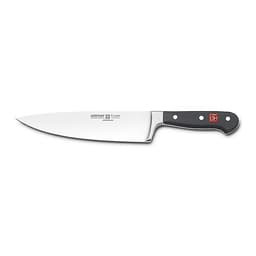
If you want the published numbers and the finish
Wüsthof Classic 8-inch Chef's Knife
The benchmark forged German chef's knife: a full-tang X50CrMoV15 blade at ~58 HRC with a bolster and heft that many cooks prefer for rock-chopping. Heavier and softer than a gyuto, and built to last decades.
Read the Wüsthof Classic 8-inch reviewPrice as of October 17, 2026. #ad How we’re funded
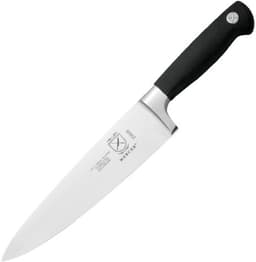
If you want the same construction for a fraction of the money
Mercer Culinary Genesis 8-inch Chef's Knife
A fully forged German-steel knife at a stamped-knife price. It is the culinary-school standby for a reason — you get bolster, full tang and a grippy Santoprene handle for around the cost of a decent stamped blade.
Read the Mercer Genesis reviewPrice as of October 17, 2026. #ad How we’re funded
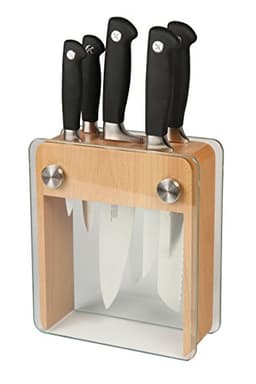
If you need several shapes at once
Mercer Culinary Genesis 6-Piece Forged Block Set
The best-value real knife set: the forged Genesis chef's knife you'd buy on its own, plus the four other blades you actually reach for, in a beech-and-tempered-glass block. The listing describes 'German stainless steel blades with thick bolsters and full tangs' across the set — not the stamped filler most cheap blocks pad the count with.
Read the Genesis 6-piece reviewPrice as of October 17, 2026. #ad How we’re funded
Frequently asked questions
Is Mercer as good as Wüsthof?
In construction, close enough that the difference is hard to argue: both the Mercer Genesis and the Wüsthof Classic are forged from a single billet with a full tang and a bolster. Where Wüsthof is clearly ahead is published information and edge geometry — it states 58 Rockwell for its forged knives and grinds to about 14 degrees per side, while Mercer's own Genesis listings publish no hardness figure and no steel grade, and the Genesis is ground at a wider angle. Fit, finish and balance also favor the Wüsthof.
Why is Mercer so much cheaper than Wüsthof?
Different market. Mercer sells into commercial kitchens and culinary schools, where knives are tools bought by the case, finished plainly and expected to be replaced. Wüsthof sells a consumer product with a refined bolster, a polished POM handle, a more acute factory edge and a brand people buy as a gift. The forging is the part that did not get cut.
What steel does Mercer use?
Mercer does not publish a grade for the Genesis line. Its own listings describe 'High Carbon Stainless Steel' and 'forged construction with short bolster' with a 'taper ground edge', and no Rockwell figure appears anywhere on them. Marketplace listings commonly give it as German X50CrMoV15 at around 58 HRC, which is plausible for the category but is not the maker's published figure — so we treat it as listing-sourced and say so.
Which holds an edge longer, Mercer or Wüsthof?
Neither is likely to be far ahead, because both are softer German-style stainless in the same band, and edge retention tracks hardness closely. The practical difference is the factory grind: Wüsthof's roughly 14-degree-per-side edge starts keener than the Genesis's wider grind, so it feels sharper for longer even if the steel wears at a similar rate.
Is the Wüsthof lifetime warranty worth the extra money?
Read the exclusions first. Wüsthof's published terms cover the initial purchaser or gift recipient and exclude bent tips, chipped blades, honing steels, customary wear, and commercial or educational use. That rules out most of what actually happens to a knife, and it rules out school and restaurant use entirely — so if you are buying for either, the warranty is not part of the value.
Which should I buy for culinary school?
The Mercer, by a wide margin. The Wüsthof warranty voids itself on educational use, Mercer's Santoprene handle grips when wet, its Genesis sets are NSF Certified per the distributor's listing, and the replacement cost is low enough that a lost or bent knife is an inconvenience. Our culinary-school page covers the whole kit.
Do Mercer and Wüsthof sharpen the same way?
Same method, different target angle. Both are softish German-style stainless that forms a burr quickly on a 1000-grit stone and comes back on a honing rod between sessions. Hone the Wüsthof at the 14.5 degrees Wüsthof itself specifies; the Genesis's factory grind is wider, so sharpening it at a Japanese 15 degrees means reprofiling the bevel rather than refreshing it — doable, but a project rather than a touch-up.
Is a Mercer Genesis actually forged?
Yes — its own listing states 'forged construction with short bolster' and a 'full tang [that] creates better balance'. That matters because forging is the one quality step in this category that is not cosmetic: Wüsthof's own account of the two processes puts its forged blades at 58 Rockwell after 'over fifty-four manufacturing steps' against 55 to 57 Rockwell for sheet-cut blades in thirty-five steps.
Sources
- The Difference Between WÜSTHOF Forged and Stamped Kitchen Knives — WÜSTHOF — Wüsthof's own account of both processes: forged blades start as a single piece of steel heated to over 2000°F and take 'over fifty-four manufacturing steps', hardened to '58 Rockwell'; non-forged blades are 'cut from a high-quality steel sheet using a precision laser' in 'thirty-five manufacturing steps' and run 'between 55 and 57 Rockwell' (accessed August 18, 2026)
- Limited Lifetime Warranty Policy Details — WÜSTHOF — Wüsthof's published warranty terms: cover for the initial purchaser or gift recipient, and the exclusions (bent tips, chipped blades, honing steels, customary wear, commercial or educational use) (accessed August 13, 2026)
- How To Sharpen Your WÜSTHOF Knives — The Chef's Table, WÜSTHOF — Wüsthof's published honing procedure and the distinction it draws: honing 'realigns the microscopic teeth on the edge of the blade and prolongs your knife's lifespan', while sharpening 'takes a small amount of steel off the blade, creating a new edge'. It gives a '14.5-degree angle between the edge of the blade and the honing steel' for Western knives and a '10-degree angle' for Asian knives, and says to run the blade 'from the "heel" to the "tip" of the knife' and 'Repeat this process 6-8 times while alternating sides' (accessed September 1, 2026)
- Using a Steel — WÜSTHOF Australia — Wüsthof's own how-to: 'Tilt the knife so that there is a 14 degree angle between the knife and the steel', 'A fairly sharp knife may only need 2-3 repetitions, while a dull knife will need more', 'Honing re-aligns the microscopic teeth in the blade', a honing steel 'should be used regularly' and even 'after each use', and the sizing rule — 'You want to make sure the steel is at least as long as the blade you are either honing or sharpening' (accessed September 1, 2026)
- Mercer Culinary M21078 Genesis 8-inch Forged Chef Knife with Short Bolster — WebstaurantStore — The Genesis line's own chef-knife listing: 'Forged construction with short bolster', a 'Taper ground edge' for 'superior stability, easy-honing, and long-lasting sharpness', and 'Full tang creates better balance' — with no steel-grade designation and no Rockwell hardness figure printed anywhere on the page (accessed August 26, 2026)
- Mercer Culinary M20050 Genesis 6-Piece Wood / Glass Knife Block Set — WebstaurantStore — The distributor listing for this set: 'German stainless steel blades with thick bolsters and full tangs', 'Ergonomic, easy-to-grip, soft Santoprene knife handles', 'Features a beech wood and tempered glass knife block' and 'Includes a paring, utility, boning, bread, and chef's knife' — itemized as a 3 1/2 inch paring, 5 inch utility, 6 inch boning, 8 inch wavy edge bread and 8 inch chef's knife in an 8 inch L x 3 1/4 inch W x 9 inch H block, blade material 'High Carbon Stainless Steel', features 'Hand Wash Only Non-Slip Handles NSF Certified'. No Rockwell hardness figure is printed (accessed August 26, 2026)
- Knife sharpening — Wikipedia — Reference on edge angle, coarse-to-fine grit progression, and honing vs sharpening (accessed July 21, 2026)
- Rockwell hardness test — Wikipedia — Definition of the Rockwell C (HRC) scale used to state knife-steel hardness (accessed July 21, 2026)
- Shun Knives FAQ — Shun Cutlery (Kai USA) — Shun's own answers: 'Shun hardens VG10 and VG-Max steel to 60-61 Rockwell and SG2 to 61-62', 'Shun knives, for example, are sharpened to a 16 degree angle on each side of the blade', and on rods, 'Please do not use a diamond steel for regular honing. Diamond steels are for sharpening and will remove metal from your knife before it is necessary' (accessed August 28, 2026)
Per-knife specs (steel, HRC, blade length, geometry) are read from each maker’s spec sheet or product listing and dated on the individual review cards above. “Not published” means the manufacturer does not state that figure — we flag it rather than guess.
Keep reading
Best Wüsthof Knives
One steel, one edge angle across the forged line — so buy the shape.
See the picksVictorinox vs Mercer
The other end of the same decision: forged budget versus stamped budget.
Compare themForged vs Stamped Knives
Wüsthof's own figures for both processes, side by side.
Compare themBest Knives for Culinary School
Where the Mercer wins outright, warranty clause included.
See the picksBest Chef Knives for the Money
Published steel and hardness per dollar, shape by shape.
See the picksWüsthof vs Zwilling
The German head-to-head one tier up from this one.
Compare them