Forged vs Stamped Knives
One is hammered from a billet, the other cut from a sheet. The difference is real, it is smaller than the price gap suggests, and it is not about how long the edge lasts.
How this is funded: we earn a commission if you buy through our links, at no extra cost to you. As an Amazon Associate we earn from qualifying purchases. It never changes which knife we recommend, and we’ll tell you when we’d skip one. Full disclosure.
“Fully forged” is one of the most-used phrases in kitchen knife marketing, and one of the least explained. It describes a manufacturing process, not a quality tier, and the useful question is what that process changes about the knife in your hand.
Helpfully, one maker publishes the numbers. Wüsthof describes its forged blades as starting from a single piece of steel heated to over 2000°F and passing through “over fifty-four manufacturing steps,” hardened to 58 Rockwell; its non-forged blades are “cut from a high-quality steel sheet using a precision laser” in “thirty-five manufacturing steps,” running between 55 and 57 Rockwell. That is the clearest published statement of the difference available from anyone, and it is the basis for most of what follows.
What each process actually is
Forgingstarts with a billet — a chunk of steel — heated until it is workable and then compressed into a rough blade shape. Because the maker is moving metal around rather than cutting it away, thickness can be varied deliberately along the blade, and extra material can be left where the bolster and tang will be. The blank is then ground, heat treated, tempered, polished and sharpened.
Stampingstarts with rolled sheet steel of uniform thickness. The blade outline is cut out with a press or a laser, then ground, heat treated and finished. There is no way to leave extra metal for a bolster, because there is no extra metal — the sheet is the thickness it is.
The differences that are real
| Forged | Stamped | |
|---|---|---|
| Blank made by | Hot compression from a billet | Cut from rolled sheet |
| Manufacturing steps | 54+ (Wüsthof's figure) | 35 (Wüsthof's figure) |
| Typical hardness | ~58 HRC | ~55-57 HRC |
| Bolster | Usually | Almost never |
| Tang | Full, visible | Full or partial |
| Weight | Heavy — momentum helps the cut | Light — agility helps the cut |
| Sharpen the heel? | Bolster can block it | Yes, the whole edge |
| Price | Higher | Lower |
Three of those rows are worth dwelling on. Weight is the most immediately obvious difference and the most genuinely a matter of taste: a heavy blade carries itself through a dense carrot, a light one goes exactly where you steer it and is less tiring over an hour of prep. The bolster keeps your fingers off the edge, which is a real safety feature and a real long-term nuisance, because a full bolster stops a whetstone reaching the heel. And the hardness gapis small but real — two or three points on the Rockwell scale, which shows up as needing to hone a stamped knife somewhat more often.
The difference that is not real
Forging does not make steel hold an edge longer. Edge retention is a function of the alloy and the heat treatment: two knives in the same steel at the same HRC will dull at the same rate whether one was hammered and the other laser-cut. The reason forged knives often dohold an edge longer is that makers run their forged lines harder — 58 rather than 55-57 — not that hammering the steel improved it.
Forging also does not make a knife sharper. Sharpness is entirely a matter of the grind and the finishing, and a stamped knife ground thin and finished well will out-cut a thick forged one every time. This is exactly why a Victorinox Fibrox — stamped, soft, cheap — keeps beating forged knives in professional test kitchens. The money not spent on forging went into geometry.
And “full tang” is not a forging exclusive. Plenty of stamped knives have full tangs; the tang is simply the part of the blank that runs into the handle, and a sheet blank can be cut with one.
Where Japanese knives sit
Mostly outside this argument. The dominant Japanese construction is laminated: a hard cutting core welded between two layers of softer stainless, which is neither forging-from-a-billet nor stamping-from-plain-sheet. Bolsters are uncommon, weight is low by design, and the properties that matter — a hard core at 60 HRC ground to 15° per side — have nothing to do with either process.
The MAC Chef Series makes the point neatly: a single piece of steel, taper-ground, no bolster, no lamination, and one of the best-regarded knives in professional kitchens. Asking whether it is forged or stamped tells you nothing useful about it. The whole tradition split is in Japanese vs German knives.
Which should you buy?
Buy forged if you want weight and momentum, if you want a bolster as a finger guard, if you rock-chop dense vegetables, or if you want one Western knife that feels substantial and will last decades. If you go forged and intend to sharpen it yourself, look for a curved or half bolster that leaves the heel reachable.
Buy stamped if you want the lightest, most agile knife; if you want the best cutting performance per dollar; if you are equipping a kitchen on a budget; or if you want an edge you can sharpen from heel to tip with nothing in the way. Buy a honing rod with it — softer steel wants one.
What you should not do is treat “forged” as a synonym for “good.” It is a description of how the blank was made, and the two knives above — one forged, one stamped, both excellent, both cheap — are the clearest possible demonstration that it does not settle the question.
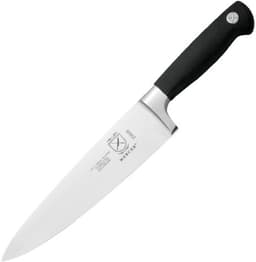
Forged, at a stamped-knife price
Mercer Culinary Genesis 8-inch Chef's Knife
A fully forged German-steel knife at a stamped-knife price. It is the culinary-school standby for a reason — you get bolster, full tang and a grippy Santoprene handle for around the cost of a decent stamped blade.
Read the full reviewPrice as of October 19, 2026. #ad How we’re funded
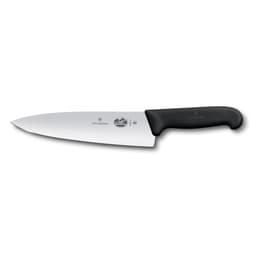
Stamped, and better than it has any right to be
Victorinox Fibrox Pro 8-inch Chef's Knife
The knife that wins nearly every budget test, and the one to buy if you buy only one. A soft, stamped X50CrMoV15 blade at ~55-56 HRC and a grippy, non-slip handle — it dulls sooner than a hard Japanese knife but takes an edge back in seconds.
Read the full reviewPrice as of October 19, 2026. #ad How we’re funded
Frequently asked questions
Are forged knives better than stamped knives?
Better at some things. Forging gets you a heavier blade, a full tang, a bolster and — as Wüsthof's own figures show — a slightly harder blade, 58 HRC against 55-57 for its laser-cut line. It does not get you a longer-lasting edge for a given hardness, and it does not get you a sharper knife. Plenty of excellent knives are stamped.
What is the difference between forged and stamped knives?
How the blank is made. A forged blade starts as a single piece of steel heated — Wüsthof says to over 2000°F — and shaped under compression, then finished over more than fifty manufacturing steps. A stamped blade is cut from a rolled sheet with a press or a precision laser, in roughly thirty-five steps. Everything else follows from that: weight, bolster, tang and price.
Does forging make the steel stronger?
Not in the way the marketing implies. The hardness and edge-holding of a finished blade come from the alloy and the heat treatment, not from being hit with a hammer. Forging does allow a maker to vary thickness along the blade and to integrate a bolster and full tang, which produce a more rigid, better-balanced knife — a structural advantage rather than a metallurgical one.
Is a stamped knife worth buying?
Often it is the smartest buy in the kitchen. The Victorinox Fibrox is stamped and repeatedly outperforms far more expensive knives in professional test kitchens, because a maker that skips forging can spend the budget on blade geometry instead. Stamped knives are lighter, more nimble and much cheaper; what they lack is heft and a bolster.
How can I tell if a knife is forged or stamped?
Look at the junction between blade and handle. A forged knife almost always has a bolster — a thick collar of steel — and a visible full tang sandwiched between the handle scales. A stamped knife runs straight from blade to handle with no collar, and is noticeably lighter for its size. If a listing does not say, it is very likely stamped.
Are Japanese knives forged or stamped?
Both, and the distinction matters much less there. Many Japanese knives are laminated — a hard core welded between softer layers — which is a different construction from either. Some are stamped from clad sheet and are excellent; the MAC Chef Series is a single-steel taper-ground blade with no bolster at all. In Japanese knives, the steel and the grind are the story, not the forging.
Sources
- The Difference Between WÜSTHOF Forged and Stamped Kitchen Knives — WÜSTHOF — Wüsthof's own account of both processes: forged blades start as a single piece of steel heated to over 2000°F and take 'over fifty-four manufacturing steps', hardened to '58 Rockwell'; non-forged blades are 'cut from a high-quality steel sheet using a precision laser' in 'thirty-five manufacturing steps' and run 'between 55 and 57 Rockwell' (accessed August 18, 2026)
- Rockwell hardness test — Wikipedia — Definition of the Rockwell C (HRC) scale used to state knife-steel hardness (accessed July 21, 2026)
- Knife sharpening — Wikipedia — Reference on edge angle, coarse-to-fine grit progression, and honing vs sharpening (accessed July 21, 2026)
Per-knife specs (steel, HRC, blade length, geometry) are read from each maker’s spec sheet or product listing and dated on the individual review cards above. “Not published” means the manufacturer does not state that figure — we flag it rather than guess.
Keep reading
Best Forged Chef Knives & Sets
The forged knives and sets in our registry, ranked on what forging actually buys.
See the forged picksVictorinox vs Mercer
A stamped knife and a forged one at the same price, head to head.
Compare themKnife Anatomy
Bolster, tang, heel and choil — what each part changes.
Learn the vocabularyKnife Hardness Chart (HRC)
Where forged and stamped lines actually land on hardness.
Read the chartBest Chef Knives
Forged and stamped picks side by side, with live prices.
See the roundupMercer Genesis 6-Piece Set Review
A whole block of forged blades, at the price stamped blocks ask.
Read the review