Kiritsuke Knife Guide
Two completely different knives are sold under this name. One is a single-bevel specialist with a reputation for being difficult; the other is a gyuto with an angled tip. Telling them apart is the whole guide.
How this is funded: we earn a commission if you buy through our links, at no extra cost to you. As an Amazon Associate we earn from qualifying purchases. It never changes which knife we recommend, and we’ll tell you when we’d skip one. Full disclosure.
No shape in a Japanese knife catalog causes more confusion than this one, because the word is doing two jobs at once. A traditional kiritsuke and a Western “kiritsuke” are not variants of each other. They are different knives that happen to share a profile in a photograph, and buying one while expecting the other is a genuinely expensive mistake.
The traditional kiritsuke
The original is a long single-bevel knife — usually 240 mm or more — with a dead-straight edge and a spine that drops on a steep angle to a sharp forward corner. It was conceived as a hybrid: enough of the usuba to handle vegetable work, enough of the yanagiba to slice fish, so one knife could do both in a kitchen where those were separate specialists.
Being single-beveled, it is ground almost entirely on one face, with a flat back carrying a shallow hollow (the urasuki) behind a narrow flat rim. That makes it handed, makes it steer through a cut, and makes it demanding to sharpen — the flat back has to stay genuinely flat, and widening that rim shortens the working life of the knife. It is also long, flat and unforgiving of a rocking motion.
Its reputation as a “head chef’s knife” is real and worth understanding for what it is: a piece of kitchen hierarchy, not a claim about performance. Using one competently took enough practice that carrying one said something about your position. Nothing about that transfers to a home kitchen.
The Western kiritsuke, which is what you will actually be sold
Almost every knife sold as a kiritsuke outside Japan is a double-bevel knife — a gyuto or a santoku — fitted with the angled k-tip. Shun’s Classic 8-inch kiritsuke is a clear example: the same VG-MAX core at ~60-61 HRC and the same 16° per side edge as the Classic chef’s knife, in a flatter profile with an angled front.
This is not a fake. It is a sensible adaptation, and it removes every genuine difficulty of the original: it is symmetrical so anyone can use it, it sharpens on an ordinary 1000/6000 stone, and it behaves like the familiar knife it is based on. What it keeps is the look and the flat push-cutting profile. What it does not keep is any of the single-bevel behavior that made the original a specialist tool.
The one thing worth knowing before you buy: how do you tell?Look for the word “single bevel” or a handedness option in the listing, and look at the back of the blade in the photographs. A single bevel has a visibly flat, hollowed back and a wide shinogi line running along the front face. A double bevel looks symmetrical from both sides. If a listing does not say, it is almost certainly double-beveled — single-bevel knives are always advertised as such, because their makers know it matters.
Kiritsuke against bunka
These two get confused constantly, and the difference is simply length and proportion. A bunka is a short, tall knife at 165-180 mm — a santoku with a k-tip. A kiritsuke is long, at 210-240 mm or more — a gyuto with a k-tip. Same tip, same flat bias, different jobs: the bunka is nimble and the kiritsuke has reach.
If you are choosing between them as a second knife and you already own a 210 mm chef’s knife, the bunka is the more useful buy because it adds something your kit does not have. The kiritsuke overlaps almost entirely with the knife you already own.
The tip, again
The angled corner is the most chip-prone tip shape in a kitchen drawer, for the same reason on a kiritsuke as on a bunka: it is a thin wedge of hard steel with nothing behind it, on a knife typically running 60 HRC or above. Hard steel does not bend out of the way. Use the tip to cut and never to lever, and keep the knife off bones and frozen food entirely.
Should you buy a kiritsuke?
Buy the double-bevel versionif you have used flat Japanese profiles, know you push-cut rather than rock, and want a long knife with a precise point — it is a good knife and there is nothing wrong with liking how it looks. Go in knowing that you are buying a gyuto variant at a small premium, not a fundamentally different tool.
Buy the single-bevel versiononly if you specifically want to learn single-bevel technique and you have a reason to — traditional Japanese preparation, a sharpening hobby, professional interest. It is a commitment, not a purchase.
And if what you actually want is one very good Japanese knife that does everything, the answer remains a plain 210 mm gyuto. Our best Japanese chef knives roundup is where that decision lives, and gyuto vs chef knife covers the step before it.
If the comparison you are actually making is against the knife you already own, kiritsuke vs chef knifesets the two side by side — the curve taken out, the tip sheared off at an angle, and what each change costs you at the board.
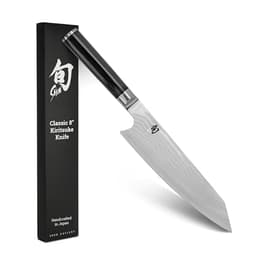
The double-bevel version, from a maker that publishes specs
Shun Classic 8-inch Kiritsuke
The kiritsuke most people actually buy: a double-bevel, Western-friendly take on a traditionally single-bevel shape, on the Classic line's VG-MAX core at ~60-61 HRC. Not what a Japanese kitchen means by kiritsuke, and none the worse for it.
Read our Shun Classic reviewPrice as of October 19, 2026. #ad How we’re funded
Frequently asked questions
What is a kiritsuke knife?
Traditionally, a long single-bevel Japanese knife with a straight edge and an angled 'k-tip', used in professional Japanese kitchens as a hybrid of the usuba and the yanagiba. In Western retail the word is now mostly attached to a double-bevel gyuto or santoku fitted with the same angled tip — a much easier knife that shares only the silhouette.
Is a kiritsuke hard to use?
The traditional single-bevel one, yes. It is handed, it steers because of the asymmetric grind, the flat edge punishes rock-chopping, and it demands a specific sharpening technique. The Western double-bevel version is not hard at all — it handles like the gyuto or santoku it is based on, with a tip you have to be more careful with.
What is the difference between a kiritsuke and a gyuto?
On a double-bevel Western kiritsuke, the tip and a flatter profile. A gyuto has a curved belly and a tapered point; a kiritsuke-tip version runs flatter and ends in a sharp angled corner. The traditional kiritsuke is a different proposition entirely — single bevel, longer, and not a general-purpose knife in the way a gyuto is.
Should a beginner buy a kiritsuke?
Not the single-bevel version, no. A double-bevel k-tip knife is a reasonable buy for someone who already likes flat blades and push-cutting, but it is still a worse first knife than a plain gyuto: the tip is fragile, the flat profile fights a rocking motion, and you pay a premium for the shape. Learn on a gyuto and buy this later if you want it.
Why is a kiritsuke considered a chef's knife?
Because in traditional Japanese kitchen hierarchy it was the head chef's knife — a knife that required enough skill that using one signaled seniority. That is a cultural convention rather than a property of the steel, and it does not transfer: buying a kiritsuke does not make anyone a better cook, and plenty of excellent Japanese chefs never use one.
How do you sharpen a kiritsuke?
Depends which one you bought. A double-bevel kiritsuke sharpens exactly like any other Japanese knife: about 15-16° per side on a 1000/6000 stone. A single-bevel kiritsuke needs the single-bevel method — the vast majority of the work on the beveled face, only enough on the flat back to remove the burr, and great care not to widen the narrow flat rim.
Sources
- Japanese kitchen knife — Wikipedia — Reference on gyuto/santoku/nakiri, single- vs double-bevel (kataba/ryoba) and edge angles (accessed July 21, 2026)
- How to Sharpen Single Bevel Knives with Whetstones — Knifewear — Specialist walkthrough naming the parts — kireha ('the flat part from the Shinogi line to the edge'), uraoshi ('the small flat parts on the back (<2mm)'), urasuki ('the concave part on the back') and koba ('micro bevel') — with the warning that 'if you sharpen the Uraoshi too much, you shorten the life of the knife by removing too much of the steel that forms the edge' (accessed August 18, 2026)
- Rockwell hardness test — Wikipedia — Definition of the Rockwell C (HRC) scale used to state knife-steel hardness (accessed July 21, 2026)
Per-knife specs (steel, HRC, blade length, geometry) are read from each maker’s spec sheet or product listing and dated on the individual review cards above. “Not published” means the manufacturer does not state that figure — we flag it rather than guess.
Keep reading
Shun Classic Kiritsuke Review
The DM0771 in full: 213 g published, the tallest blade in the line, and the tip that chips.
Read the reviewBunka Knife Guide
The shorter knife with the same angled tip.
Read the bunka guideGyuto Knife Guide
The knife most kiritsuke buyers actually wanted.
Read the gyuto guideHow to Sharpen a Single-Bevel Knife
What a traditional kiritsuke commits you to.
See the techniqueLeft-Handed Japanese Knives
Why a single-bevel kiritsuke is handed and a double-bevel one is not.
Read the guideKiritsuke vs Chef Knife
The head-to-head: flat edge and k-tip against curve and point.
Compare them