Gyuto vs Chef Knife
A gyuto is the Japanese chef's knife — same job, harder steel and finer geometry. Here's why it cuts keener, and when a Western blade is still the better call.
How this is funded: we earn a commission if you buy through our links, at no extra cost to you. As an Amazon Associate we earn from qualifying purchases. It never changes which knife we recommend, and we’ll tell you when we’d skip one. Full disclosure.
Short answer: a gyuto isa chef’s knife — the Japanese one. It does the same all-purpose job, but it’s usually made from harder steel, ground to a finer edge, and shaped with a flatter profile. That makes it cut keener and hold its edge longer, while a Western chef’s knife is tougher, more forgiving, and quicker to bring back to sharp. Pick the gyuto for finesse and edge retention; pick the Western knife for durability and ease of upkeep.
| Gyuto | Western chef's knife | |
|---|---|---|
| Typical steel hardness | 58-62 HRC (harder) | 55-58 HRC (softer) |
| Edge angle | ~15° per side or less | ~18-20° per side |
| Blade profile | Flatter, less belly | More curved belly |
| Edge retention | Longer | Shorter |
| Toughness | More brittle (can chip) | Tougher, forgiving |
| Upkeep | Whetstone | Honing rod + occasional stone |
Why the gyuto cuts keener
The keenness comes from two linked things: hardness and geometry. Steel hardness is measured on the Rockwell C scale (HRC). A typical Japanese gyuto steel like VG10 sits around 60 HRC; a German chef’s knife around 56–58. Harder steel can be ground to a thinner, more acute edge and hold that edge without rolling over, which is exactly what a fine cutting edge needs. So a gyuto is often ground near 15° per side (or less), while a softer Western blade is usually nearer 20° — a wider, more durable wedge. A more acute, harder edge meets less resistance going through food, which your hand reads as “sharper.” Our steel and hardness guide explains the trade-off in full.
What you give up
Hardness has a cost: brittleness. The same properties that let a gyuto take a razor edge make it more likely to chip if you twist it in a cut, drop it, or use it on bones or frozen food. A softer Western knife bends and recovers where a hard one cracks. Hard Japanese steel also wants a whetstone— a honing rod, which realigns a soft edge, does little for a hard one and can even micro-chip it. So a gyuto rewards a cook who’ll maintain it properly and punishes one who won’t.
Which should you buy?
If you keep your knives sharp, cut mostly vegetables, fish and boneless meat, and want the keenest daily edge, the gyuto is the upgrade — and an entry model gives you most of the benefit without the boutique price. If you’re hard on knives, cut through bones, or simply won’t learn a stone, a forgiving Western chef’s knife will serve you better and frustrate you less. Many cooks end up with both.
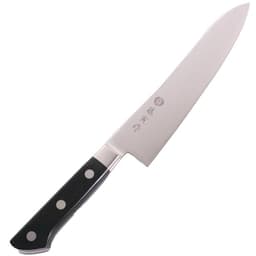
Our gyuto pick
Tojiro DP Gyuto 210 mm
The knife the internet has recommended to first-time gyuto buyers for a decade, and the numbers explain why: a real VG10 core at ~60 HRC for a fraction of the boutique price. Buy this before you spend three times as much.
Read the full comparisonPrice as of October 20, 2026. #ad How we’re funded
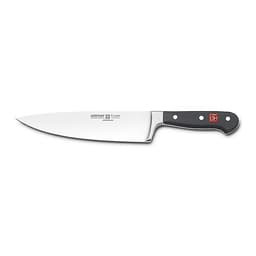
Our Western chef's knife pick
Wüsthof Classic 8-inch Chef's Knife
The benchmark forged German chef's knife: a full-tang X50CrMoV15 blade at ~58 HRC with a bolster and heft that many cooks prefer for rock-chopping. Heavier and softer than a gyuto, and built to last decades.
Read the full comparisonPrice as of October 20, 2026. #ad How we’re funded
Frequently asked questions
What is the difference between a gyuto and a chef's knife?
A gyuto is the Japanese version of a Western chef's knife. It does the same job but is typically made from harder steel (often 60+ HRC vs 55-58 for a Western knife), ground to a more acute edge, and has a flatter profile with less curved belly. The result is a keener edge that lasts longer between sharpenings, at the cost of being thinner and more brittle.
Is a gyuto better than a chef's knife?
It's keener and holds an edge longer if you keep it maintained, but 'better' depends on use. A gyuto's hard, thin edge chips if you hit bones or twist it, and it needs a whetstone rather than a honing rod. A softer Western chef's knife is tougher, more forgiving and faster to re-sharpen. Choose the gyuto for finesse, the Western knife for durability.
Why does a gyuto feel sharper than a Western knife?
Two reasons: harder steel and finer geometry. A gyuto's steel (say VG10 at ~60 HRC) can take and hold a more acute edge — often around 15 degrees per side or less — where a softer Western blade is usually ground nearer 20 degrees. A more acute, harder edge slices with less resistance, which reads as 'sharper' in the hand.
Can a beginner use a gyuto?
Yes, but it's less forgiving than a soft Western knife. The thin, hard edge chips if misused and demands stone sharpening. If you're careful and willing to learn a whetstone, an entry gyuto like the Tojiro DP is a fine first Japanese knife. If you're rough on knives, start with a Victorinox and move up later.
Sources
- Japanese kitchen knife — Wikipedia — Reference on gyuto/santoku/nakiri, single- vs double-bevel (kataba/ryoba) and edge angles (accessed July 21, 2026)
- Rockwell hardness test — Wikipedia — Definition of the Rockwell C (HRC) scale used to state knife-steel hardness (accessed July 21, 2026)
- Knife sharpening — Wikipedia — Reference on edge angle, coarse-to-fine grit progression, and honing vs sharpening (accessed July 21, 2026)
Per-knife specs (steel, HRC, blade length, geometry) are read from each maker’s spec sheet or product listing and dated on the individual review cards above. “Not published” means the manufacturer does not state that figure — we flag it rather than guess.
Keep reading
Gyuto Knife Guide
Everything about the gyuto — steel families, sizes, care.
Read the guideBest Japanese Chef Knives
Our ranked gyuto picks, with live prices.
See the gyutosKnife Steel & Hardness Guide
Why hardness makes an edge keener but more brittle.
Understand the steelChef Knife vs Santoku
The other shape decision worth settling.
Compare themJapanese vs German Knives
The same argument at the level of whole traditions.
Compare the twoTojiro DP Gyuto Review
A full look at the gyuto picked above.
Read the reviewCarbon vs Stainless Knives
The steel decision underneath the shape decision.
Compare themKnife Anatomy
Belly, heel and grind - the words this page uses.
Read the guideKiritsuke vs Chef Knife
The same comparison one step further into Japanese profiles.
Compare them