Kiritsuke vs Chef Knife
Same length, same job, different geometry: a flat edge, a tall face and a tip sheared off at an angle. The question is whether that profile suits how you already cut.
How this is funded: we earn a commission if you buy through our links, at no extra cost to you. As an Amazon Associate we earn from qualifying purchases. It never changes which knife we recommend, and we’ll tell you when we’d skip one. Full disclosure.
Buy the Western chef’s knife if you rock-chop or need a knife that tolerates abuse. Buy a double-bevel kiritsuke if you push-cut, hand wash and sharpen, and want the flat edge and the angular tip. If you want hard Japanese steel without the specialised profile, buy a gyuto — which is what most people asking this question actually want.
The two knives are the same length and do the same job. A Shun Classic kiritsuke and a Wüsthof Classic chef’s knife are both 8 inches / 203 mm, both double bevel as sold in the US, and both intended as the one knife you reach for first. Everything that differs is geometry and steel, and both are published.
The profile: curve versus flat
A Western chef’s knife has a continuous curve from heel to tip. That curve exists so you can rock — keep the tip on the board and pivot the handle down through a pile of parsley. The cost is that only a small part of the edge touches the board at any moment, which is why finishing a long slice sometimes leaves the last millimetre of an onion attached.
A kiritsuke is much flatter. The edge meets the board along most of its length at once, so a push cut — forward and down, no rocking — severs cleanly in one motion. It is also taller at the heel, which keeps your knuckles clear and gives you a face to scoop with. If you watch yourself prep and you mostly push the knife forward, the flat profile is a straight upgrade. If you rock, it will feel wrong from the first cut and no amount of steel quality will fix that.
The tip: a corner, not a point
The kiritsuke tip is a reverse tanto or k-tip: the spine drops at an angle to meet the edge, so the knife ends in a corner rather than a taper. Two real consequences.
The useful one is control. A corner held at a steep angle gives you a very precise point of contact for scoring, for separating fish from skin, for fine work where a long taper flexes. It is a genuinely better tip for that than a Western point.
The costly one is fragility. There is less steel behind a corner than behind a taper, and these knives are hard: Shun’s own FAQ states that it “hardens VG10 and VG-Max steel to 60-61 Rockwell,” against Wüsthof’s own figure of “58 Rockwell” for its forged German blades. Hard steel chips where soft steel bends. The k-tip is, by some distance, the most chip-prone tip shape in a normal kitchen drawer, and the repair — covered in our chipped knife guide — costs you blade height.
The thing that actually decides it: single bevel or double
In Japan, a kiritsuke is traditionally a single-bevel knife, and it was theshokunin’s hybrid — one blade meant to cover both the usuba’s vegetable work and the yanagiba’s slicing. Single bevel means the knife is ground on one face only, with a concave hollow on the back. It is handed (a right-handed knife is genuinely awkward in a left hand), and it has its own vocabulary and its own sharpening routine: the kireha, the urasuki hollow, and the uraoshi— the narrow flat on the back, less than 2 mm wide, which specialists warn you to treat carefully, because “if you sharpen the uraoshi too much, you shorten the life of the knife by removing too much of the steel that forms the edge.”
Almost every kiritsuke sold into a Western kitchen is not that knife. It is a double-bevel blade with the kiritsuke silhouette — sometimes honestly described as a k-tip gyuto. The Shun Classic kiritsuke is this: symmetric, ground at Shun’s published 16 degrees each side, sharpenable on any ordinary 1000/6000 stone. That is not a criticism. It is the version most people should buy, and buying it knowingly is the whole point of this page. If you want the traditional knife, read how to sharpen a single bevel knife before you spend the money, not after.
| Shun Classic Kiritsuke 8 in. | Wusthof Classic 8 in. | Tojiro DP Gyuto 210 mm | |
|---|---|---|---|
| Profile | Flat edge, tall blade, k-tip | Curved belly, pointed tip | Gentle curve, pointed tip |
| Blade length | 203 mm | 203 mm | 210 mm |
| Steel | VG-MAX core, 34-layer Damascus cladding each side | X50CrMoV15, forged | VG10 core, 13-chrome stainless clad |
| Published hardness | 60–61 HRC (Shun's FAQ, not the product page) | 58 HRC (maker's figure for forged) | Not published by Tojiro; ~60 HRC per retailer |
| Edge angle | 16° per side | Not published per model | ~15° per side |
| Bevel | Double (traditional kiritsuke is single) | Double | Double |
| Best motion | Push cut | Rock chop | Either |
| Tip durability | Lowest — angular corner on hard steel | Highest | Moderate |
| Handle | Pakkawood D-shape | POM, triple-riveted | Composite, Western |
A note on the D-shaped handle
The Shun Classic line uses a D-shaped Pakkawood handle, which is subtly asymmetric and sits most comfortably in a right hand. On a knife you hold for an hour that is a real consideration, and it is separate from the bevel question — a double-bevel blade can still have a handed handle. Our left-handed guide covers which lines offer a symmetric option.
So which should you buy?
The Western chef’s knife if you rock, if anything you cut has bone in it, or if the knife will be used by other people in your house. Softer steel rolls instead of chipping and a tapered point survives contact with a sink.
The gyuto if you want hard Japanese steel and a knife that does not ask you to change your technique. It is the answer for the large majority of people who find themselves on this page, and our gyuto vs chef knife comparison is the page for it.
The kiritsuke if you push-cut, you want the tall flat profile and the precise tip, and you are clear-eyed about the k-tip. Buy the double-bevel version unless you specifically want to learn single-bevel sharpening. And if the tall flat profile is what appeals but 203 mm is more knife than you need, look at a bunka — the same angled tip in a shorter blade.
How we compared these
Every figure above is published by the maker, except the two hardness numbers that are not: Shun does not print a Rockwell figure on its product pages (the 60-61 HRC comes from Shun’s own FAQ for the VG-MAX line), and Tojiro publishes none at all (the ~60 HRC is a specialist retailer’s figure). The table says which is which. We own none of these knives and claim no test results; our methodology page sets out what we do instead. Prices come only from our live price layer, with the date each was read.
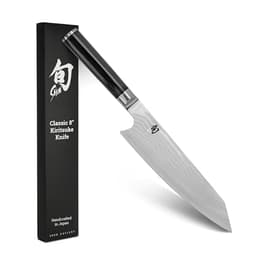
The kiritsuke most people should buy
Shun Classic 8-inch Kiritsuke
The kiritsuke most people actually buy: a double-bevel, Western-friendly take on a traditionally single-bevel shape, on the Classic line's VG-MAX core at ~60-61 HRC. Not what a Japanese kitchen means by kiritsuke, and none the worse for it.
Read the kiritsuke explainerPrice as of October 15, 2026. #ad How we’re funded
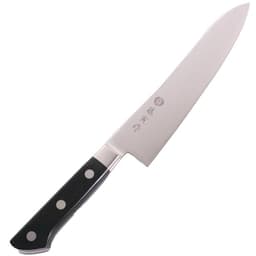
The knife we would buy instead, for most kitchens
Tojiro DP Gyuto 210 mm
The knife the internet has recommended to first-time gyuto buyers for a decade, and the numbers explain why: a real VG10 core at ~60 HRC for a fraction of the boutique price. Buy this before you spend three times as much.
Read the full Tojiro DP reviewPrice as of October 15, 2026. #ad How we’re funded
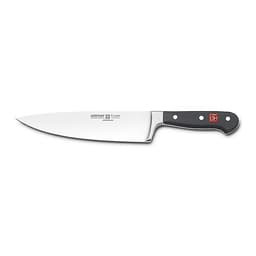
If you rock-chop and want to keep doing that
Wüsthof Classic 8-inch Chef's Knife
The benchmark forged German chef's knife: a full-tang X50CrMoV15 blade at ~58 HRC with a bolster and heft that many cooks prefer for rock-chopping. Heavier and softer than a gyuto, and built to last decades.
Read the full Wusthof Classic reviewPrice as of October 15, 2026. #ad How we’re funded
Frequently asked questions
What is the difference between a kiritsuke and a chef's knife?
Profile and tip. A Western chef's knife has a curved belly and a pointed tip, built for rocking. A kiritsuke has a flatter edge, a taller blade and a reverse-tanto tip — sheared off at an angle rather than tapering to a point — built for push cutting and for precise tip work held at a steeper angle. In Japan a kiritsuke is also traditionally single bevel, which changes everything about sharpening it.
Is a kiritsuke better than a gyuto?
No — it is more specialised. A gyuto is a Japanese chef's knife with a gentle curve, so it does everything a Western chef's knife does on harder, thinner steel. A kiritsuke trades some of that rocking ability for a flatter edge and a more precise tip. If you are choosing your first Japanese knife, buy the gyuto.
Are kiritsuke knives single bevel or double bevel?
Both exist, and the distinction matters more than the shape. The traditional Japanese kiritsuke is single bevel — flat on one side with a concave back — which makes it handed and demands specific sharpening technique. Almost every kiritsuke sold into Western kitchens, including the Shun Classic, is double bevel: the same silhouette on ordinary, symmetric geometry you can sharpen on any stone.
Is a kiritsuke good for beginners?
A double-bevel one is fine; a single-bevel one is not. The reservations with the double-bevel version are the angular k-tip, which is the most chip-prone tip shape in a kitchen drawer, and the flat profile, which punishes a rocking motion you may not realize you use. A single bevel adds handedness and a sharpening routine that can shorten the knife's life if you get it wrong.
What is a kiritsuke used for?
The same work as a chef's knife, with a bias towards push cuts and precise tip work: slicing, portioning fish and protein, fine vegetable work where you want the tip at a steep angle. Traditionally it was a hybrid for a chef who wanted one knife to cover both the usuba's vegetable work and the yanagiba's slicing — which is exactly why it compromises on both.
Will a kiritsuke chip more easily than a chef's knife?
Yes, for two compounding reasons. The tip is an angular corner rather than a taper, so there is less steel supporting it, and the knives are usually hard — Shun hardens VG-MAX to 60-61 Rockwell against Wusthof's 58 for forged German blades. Keep it off bone, off frozen food and out of a sink full of metal and it is fine.
Can I sharpen a kiritsuke on a normal whetstone?
A double-bevel one, yes — exactly like any other Japanese knife, at the maker's angle on a 1000/6000 stone. A single-bevel one needs its own method: the flat back (uraoshi) is barely touched, and specialists warn that 'if you sharpen the uraoshi too much, you shorten the life of the knife by removing too much of the steel that forms the edge'.
Should I buy a kiritsuke or a Western chef's knife?
Buy the Western chef's knife if you rock-chop, cut through anything with bone in it, or want a knife that tolerates being treated as a tool. Buy a double-bevel kiritsuke if you push-cut, you already hand wash and sharpen, and you want the flat edge and the tip. If you want hard Japanese steel but not the specialised profile, buy a gyuto instead.
Sources
- Shun Classic 8-inch Chef's Knife — Shun Cutlery (Kai USA) — Shun's published spec for the knife itself: a 'VG-MAX' core in '69 layer Damascus' — described as '34 layers of stainless Damascus cladding each side (68 total)' — a '16 degree edge each side', an '8 in. (203mm)' blade, '6.7 oz (190 g)', an ebony-color Pakkawood D-shaped handle, 'Handcrafted in Seki City, Japan' and a 'Limited Lifetime Warranty'. No Rockwell figure appears on the product page (accessed August 28, 2026)
- Shun Knives FAQ — Shun Cutlery (Kai USA) — Shun's own answers: 'Shun hardens VG10 and VG-Max steel to 60-61 Rockwell and SG2 to 61-62', 'Shun knives, for example, are sharpened to a 16 degree angle on each side of the blade', and on rods, 'Please do not use a diamond steel for regular honing. Diamond steels are for sharpening and will remove metal from your knife before it is necessary' (accessed August 28, 2026)
- How to Sharpen Single Bevel Knives with Whetstones — Knifewear — Specialist walkthrough naming the parts — kireha ('the flat part from the Shinogi line to the edge'), uraoshi ('the small flat parts on the back (<2mm)'), urasuki ('the concave part on the back') and koba ('micro bevel') — with the warning that 'if you sharpen the Uraoshi too much, you shorten the life of the knife by removing too much of the steel that forms the edge' (accessed August 18, 2026)
- The Difference Between WÜSTHOF Forged and Stamped Kitchen Knives — WÜSTHOF — Wüsthof's own account of both processes: forged blades start as a single piece of steel heated to over 2000°F and take 'over fifty-four manufacturing steps', hardened to '58 Rockwell'; non-forged blades are 'cut from a high-quality steel sheet using a precision laser' in 'thirty-five manufacturing steps' and run 'between 55 and 57 Rockwell' (accessed August 18, 2026)
- VG10 — TAKEFU SPECIAL STEEL CO., LTD. — The steel maker's own published composition for VG10: 'C: 1.00, Cr: 15.00, Mo: 1.00, V: 0.25, Co: 1.55' (percent), a hardness of 'HRC60≦' (60 HRC and above), and the maker's own explanation that '15% chromium (Cr), 1% molybdenum (Mo), and 1.5% cobalt (Co) which all strengthen the matrix, yielding high hardness, in addition to maintaining a long-lasting sharp edge'. Intended uses listed as kitchen knives, general-purpose knives and machine blades (accessed September 18, 2026)
- Japanese kitchen knife — Wikipedia — Reference on gyuto/santoku/nakiri, single- vs double-bevel (kataba/ryoba) and edge angles (accessed July 21, 2026)
- Rockwell hardness test — Wikipedia — Definition of the Rockwell C (HRC) scale used to state knife-steel hardness (accessed July 21, 2026)
Per-knife specs (steel, HRC, blade length, geometry) are read from each maker’s spec sheet or product listing and dated on the individual review cards above. “Not published” means the manufacturer does not state that figure — we flag it rather than guess.
Keep reading
Shun Classic Kiritsuke Review
The DM0771 in full: 213 g published, the tallest blade in the line, and the tip that chips.
Read the reviewWhat Is a Kiritsuke?
The shape, its history and the single-bevel original.
Read the explainerGyuto vs Chef Knife
The comparison most people actually want before this one.
Compare themBest Japanese Chef Knives
The gyuto field, compared on published steel and hardness.
See the picksHow to Sharpen a Single Bevel Knife
If you are considering the traditional version, read this first.
Learn the methodWhat Is a Bunka?
The shorter knife with the same angled tip.
Read the explainerJapanese Knife Types
Every shape on this site, and what each one is for.
See the shapes