How to Tell the Grit of a Sharpening Stone
You inherited a stone, or the label came off. Six tests, in the order they are worth running — and an honest warning about which answers you can trust.
How this is funded: we earn a commission if you buy through our links, at no extra cost to you. As an Amazon Associate we earn from qualifying purchases. It never changes which knife we recommend, and we’ll tell you when we’d skip one. Full disclosure.
You can place an unmarked stone in a grit band in about five minutes. You cannot establish its number, and nobody can do that at home. The band is what actually matters: coarse (under roughly 400) for repair, medium (800–1200) for real sharpening, finishing (3000–6000) for refining, and polishing (8000 and up). Knowing which of those four you are holding is enough to use the stone safely.
First, what the numbers mean at all. A grit designation describes the abrasive particle size — higher number, finer particles, finer scratch pattern. Japanese water stones run from a few hundred up past 8000. The numbering is not standardized across countries or abrasive families, which is why a 1000-grit Japanese water stone and a 1000-mesh diamond plate do not leave the same finish. For a reference point that is published, DMT gives its own grades as Coarse at 325 mesh / 45 micron, Fine at 600 / 25 micron and Extra-Fine at 1200 / 9 micron.
Test 1: the marker test (the most informative one)
Color the bevel of a knife you do not love with a permanent marker, wet the stone, and take three light passes.
- Ink gone in one or two passes, with visible metal swarf— coarse. Under about 400.
- Ink gone in three to six passes, grey slurry forming— medium. Somewhere in the 800–1200 band, which is the workhorse range.
- Ink fading slowly over a dozen passes, almost no swarf— finishing, 3000–6000.
- Ink barely marked after twenty passes, surface feels slick — polishing, 8000 and up.
This works because cutting rate is the practical definition of grit. It is the same marker trick used to check sharpening angle, described in our troubleshooting guide, applied to a different question.
Test 2: feel the surface, dry
Dry, with a clean fingertip, drag across the face rather than along it. A coarse stone feels like a sidewalk — you can feel individual particles catch. A medium stone feels like fine sandpaper: uniform tooth, no individual grains. A finishing stone feels smooth with a faint drag, like unglazed porcelain. A polishing stone feels like glass with a slight grip. This is crude and surprisingly reliable at separating the four bands.
Test 3: what it does with water
This identifies the family, which correlates loosely with grit. There are two kinds of water stone: soaking stones that must be submerged until saturated, and splash-and-go stones that need only surface water. One maker’s own range splits exactly that way — its Traditional, Aotoishi, Lobster and Hibiki lines are “soaked for several minutes” while its Chocera Pro, S1/S2 Advance and diamond stones are splash-and-go.
- Drinks water audibly, bubbles, darkens— a porous traditional soaker. These cluster coarse-to-medium, and the classic learner’s stones are in this group.
- Water beads or sits on the surface— a dense, hard formulation, typically a harder modern synthetic, and more often fine than coarse.
- Water will not wet it at all and it smells faintly of oil— it is an oil stone, not a water stone. Do not soak it, and do not expect water stone behaviour; it wants honing oil.
Our soaking guide covers why soaking the wrong stone is a genuine way to crack it.
Test 4: read the scratch pattern on the bevel
After the marker test, tilt the bevel to a light. Coarse stones leave scratches you can see with the naked eye and a bevel that looks matte grey. Medium stones leave a uniform satin finish. Finishing stones leave a bevel in which you can start to see a reflection. A polishing stone leaves something close to a mirror. Compare two unknown stones against each other this way and you can rank them confidently even when you cannot number either.
Test 5: slurry color and amount
Work the stone wet for thirty seconds. A coarse stone throws a thick dark slurry quickly — that is steel plus released abrasive. A medium stone builds a thinner grey slurry. Fine stones produce very little, and what there is looks pale. A stone that produces no slurry and no feedback at all is either very fine or glazed over, which brings us to the last check.
Test 6: is it flat, and is it glazed?
Before trusting any of the above, establish that the stone is usable. Stones dish in the middle with use, and a hollow stone grinds a convex bevel whatever its grit. Draw a pencil grid across the face and take a few passes on a flattening plate: if the grid survives in the middle, the stone is dished. Our flattening walkthrough is the fix, and it also removes glazing — a polished, metal-loaded surface that makes a medium stone behave like a fine one and will throw every test above.
What none of this will tell you
A number. Treat any specific figure you arrive at as a guess. Band yes; number no.
Whether it is natural or synthetic, in many cases — and with natural stones the grit varies within one stone.
Whether it is safe for your best knife. This is the part worth being conservative about. If a mystery stone turns out to be coarser than you assumed, you will take significantly more steel off a thin 60 HRC Japanese edge than you meant to. Test on a cheap knife, and if the stone is dished, cracked or oil-soaked, the honest answer is that a new marked stone costs less than the knife you are risking. The three below all print their grit on the stone, which is the whole point.
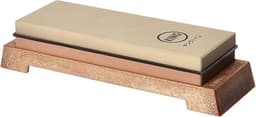
The marked combination stone to replace a mystery one
King (Matsunaga) KW-65 1000/6000 Combination Whetstone
The stone that has taught more people to sharpen than any other. One side 1000-grit to set an edge, one side 6000-grit to polish it, made in Japan, for the price of a takeout dinner. Start here.
Read the full King KW-65 reviewPrice as of October 6, 2026. #ad How we’re funded
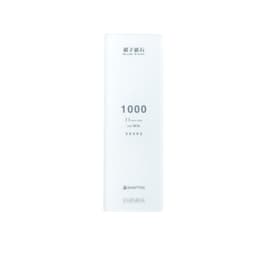
If you want a hard, fast, splash-and-go stone
Shapton GlassStone 1000
The upgrade once you know you're sticking with sharpening: a thin, hard ceramic layer bonded to glass. It's splash-and-go (no soaking), stays dead flat far longer than a soft stone, and cuts fast. You'll pay for it.
Read the full Shapton reviewPrice as of October 6, 2026. #ad How we’re funded
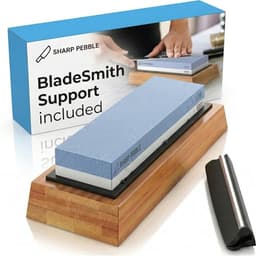
The beginner kit, grit printed on both faces
Sharp Pebble Premium 1000/6000 Whetstone Kit
The Amazon best-seller, and a sensible one: the same 1000/6000 combination as the King, plus a non-slip bamboo base and a plastic angle guide to keep beginners honest. The kit is why it's the default gift.
Read the full Sharp Pebble reviewPrice as of October 6, 2026. #ad How we’re funded
Frequently asked questions
How can I tell what grit my sharpening stone is?
Run four checks in order: how fast it cuts a marker line off a bevel, how the surface feels under a fingertip, how it behaves with water, and what the scratch pattern on the bevel looks like. Together they will place a stone in a band — coarse (under 400), medium (800-1200), finishing (3000-6000) or polishing (8000+). They will not give you a number, and no test at home will.
Does the color of a whetstone tell you the grit?
Only within one brand's own range, and even then only as a hint. Color coding is real but proprietary: DMT publishes its own color codes with a mesh and micron figure for each grade — Coarse at 325 mesh / 45 micron, Fine at 600 / 25, Extra-Fine at 1200 / 9. Across brands it means nothing; plenty of makers use the same orange or the same cream at completely different grits.
What do the numbers on a whetstone mean?
They are a grit designation: roughly, the number of abrasive particles per unit area, so higher means finer. Japanese water-stone numbering runs from a few hundred for repair work to 8000 and beyond for polishing. The numbers are not standardized across countries or abrasive types, which is why a 1000-grit Japanese water stone and a 1000-mesh diamond plate do not leave the same finish.
Can I use a stone if I don't know its grit?
Yes, as long as you place it in a band first. The risk of guessing wrong is asymmetric: using a coarse stone when you think it is fine removes far more steel than you intended and can round a thin Japanese edge. Using a fine stone when you think it is coarse just wastes time. When unsure, assume coarser than you hope and test on a cheap knife.
How does soaking tell you about a stone?
It tells you the family, not the grit. There are two kinds of water stone: soaking stones that must be submerged until saturated, and splash-and-go stones that need only surface water. A stone that drinks water greedily with a stream of bubbles is usually a traditional soaker, and traditional soakers cluster in the coarse-to-medium range; a dense stone that beads water tends to be a harder, finer, modern formulation.
Is it worth identifying an old stone at all?
Often, yes — old natural and vintage synthetic stones can be very good. But if a stone is dished, cracked, or oil-soaked and you cannot tell what it is, a new marked stone costs less than the knife you would risk on it. Stones dish in the middle with use, which changes the bevel you grind regardless of grit.
Sources
- Sharpening stone — Wikipedia — Reference on water, oil and diamond stones: Japanese water-stone grit ranges, why stones dish in the middle with use, and why a diamond plate retains its flatness (accessed August 13, 2026)
- Japanese Water Stones — Sharpening Supplies — The two families of water stone: soaking stones that must be submerged until saturated, and splash-and-go stones that need only surface water (accessed August 13, 2026)
- Comparing Naniwa Stones — Sharpening Supplies — Line-by-line record of which stones in one maker's range soak (Traditional, Aotoishi, Lobster, Hibiki — 'soaked for several minutes') and which are splash-and-go (Chocera Pro, S1/S2 Advance, diamond) (accessed August 13, 2026)
- DMT Diamond and Ceramic Color-Coded Grit Chart — Sharpening Supplies — DMT's own color codes with the mesh and micron figure for each grade (Coarse 325/45 µm, Fine 600/25 µm, Extra-Fine 1200/9 µm) (accessed August 11, 2026)
- Knife sharpening — Wikipedia — Reference on edge angle, coarse-to-fine grit progression, and honing vs sharpening (accessed July 21, 2026)
- How to Sharpen a Knife With a Whetstone — Montana Knife Company — Master-bladesmith walkthrough of whetstone angle, grit progression and deburring (accessed July 21, 2026)
Per-knife specs (steel, HRC, blade length, geometry) are read from each maker’s spec sheet or product listing and dated on the individual review cards above. “Not published” means the manufacturer does not state that figure — we flag it rather than guess.
Keep reading
Whetstone Grit Guide
Once you know the grit: which one to use for which job.
Read the guideSoaking a Whetstone
How long, and which stones should never be soaked at all.
Read the guideHow to Flatten a Whetstone
The pencil grid method — and why a dished stone ruins a bevel.
Learn the methodWhetstone Brands Explained
King, Shapton, Naniwa, DMT — who numbers what, and how.
Read the guideBest Whetstones for Kitchen Knives
The field, compared by grit — every one with its number printed on it.
See the picks1000 vs 6000 Grit
What each end of a combination stone actually does.
Compare them