What a beginner actually needs
Three things, in this order. An 8-inch chef’s knife, which does eighty per cent of everything. Something small— a paring or 5-inch utility knife — for the jobs where a big blade is clumsy. And a serrated bread knife, because nothing else cuts a crust without crushing the loaf.
Everything else is a later decision made with better information. A boning knife matters if you break down chickens; a santoku or nakiri matters if you cook a lot of vegetables; steak knives matter if you serve steak. Buying all of them on day one means buying them in the cheapest possible version, which is the opposite of what a beginner should do.
Two things no beginner set includes and every beginner needs: a decent wood or soft-poly cutting board (glass and stone boards destroy edges, and the board you own matters more than which of these sets you buy), and a honing rod. Those two purchases improve your cooking more than upgrading from a $60 block to a $200 one.
Why the Mercer Genesis block is the pick
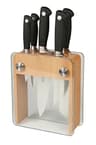
Because it is the rare block set where the padding is absent. The listing describes German stainless blades “with thick bolsters and full tangs” across the set — forged construction on every blade, not a forged chef’s knife carrying four stamped passengers. The five knives are exactly the five a working kitchen reaches for, and Mercer publishes both the hardness (56 ±1 HRC) and a 15° blade angle, which is more specification than most premium brands print.
Three honest notes. There is no honing rod and no shearsin the box, so budget for a rod. The set is hand-wash only, and the tempered-glass block face shows every fingerprint. And Mercer’s NSF certification on this set reads “NSF Knives Only” — the block itself is not covered, which is a minor point for a home kitchen but worth knowing if you read the badge as applying to the whole thing. Our full review of this set goes through the contents piece by piece.
The case for a two-knife set instead
If you would rather own two very good knives than five decent ones, this is the better route, and it is what we would buy for ourselves.
The Wüsthof Classic 2-piece— an 8-inch chef’s knife and a paring knife, both forged X50CrMoV15 at ~58 HRC with a half bolster, triple-riveted POM handles and Wüsthof’s warranty behind them. The half bolster matters for a beginner more than it sounds: it means the whole edge, heel included, reaches a flat stone, so the knife stays sharpenable for decades. The trade is that there is no block and no storage, so you need a magnetic strip, a drawer insert or blade guards.
The MAC Chef Series 2-piece (TH-201)is the same idea with a Japanese grind: MAC’s own page names both knives model by model — the TH-80 chef’s knife and the TH-50 paring knife — and they match the listing exactly, which is more transparency than this category usually offers. MAC blades are thinner than German ones and cut more cleanly. The documentation gap is the hardness: MAC publishes no Rockwell figure anywhere on its own site, describing the steel only as a high-carbon molybdenum alloy, and we mark that “Not published” rather than quoting a number MAC does not stand behind.
The budget pick, and why it is not a trap
The McCook MC29 is the best-selling budget block for an understandable reason: for roughly the price of one mid-range chef’s knife you get a complete kitchen — stamped German-stainless blades, a full slot count, and a sharpener built into the block. If the choice is between this and a drawer of mismatched supermarket knives, buy this.
Two caveats, both real. The steel is entry-level, so edge holding is modest and you will be honing often. And the built-in pull-through sharpener in the block is a carbide scraper: convenient, and it removes a lot of metal every time you drag a blade through it. Using it monthly will visibly shorten these knives over a few years. That is tolerable on a set at this price and would be vandalism on a forged knife — which is exactly why we rank it as the budget pick rather than the beginner default.
The set to grow into
The Tojiro Classic Damascus 2-piece is here for one specific beginner: the person who already knows they will learn to use a whetstone. Two knives, a VG-10 core under 37 layers of clad stainless at a retailer-published 60 HRC, and micarta handles built to be washed rather than babied. It holds an edge far longer than anything else on this page.
The condition is maintenance. A 60 HRC edge does not take a ribbed steel rod — the apex breaks instead of bending — so a stone is not optional, it is the maintenance plan. Also worth recording: Tojiro’s own English site currently serves a renewal notice in place of its product pages, so the specification for this set comes from the listing and the specialist trade rather than from the maker. If that sounds like more commitment than you want, buy the Wüsthof pair instead and be happy. Our sub-$50 whetstone picks cover the stone, and our first-Japanese-knife guide sets out the whole path.
What to avoid as a beginner
Any set whose piece count is more than double its blade count. That is the signal that you are buying steak knives, shears and wood rather than knives.
A set with no chef’s knife you would buy on its own.The chef’s knife is the set. If it would not survive being sold separately, the block is decoration.
Spending the whole budget on knives and nothing on a board. A glass, stone or hard ceramic board will chip and roll edges faster than any amount of cutting. End-grain wood is best and a simple poly board is completely fine.
How we picked
Every set here is in our registry with a verified live listing and a price read live from Amazon at the date stamped on its row. We ranked on blade count against piece count, on published construction and hardness where the maker prints them, and on whether a beginner would still want the knives in five years — not on an overall score, because we own none of these sets and have not tested them against each other. Where a maker publishes nothing, the spec table says “Not published”, which on this page is the most informative column there is.