Soaking a Whetstone
Some stones must be submerged until the bubbles stop. Others are quietly ruined by it. The packaging rarely says which one you bought — here is how to tell.
How this is funded: we earn a commission if you buy through our links, at no extra cost to you. As an Amazon Associate we earn from qualifying purchases. It never changes which knife we recommend, and we’ll tell you when we’d skip one. Full disclosure.
The short answer: soak a soaking stone until the bubbles stop — roughly five to fifteen minutes — and do not soak anything else. Almost every problem people have with this step comes from not knowing which of the two they own, because the two look broadly alike sitting on a shelf and the box frequently says nothing.
It matters more than it sounds. A soaking stone used dry glazes over and stops cutting within a couple of strokes; a splash-and-go stone left in a tub of water can be degraded by the treatment. Getting this one detail right is the difference between a stone that works properly for years and one that quietly disappoints you and gets blamed on your technique.
The two families of water stone
Water stones divide cleanly into two groups, and Sharpening Supplies puts the distinction plainly: soaking stones need to be submerged in water until saturated before use, whereas splash-and-go stones only need some water to be applied to their surface. The split is a property of how the abrasive is bound together, not of grit, price or country of origin.
Soaking stonesare porous. Their structure is full of tiny voids, and those voids need to be full of water before the stone will work — the water is what carries away the swarf and lets fresh abrasive come to the surface as the old layer breaks down. Most inexpensive combination learner stones are of this type, including the King KW-65, which our registry lists with a stated use style of a five-to-ten-minute soak, and the various 1000/6000 kit stones which typically want ten to fifteen.
Splash-and-go stonesuse a harder, denser binder that holds very little water. There is not much to saturate, so wetting the surface is all the preparation they need. The Shapton GlassStone is the clearest example: a thin ceramic abrasive layer bonded to a glass plate, ready a few seconds under a tap. Harder professional ceramics behave the same way — one maker’s range documents its professional and advance lines as needing only to be splashed a few times over the course of a minute, while its traditional lines must be soaked for several minutes. Same brand, same shelf, opposite instructions.
Which is “better” is mostly a question of ritual. Splash-and-go is more convenient and the hard binders hold flat longer; soft soaking stones cut fast, feel forgiving under the blade and cost a fraction as much, which is exactly why they remain the standard recommendation for a first stone in our whetstone roundup.
How to tell which one you have
| Soaking stone | Splash-and-go | |
|---|---|---|
| Feel and weight | Thick, chalky, relatively light | Dense and hard, or thin on a backing |
| Water on the surface | Vanishes into the stone in seconds | Beads or sits there |
| Bubbles when submerged | Streams of them for minutes | A few, then nothing |
| Typical construction | Porous magnesia or resin binder | Hard ceramic, or ceramic on glass |
| Common examples | 1000/6000 combination learner stones | Ceramic-on-glass and pro ceramics |
| Preparation | 5-15 min submerged | Splash the surface, go |
| Dishes with use | Quickly — plan to flatten often | Slowly |
| Store submerged? | Generally no | Never |
The bubble test settles it in under a minute and needs no documentation. Drop the stone in water: while it is streaming air, it is drinking, and it is a soaking stone. If a few bubbles come off the surface and then it just sits there, you have a splash-and-go stone and you can take it straight back out.
How long, and why the clock is the wrong instrument
Five to fifteen minutes covers most soaking stones, but the number varies with thickness, grit and binder, and the stone itself will tell you when it is done. Air is leaving the pores as water enters, so a steady stream of fine bubbles means the process is still running. When the stream stops, saturation is complete and further time in the water achieves nothing.
Coarse, thick, soft stones take the longest — they have the most void volume to fill. Fine finishing stones take the least, and many above about 3000 grit are made as splash-and-go precisely because a dense fine abrasive has little to gain from soaking.
If you use a combination stone with a coarse and a fine face bonded together, soak the whole block on the coarse side’s schedule. You cannot saturate half a stone, and the fine face is not harmed by the extra few minutes.
What over-soaking actually does
Leaving a stone in water indefinitely — “permasoaking” — is a habit some sharpeners adopt to skip the wait. A small number of coarse soaking stones are sold as suitable for it. For everything else it causes three distinct problems.
It softens the binder.The material holding the abrasive particles together is not always indifferent to permanent immersion, and a stone whose binder has gone soft wears far faster and can crumble at the edges. One maker’s splash-and-go range is explicitly documented as not to be permanently soaked.
It cracks stones that freeze. Water expands when it freezes, and a saturated stone left in a garage, a shed or an unheated outbuilding through a cold night can split along the grain. This is the most common way people destroy a stone outright.
It grows things. Standing water plus organic binder plus steel particles is a hospitable environment, and a permanently soaked stone in a closed tub develops a smell and a film soon enough. Change the water or, better, do not store it wet.
A fine stone is also at some risk from long soaks even before it freezes: dense finishing stones can crack when repeatedly waterlogged, which is one reason makers label them splash-and-go rather than leaving it to the user.
Water during the session, not just before it
Soaking is preparation, not the whole job. Once the stone is out of the tub it starts losing water immediately — to evaporation, to the blade, and to the slurry you are generating — so keep splashing it as you work. The signal is visual: a properly wet stone looks glossy and produces a thin, mobile gray slurry, while a stone that has dried out looks matt and the slurry goes pasty and stops moving.
That slurry matters. On a soft stone the abrasive breaks down as you sharpen, and the suspension of fresh abrasive and steel particles does a meaningful share of the cutting. Too little water and it packs the surface; too much and you rinse away the very thing doing the work. Enough to keep a thin film moving is right.
Do not sharpen with the stone still submerged in its tray, incidentally. You cannot see the slurry, you cannot feel the feedback, and the stone slides. Lift it out and set it on a base or a damp cloth. The full sequence around this step is in how to sharpen a knife on a whetstone.
Afterwards: rinsing, drying and the flattening that follows
Rinse the metal-laden slurry off under a tap, wipe the stone, and let it dry fully in open air before it goes into a drawer or a case. A stone shut away damp is the mold case above; a stone shut away wet somewhere cold is the freezing case.
Soaking stones also dish. Because they work by breaking down, they hollow out in the middle where you use them most — and a stone that has gone concave grinds a matching curve into your edge. Splash-and-go ceramics and diamond plates hold flat far longer; a diamond plate stays flat essentially indefinitely, because the only thing that wears is a thin coating of grit and adhesive. If you own a soft soaking stone, own a way to flatten it too: how to flatten a whetstone covers the pencil-grid check and the three ways to fix it.
Which stone to buy if you hate the wait
The soak is a real ergonomic cost. It is ten minutes of standing around before every session, and ten minutes is long enough that people skip sharpening altogether on a weeknight. If that describes you, buy the problem away.
A splash-and-go ceramic is ready in seconds, holds flat much longer and cuts hard steel faster — you pay several times the price of a soft combination stone for it. A diamond plate goes further still: nothing to soak, nothing to flatten, and it will outlast every other stone in the drawer, at the cost of a coarser feel and a finish that stops short of a polish. Both are covered in the diamond plate roundup and the whetstone roundup.
And if none of that appeals, the soak is genuinely not a burden once it is a habit. Put the stone in water when you start cooking; by the time the board is clear it is ready.
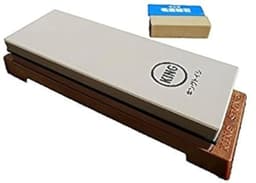
A classic soaking stone
King (Matsunaga) KW-65 1000/6000 Combination Whetstone
The stone that has taught more people to sharpen than any other. One side 1000-grit to set an edge, one side 6000-grit to polish it, made in Japan, for the price of a takeout dinner. Start here.
Read the full King KW-65 review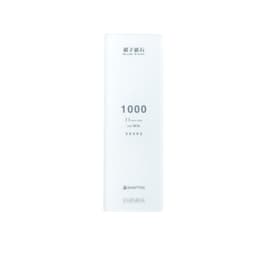
If you would rather never soak anything
Shapton GlassStone 1000
The upgrade once you know you're sticking with sharpening: a thin, hard ceramic layer bonded to glass. It's splash-and-go (no soaking), stays dead flat far longer than a soft stone, and cuts fast. You'll pay for it.
Read the full Shapton reviewPrice as of October 20, 2026. #ad How we’re funded
No water ritual at all
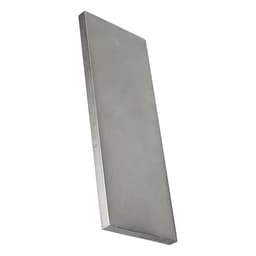
DMT D8F Dia-Sharp 8-inch Bench Stone, Fine
The single-grit, continuous-surface plate — no holes, so nothing catches a thin blade tip on the way across. Fine 600 is the grit a kitchen knife actually lives at, and this is the version to buy if you want one plate that does the job properly rather than two that do it adequately.
See the full diamond-plate fieldPrice as of October 20, 2026. #ad How we’re funded
Frequently asked questions
How long should I soak a whetstone?
Until it stops releasing air bubbles, which for a typical soft 1000/6000 combination stone is about five to fifteen minutes. The bubbles are the real indicator: they are air leaving the stone's pores as water takes its place, so when they stop, the stone is saturated. A thinner or harder stone saturates faster; a thick, soft, coarse stone takes longer.
Do I need to soak a whetstone before use?
Only if it is a soaking stone. Water stones divide into two families — soaking stones, which must be submerged until saturated, and splash-and-go stones, which need only water applied to the surface. Soaking a splash-and-go stone is at best pointless and at worst damaging, so check what you own before you fill a tub.
Can you leave a whetstone in water permanently?
Not as a general rule. A few coarse soaking stones tolerate being stored wet, but most do not: permanently soaking a stone that was not designed for it softens the binder, and any stone left full of water in a place that can freeze will crack as the water expands. One maker's splash-and-go range is explicitly documented as not to be permanently soaked. Soak before the session, dry after it.
Which whetstones should never be soaked?
Splash-and-go stones and anything that is not a water stone at all. A thin ceramic abrasive bonded to a glass plate, hard professional ceramics and diamond plates all fall into this group — the abrasive is not porous, so there is nothing to saturate, and prolonged water exposure only threatens the backing or the adhesive. Fine finishing stones above about 3000 grit are usually splash-and-go too, and long soaking can crack them.
What happens if you don't soak a soaking stone?
It stops cutting almost immediately. A dry porous stone pulls the surface water straight into itself, so within a stroke or two you are grinding steel against dry abrasive: the swarf has nothing to float in, it packs into the surface, and the stone glazes over and starts burnishing the edge instead of cutting it. You will also generate far more heat and wear the stone unevenly.
Should you soak a diamond plate?
No. There is nothing porous to soak — the abrasive is diamond grit bonded to a metal surface. Use a plate dry, or with a few drops of water or soapy water to stop swarf clogging the surface, and wipe it afterwards so the metal backing does not sit wet.
Sources
- Japanese Water Stones — Sharpening Supplies — The two families of water stone: soaking stones that must be submerged until saturated, and splash-and-go stones that need only surface water (accessed August 13, 2026)
- Comparing Naniwa Stones — Sharpening Supplies — Line-by-line record of which stones in one maker's range soak (Traditional, Aotoishi, Lobster, Hibiki — 'soaked for several minutes') and which are splash-and-go (Chocera Pro, S1/S2 Advance, diamond) (accessed August 13, 2026)
- Sharpening stone — Wikipedia — Reference on water, oil and diamond stones: Japanese water-stone grit ranges, why stones dish in the middle with use, and why a diamond plate retains its flatness (accessed August 13, 2026)
- Knife sharpening — Wikipedia — Reference on edge angle, coarse-to-fine grit progression, and honing vs sharpening (accessed July 21, 2026)
Per-knife specs (steel, HRC, blade length, geometry) are read from each maker’s spec sheet or product listing and dated on the individual review cards above. “Not published” means the manufacturer does not state that figure — we flag it rather than guess.
Keep reading
How to Sharpen a Knife on a Whetstone
The full session, from soak to strop, as a numbered process.
Read the guideBest Whetstones for Kitchen Knives
Six stones compared on grit, material and how they prep.
See the picksWhetstone Grit Guide
What the numbers mean, and which ones a kitchen knife needs.
Read the guideHow to Flatten a Whetstone
The other maintenance job soft soaking stones create.
Read the guideWhetstone Brands Explained
Which houses make soakers and which make splash-and-go.
See the brands