Chef Knife vs Santoku
Same job, different shape. Which one to buy comes down to how you cut — rocking or push-cutting — and the size of your hands and board.
How this is funded: we earn a commission if you buy through our links, at no extra cost to you. As an Amazon Associate we earn from qualifying purchases. It never changes which knife we recommend, and we’ll tell you when we’d skip one. Full disclosure.
Short answer: buy a chef’s knife if you rock-chop and want one long, do-everything blade; buy a santokuif you push-cut vegetables, have smaller hands, or work on a small board. They do the same three jobs — slicing, dicing, chopping — but the santoku is shorter and flatter, and that single difference in geometry changes how each one wants to be used.
| Chef's knife | Santoku | |
|---|---|---|
| Typical blade length | 200-210 mm (8 in) | 165-180 mm (6.5-7 in) |
| Edge profile | Curved belly | Flat, gentle curve |
| Tip | Fine point | Blunt sheepsfoot |
| Best cutting motion | Rocking + slicing | Push-cut + chop |
| Board size | Medium to large | Small to medium |
| Best for | One do-it-all knife, rockers | Push-cutters, tight spaces |
The real difference is profile, not brand
A chef’s knife and a santoku can be made from the exact same steel at the same hardness — plenty of makers offer both in a matched line. So the choice isn’t about which cuts “sharper.” It’s about the shape of the edge. A chef’s knife has a pronounced curved belly, which is what lets you keep the tip on the board and rock the blade through a pile of herbs or garlic. A santoku’s edge is much flatter and ends in a blunt, rounded (“sheepsfoot”) tip, so the whole edge meets the board at once — ideal for a push cut or a straight up-and-down chop, and less suited to rocking.
That flatness is a feature, not a compromise. Many cooks find a flat edge gives cleaner, more consistent chops on vegetables, because you’re not pivoting the food under a curve. The blunt tip also feels safer and works well for scooping and for detail work close to the fingers. What you give up is the long slicing stroke and the fine tip that a chef’s knife brings to breaking down larger items or making precise cuts in meat.
How to choose
Watch how you already cut. If your instinct is to keep the tip planted and rock, or you slice large things like melons and roasts, the chef’s knife suits you. If you chop straight down and mostly work through vegetables on a modest board, the santoku will feel more natural — and its shorter length is easier to control if a full 8-inch blade feels unwieldy. Board and hand size matter too: a santoku is friendlier in a small kitchen.
You don’t strictly have to choose. Many cooks own both and reach for whichever the task suits — a chef’s knife for the big jobs, a santoku for daily vegetable prep. If you want a single knife that splits the difference, a gyuto is the Japanese chef’s knife: flatter than a Western chef’s knife but with more tip and length than a santoku.
Our picks, same steel, so shape is the only variable
These two Victorinox knives share the same soft, forgiving X50CrMoV15 steel and grippy handle — the only thing that changes between them is the blade shape, which makes them a clean way to try each profile without confounding the steel.
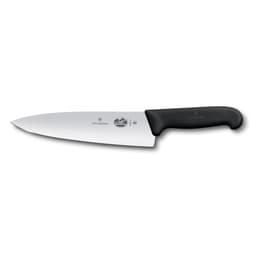
Our chef's knife pick
Victorinox Fibrox Pro 8-inch Chef's Knife
The knife that wins nearly every budget test, and the one to buy if you buy only one. A soft, stamped X50CrMoV15 blade at ~55-56 HRC and a grippy, non-slip handle — it dulls sooner than a hard Japanese knife but takes an edge back in seconds.
Read the full comparisonPrice as of October 20, 2026. #ad How we’re funded
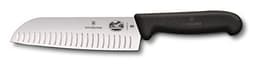
Our santoku pick
Victorinox Fibrox Pro 7-inch Santoku (Granton)
The Fibrox chef knife's santoku sibling: soft, forgiving X50CrMoV15 steel, granton dimples to reduce sticking, and the same grippy handle — at a price that makes it the obvious first santoku.
Read the full comparisonPrice as of October 20, 2026. #ad How we’re funded
Frequently asked questions
Is a santoku better than a chef's knife?
Neither is better — they suit different techniques. A santoku's shorter, flatter blade is better for push-cutting and straight chopping and is easier to control on a small board. A chef's knife's longer, curved blade is better for rocking cuts and slicing larger items. If you rock-chop herbs and garlic, get a chef's knife; if you push-cut vegetables, a santoku will feel more natural.
What is the difference between a santoku and a chef's knife?
Three things: length (a santoku is usually 165-180mm versus a chef's knife's 200-210mm), profile (a santoku is flatter with a blunt sheepsfoot tip; a chef's knife has a curved belly and a fine point), and motion (a santoku is built for push-cutting and chopping, a chef's knife for rocking). The steel can be identical — it's the geometry that differs.
Can you rock chop with a santoku?
Not really. A santoku's flat edge doesn't have the curved belly a rocking cut needs — the blade lifts off the board at the ends. It's designed for a push cut (forward and down) or a straight up-and-down chop. If rocking is your instinct, a chef's knife or a gyuto will frustrate you less.
Should a beginner get a chef's knife or a santoku?
A chef's knife is the more versatile default and the shape most recipes and videos assume. But a santoku's shorter blade feels less intimidating to many new cooks and its flat profile makes clean, safe chops easy. Try to hold both if you can; if you can't, an 8-inch chef's knife is the safer first buy.
Sources
- Japanese kitchen knife — Wikipedia — Reference on gyuto/santoku/nakiri, single- vs double-bevel (kataba/ryoba) and edge angles (accessed July 21, 2026)
- Rockwell hardness test — Wikipedia — Definition of the Rockwell C (HRC) scale used to state knife-steel hardness (accessed July 21, 2026)
Per-knife specs (steel, HRC, blade length, geometry) are read from each maker’s spec sheet or product listing and dated on the individual review cards above. “Not published” means the manufacturer does not state that figure — we flag it rather than guess.
Keep reading
Santoku Knife Guide
The 'three virtues' knife in depth — profile, use and care.
Read the guideBest Chef Knives
Our ranked chef's knife picks, with live prices.
See the picksChef Knife Types Explained
Every blade shape mapped to the task it's for.
Learn the typesGyuto vs Chef Knife
The other decision people get stuck on.
Compare themBest Santoku Knives
Six santokus ranked on steel and grind.
See the picksGyuto vs Santoku
The same question, both knives Japanese.
Compare themChef Knife Size Guide
How much of this decision is really about length.
Read the guideSantoku vs Nakiri
If the santoku won, this is the next question.
Compare them