Santoku vs Nakiri
Two Japanese knives that look similar in a photograph and behave completely differently on a board. The difference is one centimeter of tip.
How this is funded: we earn a commission if you buy through our links, at no extra cost to you. As an Amazon Associate we earn from qualifying purchases. It never changes which knife we recommend, and we’ll tell you when we’d skip one. Full disclosure.
Put a santoku and a nakiri side by side and the family resemblance is obvious. Both are Japanese, both are around 165–180 mm, both are far flatter than a Western chef’s knife, and both are built for pushing down rather than rocking. Nine out of ten photographs of them make the same knife-shaped impression.
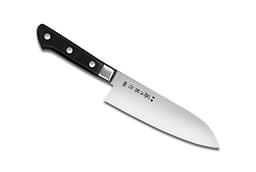
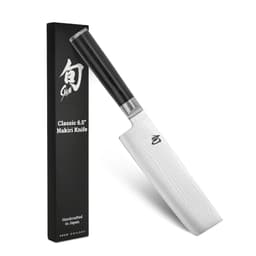
The difference is at the front. A santoku has a sheepsfoot spine that curves down to meet a slightly curved edge, which leaves it with a short but real point. A nakiri is a rectangle: the spine runs straight to a blunt front corner and the edge is dead flat, so there is effectively no tip at all. Every practical consequence below comes from that one detail.
The decision table
| Santoku | Nakiri | |
|---|---|---|
| Edge profile | Slight curve | Dead flat |
| Tip | Short but usable | None |
| Typical length | 165-180 mm | 165-180 mm |
| Blade height | Moderate | Tall (50 mm+) |
| Cutting motion | Push cut, slight rock | Push cut only |
| Vegetables | Very good | Best in class |
| Meat and fish | Boneless, fine | Boneless slicing only |
| Piercing and coring | Yes | No |
| Can be your only knife | Just about | No |
What the tip is actually worth
More than people expect, and it is the reason the santoku wins by default. In an average week of home cooking, the point of a knife does a lot of quiet work: coring a pepper, scoring skin, splitting a chicken breast, prying out a potato eye, opening a packet, starting a cut in the middle of a large vegetable. None of those is a headline task and all of them stop dead without a tip.
A nakiri owner does those jobs with a second knife — usually a petty or a chef’s knife that is already on the board. That is a perfectly reasonable arrangement if the second knife exists. It is a bad surprise if the nakiri was bought as an upgrade to a single-knife kitchen.
What the flat edge is worth
Also more than people expect, in one specific way. On a curved edge, the last part of a downward chop is the part where the curve has lifted away from the board — so a slice of onion stays attached by a hinge at one end and you finish with a second movement. On a truly flat edge that never happens. Every chop separates completely, first time, along the entire length of the blade.
Multiply that across a cabbage and it is a genuine speed difference, not a connoisseur’s distinction. The nakiri’s extra height compounds it: more knuckle clearance means you can keep your guiding hand in a proper claw and move faster, and the taller blade face carries the finished prep to the pan in one lift.
Which one to buy
Buy the santoku if it will be your only knife or your main one; if you want one knife that does vegetables well and everything else adequately; if you are buying a gift and cannot ask what else is in the kitchen; or if you are unsure. The santoku is the safer answer to almost every version of this question, and our santoku roundup covers the field from about $40 to $180.
Buy the nakiri ifyou already own a chef’s knife or gyuto you like; if most of your prep is vegetables; if you cook a lot of Asian food where volumes of finely cut vegetables are the norm; or if you have used a santoku and found yourself wishing it were flatter and taller. The field is in best nakiri knives.
Buy neither if you rock-chop and enjoy it. Both of these knives fight that motion, and re-learning your technique to suit a new knife is a bad trade. A Western chef’s knife with a proper belly is what you want, and there is no shame in it.
Sharpening either one
Both are easier to sharpen than a chef’s knife, and the nakiri is the easiest kitchen knife there is: with no curve to sweep through, the whole edge lies on the stone at once and all you have to do is hold the angle. That makes a cheap nakiri a genuinely good knife to learn stone technique on.
The maintenance rule follows the steel rather than the shape. Soft German versions of either knife are happy on a honing rod; hard Japanese ones at around 60 HRC want a fine ceramic rod or a strop between sharpenings and a 1000/6000 stone when they genuinely need work. The full method is in how to sharpen a knife on a whetstone.
If the answer is santoku
Tojiro DP Santoku 170 mm
The same VG10 core and value proposition as the Tojiro DP gyuto, in the shorter, flatter santoku shape. If you push-cut and chop more than you rock, this is the format — and the best-value way into it.
See all six santokus comparedPrice as of October 19, 2026. #ad How we’re funded
If the answer is nakiri
Shun Classic 6.5-inch Nakiri (DM0728)
The nakiri most people end up buying, and a fair default: VG-MAX core, Damascus cladding, and a genuinely flat 165 mm edge that meets the board along its whole length. Buy it if you want one vegetable knife and you want it to be nice.
See all six nakiris comparedPrice as of October 19, 2026. #ad How we’re funded
Frequently asked questions
What is the difference between a santoku and a nakiri?
A santoku has a curved sheepsfoot spine that drops to meet a slightly curved edge, giving it a short but usable point. A nakiri is a tall rectangle with a dead-flat edge and effectively no tip. That single difference makes the santoku a general-purpose knife and the nakiri a vegetable specialist that cannot pierce, core or bone.
Should I buy a santoku or a nakiri?
A santoku, unless you already own a chef's knife or gyuto. The santoku can be somebody's only knife; the nakiri cannot, because it has no tip. If you already have a good chef's knife and want a dedicated vegetable knife that is faster and more controlled on a cabbage, the nakiri is the better second purchase.
Is a nakiri better than a santoku for vegetables?
Yes, marginally but genuinely. The nakiri's edge is truly flat, so the whole blade meets the board at once and there is never an uncut hinge at the end of a stroke. It is also taller, which means more knuckle clearance and a bigger blade face for scooping prep into a pan. A santoku's slight curve makes both of those a little less clean.
Can you rock-chop with a santoku or a nakiri?
Neither, properly. Both are push-cutting knives: the blade comes down and forward, the whole edge meets the board, the cut finishes. A santoku has a little curve so a small rocking motion sort of works; a nakiri has none at all and will simply slap the board. If rock-chopping is your habit, buy a Western chef's knife.
What size santoku or nakiri should I buy?
Santokus run 165-180 mm; take 165 mm if it joins an existing chef's knife and 178-180 mm if it will be your main knife. Nakiris are usually 165-180 mm too, but height matters more than length — a taller blade gives more knuckle clearance and a better scoop, and 50 mm or more is what you want.
Do I need both a santoku and a nakiri?
Almost nobody does. They overlap heavily — both are flat-ish push-cutting knives in the same length range — so owning both usually means one of them sits unused. The more useful pairing is a 200-210 mm chef's knife or gyuto for general work plus whichever of these two you prefer for vegetables.
Sources
- Japanese kitchen knife — Wikipedia — Reference on gyuto/santoku/nakiri, single- vs double-bevel (kataba/ryoba) and edge angles (accessed July 21, 2026)
- Rockwell hardness test — Wikipedia — Definition of the Rockwell C (HRC) scale used to state knife-steel hardness (accessed July 21, 2026)
Per-knife specs (steel, HRC, blade length, geometry) are read from each maker’s spec sheet or product listing and dated on the individual review cards above. “Not published” means the manufacturer does not state that figure — we flag it rather than guess.
Keep reading
Best Nakiri Knives
Six vegetable knives compared, with live prices.
See the nakirisShun Classic Nakiri Review
The nakiri most people end up buying, checked against Shun's own numbers.
Read the reviewBest Santoku Knives
Six santokus from about $40 to $180.
See the santokusChef Knife vs Nakiri
The comparison that decides whether a nakiri is a second knife.
Compare themChef Knife Types Explained
Every shape on this site, in one reference.
See the shapes