Shun vs Miyabi
Two Damascus-clad knives handmade in the same Japanese city, at nearly the same hardness, for nearly the same money. The edge angle is the difference that actually reaches your cutting board.
How this is funded: we earn a commission if you buy through our links, at no extra cost to you. As an Amazon Associate we earn from qualifying purchases. It never changes which knife we recommend, and we’ll tell you when we’d skip one. Full disclosure.
Most brand comparisons on this site pit two different philosophies against each other. This one does not. The Shun Classic and the Miyabi Kaizen II are both handcrafted in Seki, Japan, both built on a hard stainless core, both wrapped in Damascus cladding, both fitted with a D-shaped pakkawood handle, and both sold at essentially the same price. They are the two knives people put in a browser tab next to each other and then cannot separate.
So the useful version of this comparison is narrow: where do the published specifications actually diverge, and does that divergence reach your board? The short answer is that the hardness gap is nearly nothing and the edge-angle gap is real. Everything below follows from that.
The decision table
| Shun Classic | Miyabi Kaizen II | |
|---|---|---|
| Core steel | VG-MAX | FC61 (fine-carbide) |
| Hardness (published) | 60-61 Rockwell (Shun FAQ) | 60-62 HRC (Zwilling) |
| Factory edge | 16° per side | 9.5-12° per side, Honbazuke |
| Cladding | 34 Damascus layers per side (69 total) | 48 Damascus layers (49 total) |
| Heat treatment claim | None published | Double ice-hardened FRIODUR |
| Blade length | 8 in. (203 mm) | 7.87 in. (200 mm) |
| Weight | 6.7 oz (190 g) | 0.44 lb (about 200 g) |
| Handle | Ebony-color pakkawood, D-shape | Black pakkawood, D-shape |
| Bolster | Stainless, slim | Thicker, rounded |
| Made in | Seki City, Japan | Seki, Japan |
| Warranty | Limited lifetime | Not published on the product page |
The hardness gap is not the story
This is the first thing to get out of the way, because it is where most comparisons spend their word count. Shun’s own FAQ states plainly that it hardens VG10 and VG-MAX steel to 60-61 Rockwell. Zwilling publishes 60-62 HRCfor the Kaizen II’s FC61 core. Those ranges overlap. On any given pair of knives the difference is likely to be a single Rockwell point, and possibly zero.
A point of hardness is not nothing — it is roughly the difference between a knife that holds an edge for a long time and one that holds it for a slightly longer time — but it is not a difference you will perceive while cooking. Our hardness chart places both of these knives in the same band, alongside most VG10-cored Japanese knives, and well above the 55-58 HRC where German stainless lives.
There is one asymmetry worth noticing, and it is about disclosure rather than steel. Zwilling prints the hardness on the product page. Shun does not — you have to go to its FAQ to find the figure at all, and its blade-steels page describes VG-MAX’s composition without ever stating how hard it is run. Both makers do publish it somewhere, which puts them ahead of most of the field, but only one of them puts it where a buyer is standing.
The edge angle is the story
Here the two knives genuinely part company. Shun states its knives are sharpened to a 16 degree angle on each side. Zwilling states the Kaizen II is hand-honed using the historic Honbazuke method to an exceptionally sharp 9.5 to 12 degrees. That is not a rounding difference. At the extremes it is a bevel roughly 40% narrower on the Miyabi.
What that buys, and what it costs:
- Out of the box, the Miyabi cuts more keenly.A thinner included angle meets less resistance entering food, which is most obvious on things with a skin — tomatoes, peppers, a chicken breast.
- The Miyabi’s edge is more fragile. Less steel supports the apex, so lateral force, bone contact or a hard board takes a chip where a wider bevel would have survived. Both knives are chip-prone at this hardness; the Miyabi is more so.
- The Shun is easier to maintain. A 16 degree bevel raises a burr faster on a stone and forgives a wandering wrist. Reproducing a true 9.5-12 degree Honbazuke edge at a kitchen table is a real skill, and most Miyabi owners end up with a slightly thicker edge than the one they bought.
This is the honest trade, and it is the same one the site makes everywhere: a thinner edge is a loan against your technique. If you already sharpen confidently on a whetstone, take the thinner edge. If you do not yet, the difference will have evaporated within a few months either way.
What FRIODUR actually claims
Zwilling describes the Kaizen II as a double ice-hardened FRIODUR blade. This is a real, published process, not a slogan: after quenching, the steel is deep-frozen, which converts more of the retained austenite left over from hardening. The practical results a maker is after are hardness and corrosion resistance from the same alloy.
The reason to be calm about it is that the result is already in the number. Whatever the process, it produced a 60-62 HRC core — which is where Shun lands without publishing a process name at all. Treat FRIODUR as an explanation of how Zwilling got there, not as a bonus stacked on top of the hardness figure.
Damascus layers are a decoration, on both
Shun publishes 34 layers of stainless Damascus cladding each side, 69 layers counting the core. Zwilling publishes 48 layers over the FC61 core, 49 in total. A buyer scanning specs reads that as Miyabi winning on a spec sheet.
It is not a performance number on either knife. The cladding is soft stainless wrapped around a hard cutting core; it adds corrosion resistance and a great deal of visual appeal, and it does not touch the food. Layer count is a pattern decision. The two knives look different — Shun’s classic rippled Damascus against Miyabi’s darker flower pattern — and if you prefer one, that is a completely legitimate reason to buy it. Just do not read it as cutting performance. Our Damascus explainer goes through what cladding does and does not do.
Handles, bolsters and the thing you should actually test
Both are pakkawood D-handles, and both are therefore contoured for a right palm — a point worth reading up on in left-handed Japanese knives if you cut with your left. Shun’s is ebony-colored with a slim stainless bolster and end cap; Miyabi’s is black with what Zwilling calls a thicker, rounded bolster for comfort and balance.
That bolster is the difference most people actually feel. A slim bolster leaves the heel of the blade fully accessible — useful when you sharpen, because you can take the stone all the way to the heel. A thicker rounded one fills the web of your hand and shifts the balance point back, which some cooks find noticeably more comfortable over a long prep session and others find intrusive in a pinch grip.
The weights are effectively identical: 190 g against roughly 200 g, on blades three millimeters apart in length. Nobody is buying one of these because it is lighter. If you have a shop within reach, hold both — this is the one variable in the whole comparison that a spec table genuinely cannot settle.
Living with either one
The maintenance routine is the same for both, and it is not the routine most people arrive with. Neither knife takes a traditional grooved steel rod: at 60-plus HRC an edge fractures instead of realigning. Shun goes further and warns against diamond steels for regular honing, on the grounds that they remove metal before it is necessary. Use a fine ceramic rod or a strop between sessions, and a stone when the edge is genuinely worn — the distinction is laid out in sharpening vs honing.
Both are stainless and neither needs the patina management a carbon knife does. Both should stay off glass and stone boards, out of the dishwasher, and away from bone. Neither should be twisted through anything. If that list sounds restrictive, it is the same list for every knife in this hardness band, and it is covered in the care guide.
Buying: the one place Shun is measurably ahead
Shun publishes a limited lifetime warrantyon the Classic product page. Zwilling does not state warranty terms on the Kaizen II product page we read, which is not the same as there being none — but it does mean you should confirm it with the seller rather than assume.
Both brands are counterfeited, and Shun’s own guidance on that is unusually blunt: no single visual feature confirms authenticity, not every seller on a trusted marketplace is authorized, and only knives bought from an authorized dealer are eligible for warranty service. That is worth taking seriously at this price. The channels, and how to read a listing, are compared in where to buy a Japanese chef knife.
Which one to buy
Buy the Shun if you want the keenest mainstream Japanese edge you can comfortably maintain yourself; if you sharpen your own knives and want a heel you can reach on a stone; if a published lifetime warranty matters to you; or if you simply prefer the look of the classic rippled Damascus. It is the safer of two safe choices.
Buy the Miyabiif you want the thinnest factory edge on offer at this price and will treat it accordingly; if a fuller, rounded bolster suits your grip; if you want the maker’s hardness figure printed on the page you are buying from; or if the darker flower Damascus is the object you would rather own.
Buy neitherif what you actually want is the cutting performance without the object. A plain-clad knife with a comparable hard stainless core costs a fraction of either — the case is made in Tojiro vs Shun, and the whole field sits in best Japanese chef knives. There is nothing wrong with paying for the object. It is just worth knowing that is what you are doing.
How we compared these
We own neither knife and have not cut with either. Every figure above was read from the maker’s own site on the date in the sources below — Shun’s product page and FAQ for the Classic, Zwilling’s product page for the Kaizen II — rather than from a retailer listing or another review. Where a maker does not publish something, we say so instead of filling the gap: Shun states no heat treatment process and no hardness on its product page, and Zwilling states no warranty on the Kaizen II’s. Prices come from the live pricing feed with their own date stamp, never from this text. Our methodology page sets out the whole approach.
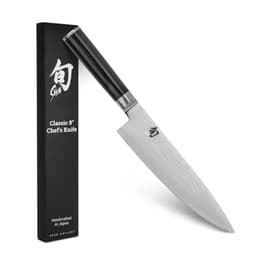
If the answer is Shun
Shun Classic 8-inch Chef's Knife
The knife most people picture when they think 'nice Japanese knife': a VG-MAX core at ~61 HRC under 34 layers of Damascus cladding, with a slim D-shaped handle. You pay for the finish, but the steel is genuinely hard.
Read the full Shun reviewPrice as of October 20, 2026. #ad How we’re funded
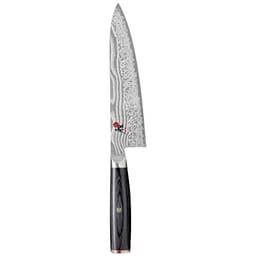
If the answer is Miyabi
Miyabi Kaizen II 8-inch Chef's Knife
Miyabi is Zwilling's Japan-made line, and the Kaizen II pairs an FC61 core at ~60 HRC with a 48-layer Damascus jacket and a comfortable D-handle. A polished alternative to the Shun Classic at a similar price.
Read the full Miyabi reviewPrice as of October 20, 2026. #ad How we’re funded
Frequently asked questions
Is Miyabi better than Shun?
Neither is better, and they are far closer than the marketing suggests: Shun states it hardens VG-MAX to 60-61 Rockwell, Zwilling states the Kaizen II's FC61 core runs 60-62 HRC, and both knives are handcrafted in Seki, Japan. The real split is geometry. Miyabi hand-hones to 9.5-12 degrees per side, Shun grinds to 16. The Miyabi starts keener; the Shun's slightly stouter edge is more tolerant of a clumsy moment and easier to re-establish on a stone.
Which is sharper out of the box, Shun or Miyabi?
Miyabi, on the published numbers. Zwilling states the Kaizen II is hand-honed by the three-step Honbazuke method to 9.5 to 12 degrees per side; Shun's own FAQ states its knives are sharpened to 16 degrees per side. That is a meaningfully thinner edge on the Miyabi. It is also a more fragile one, and the gap closes the first time you sharpen either knife yourself.
Are Shun and Miyabi both made in Japan?
Yes, and in the same place. Shun's Classic line is 'handcrafted in Seki City, Japan' by Kai. Miyabi is Zwilling J.A. Henckels' Japanese brand and the Kaizen II is handcrafted in Seki as well. Miyabi being owned by a German company does not make it a German knife — the steel, the grind and the workshop are Japanese.
Can you use a honing steel on a Shun or a Miyabi?
Not a traditional grooved steel rod on either. Both edges sit at 60+ HRC, where steel fractures rather than realigns. Shun's own FAQ also warns against diamond steels for routine honing, because they remove metal before it is necessary. Use a fine ceramic rod or a leather strop between sharpenings, and a whetstone when the edge genuinely needs metal taken off.
What is FRIODUR ice-hardening, and does it matter?
It is Zwilling's published heat-treatment process, and the Kaizen II is described as a double ice-hardened FRIODUR blade. Deep-freezing after quenching converts more of the steel's retained austenite, which is how a maker gets hardness and corrosion resistance out of the same alloy. What it is not is a separate performance tier: the number that results, 60-62 HRC, is the honest way to compare it, and that number is a point away from Shun's.
Which is easier to sharpen at home?
The Shun, marginally. A 16 degree bevel is wider than a 9.5-12 degree one, so it needs less time on the stone to raise a burr and is less punishing if your angle wanders. Restoring a true Honbazuke edge on the Miyabi is realistic but demanding, and most owners settle for a slightly thicker edge than the factory's. Both are stainless and neither is hard to keep rust-free.
Sources
- Shun Knives FAQ — Shun Cutlery (Kai USA) — Shun's own answers: 'Shun hardens VG10 and VG-Max steel to 60-61 Rockwell and SG2 to 61-62', 'Shun knives, for example, are sharpened to a 16 degree angle on each side of the blade', and on rods, 'Please do not use a diamond steel for regular honing. Diamond steels are for sharpening and will remove metal from your knife before it is necessary' (accessed August 28, 2026)
- Shun Classic 8-inch Chef's Knife — Shun Cutlery (Kai USA) — Shun's published spec for the knife itself: a 'VG-MAX' core in '69 layer Damascus' — described as '34 layers of stainless Damascus cladding each side (68 total)' — a '16 degree edge each side', an '8 in. (203mm)' blade, '6.7 oz (190 g)', an ebony-color Pakkawood D-shaped handle, 'Handcrafted in Seki City, Japan' and a 'Limited Lifetime Warranty'. No Rockwell figure appears on the product page (accessed August 28, 2026)
- MIYABI Kaizen II 5000FCD 8-inch Chef's Knife — ZWILLING — Zwilling's published spec for the line: an 'FC61' core with fine carbide distribution at '60-62 HRC', '48 layers of stainless steel' Damascus over the core (49 total), an edge 'hand-honed using the historic Honbazuke method to an exceptionally sharp 9.5 to 12 degrees', a 'double ice-hardened FRIODUR' blade, a 'thicker and rounded bolster for increased comfort and balance', a black Pakkawood D-shaped handle, a 7.87 in blade at 0.44 lbs, handcrafted in Seki, Japan (accessed August 28, 2026)
- How to Spot a Fake Shun Knife — Shun Cutlery — Shun's own statement that no single visual feature confirms authenticity, that not all sellers on a trusted marketplace are authorized, and that only knives bought from an authorized dealer are eligible for warranty service (accessed August 13, 2026)
- Rockwell hardness test — Wikipedia — Definition of the Rockwell C (HRC) scale used to state knife-steel hardness (accessed July 21, 2026)
Per-knife specs (steel, HRC, blade length, geometry) are read from each maker’s spec sheet or product listing and dated on the individual review cards above. “Not published” means the manufacturer does not state that figure — we flag it rather than guess.
Keep reading
Best Shun Knives
Which Classic to buy, on the shape and the published weight - the only two things that differ across the line.
See the roundupFC61 vs VG10
The two steels behind these knives, compared on their own.
Read the comparisonShun Classic 8-inch Review
One half of this pairing, examined on its own published specs.
Read the reviewMiyabi Kaizen II 8-inch Review
The other half, and what an FC61 core asks of you.
Read the reviewShun vs Wüsthof
The same knife against the German answer, where the gap is real.
Compare themTojiro vs Shun
What the premium buys when the steel is already this hard.
Compare themBest Japanese Chef Knives
Both knives in the wider field, with live prices.
See the roundupKnife Hardness Chart (HRC)
Where 60-62 HRC actually sits, and what it costs you.
Read the chart