Chef Knife vs Utility Knife
One is built to work on a board, the other to work off it. They are not a big knife and a small version of the same knife, and treating them that way is how people end up with a drawer of overlap.
How this is funded: we earn a commission if you buy through our links, at no extra cost to you. As an Amazon Associate we earn from qualifying purchases. It never changes which knife we recommend, and we’ll tell you when we’d skip one. Full disclosure.
People treat these two as the same knife at two sizes, and the mental model does real damage: it produces kitchens with a 200 mm chef’s knife and a 180 mm “utility” knife that never gets used, or a cook grimly trying to hull strawberries with the tip of a full-size blade.
They are different tools with different intents. The chef’s knife is designed for work on a board, where the board supports the food and the knife supplies reach, height and mass. The utility knife is designed for work off a board — in your hand, against a small object, in a confined space — where reach and mass are liabilities and control is everything.
The decision table
| Chef's knife | Utility knife | |
|---|---|---|
| Blade length | 200-210 mm typical | 110-150 mm typical |
| Blade height at heel | Tall — knuckle clearance | Shallow — no clearance |
| Weight | Substantial; does its own work | Light; you supply the force |
| Primary grip | Pinch grip, on a board | Pinch or handle grip, in hand |
| Profile | Belly for rocking, flat for pushing | Mostly straight, fine tip |
| Onions, cabbage, squash | Yes | No |
| Trimming, segmenting, peeling | Clumsy | Yes |
| Sandwiches, tomatoes, small fruit | Overkill | Ideal |
| As an only knife | Yes | No |
| Buy it | First | Second |
What a utility knife actually is
A utility knife is a straight-ish, shallow blade of roughly 110–150 mm with a fine tip. That is the whole definition, and it is deliberately loose, because the category exists to catch everything between a paring knife and a chef’s knife rather than to describe one job.
The naming is a mess and it is worth clearing up, because it makes shopping confusing. Japanese makers call this knife a petty, from the French petit, and Western makers call it a utility. It is the same tool. Within a single brand’s catalog you will find a 130 mm listed as a petty and a 150 mm listed as a utility with no meaningful difference other than the label. The genuine distinctions are the ones that separate Japanese and Western knives generally — a petty is usually thinner, harder and ground finer, a Western utility knife a little more robust. Our petty knife guide goes through that in detail, and Japanese vs German knives covers the underlying trade-off.
What a utility knife is notis a scaled-down chef’s knife. Scale a chef’s knife down and you get a shorter knife that is still tall and still belly-heavy — a 6-inch chef’s knife, which is a real product and a different thing. The utility knife is shallow on purpose: the missing height is what lets you work with the blade close to your other hand, into a piece of fruit, along a bone, without the knife getting in the way of its own cut.
Where the chef’s knife wins
Anything on a board, in quantity. Reach is the obvious part — you cannot span a cabbage or a large squash with 130 mm of blade — but height is the part people underrate. A tall blade lets you curl your guiding hand into a claw with your knuckles against the flat of the knife, which is the technique that makes chopping both fast and safe. A shallow blade cannot do this. Your knuckles have nowhere to rest, so you lift your fingertips instead, and that is exactly the hand position that gets cut.
Mass is the third advantage. A chef’s knife has enough weight to carry itself through an onion; a utility knife has to be pushed. Over a large batch of prep that is the difference between finishing comfortably and finishing with a tired forearm.
Which knife within that category is a separate question — gyuto, Western chef, santoku — and our chef knife vs santoku comparison and the size guide cover it.
Where the utility knife wins
Everything small, fiddly, or done in your hand rather than on a board. Concretely:
In-hand work. Hulling strawberries, coring a pepper, deveining a chilli, trimming the fat off a chop, popping the eyes out of a potato. A 210 mm blade held over your palm is intimidating and imprecise; a 130 mm blade is just a tool.
Small produce on a board.A shallot, a clove of garlic, a lime, a mushroom. The chef’s knife can do all of these, but you are using two inches of a blade you have to lift eight inches of, and the tip-work is finer with a shorter knife.
Anything with a skin and a soft interior. Tomatoes, plums, a bread roll, a sandwich. A fine tip and a straight edge start the cut without crushing what is underneath.
Working around a bone or a joint.Not a substitute for a boning knife, but far better than a chef’s knife at following a contour, because you can see what you are doing and the blade will turn.
Cheese, charcuterie, and anything you do at the table.Bringing a chef’s knife to the table is theater. A utility knife is a knife.
The second-knife mistake
Here is the trap. Somebody owns a 200 mm chef’s knife, decides they need one more knife, and buys a 180 mm santoku or a 165 mm chef’s knife because it looks like a useful in-between size. It is not. It does the same job as the knife they already own, slightly worse, and it sits in the block.
The useful second knife is the one that does a job the first knife is bad at, and that means going small, not going slightly-smaller. A 200–210 mm chef’s knife plus a 130–150 mm utility knife is the two-knife kitchen that actually covers everything, with no dead weight, because the gap between them is wide enough that each one owns its territory outright. Add a serrated bread knife and you can stop.
The same logic applies to sizing the utility knife itself. If it will live next to a full-size chef’s knife, take the longer end — 145 or 150 mm — because the gap is what makes it useful. If you already own a paring knife, take the longer end for the same reason at the other boundary.
Utility versus paring, briefly
These two overlap far more than the chef’s knife and the utility do, and most kitchens do not need both immediately. A paring knife is 75–90 mm and is designed to be used entirely in the hand, thumb braced against the food. It is excellent at peeling, coring and eyeing, and it can do nothing whatever that is longer than itself.
A utility knife does most of the parer’s work slightly less comfortably, and a great deal the parer cannot touch. If you are buying one small knife, buy the utility. Buy the parer when you find yourself wanting it, which for most people is when they start peeling apples in the hand.
How to choose
If you own nothing:buy the chef’s knife. It is not a close call. One good 200–210 mm blade does eighty per cent of the work in any kitchen, and every other knife is an optimization on top of it. Our chef knife roundup and beginner picks are the place to start.
If you own a chef’s knife and want one more:buy the utility knife, at 130–150 mm, and spend modestly. This is a knife that does light work with a short edge, so the case for hard, expensive steel is weaker here than anywhere else in the kitchen — the field is covered here, and the value picks are genuinely competitive with the premium ones.
If you are choosing between a second chef’s knife and a utility knife:utility, every time. Duplicating reach buys you nothing. The only reason to own two knives of similar length is if they are genuinely different shapes doing different cuts — a chef’s knife and a nakiri, say — and even then it is a refinement rather than a gap being filled.
Whichever you buy, the thing that decides how well it cuts is not which of the two it is. It is whether the edge is sharp, and a short blade is the easiest thing in the kitchen to keep that way — two minutes on a stone and a utility knife is back to new.
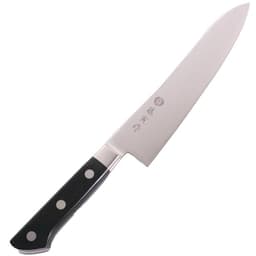
The board knife
Tojiro DP Gyuto 210 mm
The knife the internet has recommended to first-time gyuto buyers for a decade, and the numbers explain why: a real VG10 core at ~60 HRC for a fraction of the boutique price. Buy this before you spend three times as much.
See the full chef's knife fieldPrice as of October 19, 2026. #ad How we’re funded
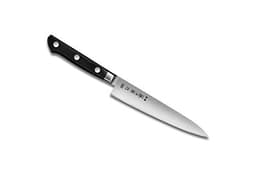
The off-board knife
Tojiro DP Petty 150 mm (F-802)
The DP gyuto's little brother, and the petty we would buy. Same VG10 core, same stainless cladding, same ~60 HRC — shrunk to the size where a big knife stops being useful. If you already own a Tojiro gyuto, this is the knife that fills the gap under it.
See the full utility fieldPrice as of October 19, 2026. #ad How we’re funded
Frequently asked questions
What is the difference between a chef knife and a utility knife?
Length and intent. A chef's knife is 200-210 mm with enough height to keep your knuckles clear of the board, and it is built for volume board work — dicing, slicing, breaking down produce. A utility knife is 110-150 mm, much shallower, and built for the jobs a chef's knife is clumsy at: trimming, segmenting, slicing a sandwich, working in your hand rather than on a board.
Is a utility knife the same as a petty knife?
Effectively yes — petty is the Japanese name for the same tool, from the French 'petit'. The differences are the usual Japanese-versus-Western ones rather than anything about the shape: a petty tends to be thinner, harder and ground to a finer angle, a Western utility knife is a little sturdier. Makers use both words for knives in the same 120-150 mm bracket, and some list a knife as 'utility' in one size and 'petty' in another.
Do I need a utility knife if I have a chef's knife?
Not on day one, but it is the most useful second knife most kitchens can add. The chef's knife handles everything on the board; where it struggles is small, in-hand and fiddly work — hulling strawberries, trimming fat, segmenting citrus, slicing a bread roll. If you find yourself using the tip of a 210 mm blade for those, a utility knife will make them easier and safer.
Should I buy a utility knife or a paring knife?
A utility knife, if you are only buying one. A parer is 75-90 mm and is genuinely an in-hand tool — excellent for peeling and coring, useless for anything longer than itself. A utility knife at 130-150 mm does most of what a parer does and can also slice a tomato, a sandwich or a small onion, which a parer cannot. Buy the parer third.
Can a utility knife replace a chef's knife?
No, and trying it is unpleasant. A utility knife is too short to span anything large, too shallow to give your knuckles clearance under a claw grip, and too light to do work of its own. Half an hour of dicing onions with one will make the case better than any article can.
What size utility knife should I buy?
Around 130-150 mm. Shorter than about 120 mm and you are close enough to a paring knife that the overlap is wasteful; longer than about 150 mm and you start losing the in-hand nimbleness that is the whole reason for owning one. If it will sit next to a 200-210 mm chef's knife, the longer end of that bracket keeps the gap between them useful.
Sources
- Japanese kitchen knife — Wikipedia — Reference on gyuto/santoku/nakiri, single- vs double-bevel (kataba/ryoba) and edge angles (accessed July 21, 2026)
- Rockwell hardness test — Wikipedia — Definition of the Rockwell C (HRC) scale used to state knife-steel hardness (accessed July 21, 2026)
Per-knife specs (steel, HRC, blade length, geometry) are read from each maker’s spec sheet or product listing and dated on the individual review cards above. “Not published” means the manufacturer does not state that figure — we flag it rather than guess.
Keep reading
Petty Knife Guide
The Japanese version of this knife, in depth.
Read the guideBest Petty & Utility Knives
Five compared on steel, length and grind.
See the picksChef Knife Size Guide
Why 200-210 mm is the default, and when it is wrong.
Read the guideChef Knife Types Explained
Every blade shape in one scannable reference.
Read the explainerPetty vs Utility Knife
The narrower question: petty against utility, not chef against either.
Compare them