Granton Edge vs Straight Edge
The scallops sit above the edge, so they cannot make a knife sharper. What they change is whether a wet slice lets go of the blade — and that pays off on a long slicer far more than on a short one.
How this is funded: we earn a commission if you buy through our links, at no extra cost to you. As an Amazon Associate we earn from qualifying purchases. It never changes which knife we recommend, and we’ll tell you when we’d skip one. Full disclosure.
Choose the Granton edge when the blade is long and the food is wet: carving a roast, slicing salmon, cutting starchy vegetables or cheese. Ignore it on a short knife, and never pay a premium for it. The scallops sit above the cutting edge, so they cannot make a knife sharper or thinner where it matters — they break the suction that makes a slice cling to the steel, and the only source we could find that actually tested them concluded they were unnecessary on santokus and useful on slicers.
This comes up because the same knife is often sold two ways at the same price, and the listing copy never explains the difference beyond “prevents food from sticking.” Three names, one feature: Granton edge (English, from the patent), Kullenschliff or hollow edge (German), and dimpled or fluted on some Japanese and professional lines. All describe oval scallops ground into both faces of the blade just above the edge.
Where the feature comes from
It is not a modern marketing invention. America’s Test Kitchen records that the hollows were “patented in 1928 by what’s now the Granton Knives Co. in Sheffield, England,” which is why the English-language name is a company name. The design spread first through butchery and slicing knives — long blades working on wet protein — and only later onto santokus and chef’s knives, where it is now mostly a styling choice.
What the scallops do — two mechanisms, not one
1. They break suction. A flat, wet slice pressed against a flat steel face is held there by surface tension and the absence of air. Scallops create pockets, air gets in, and the slice falls away instead of riding up the blade. This is the claim every listing makes, and it is real but conditional: it needs a wet or starchy surface and a reasonable area of contact to matter at all.
2. They remove metal.This is the part the marketing leaves out and the part a testing source puts first. America’s Test Kitchen notes that “many sources claim the design prevents food from clinging to the blade,” then adds a second purpose in its own words: “the scallops make the blade thinner and lighter to help it slide through food” while “maintaining some rigidity at the spine for control.” In other words part of what you feel from a hollow-edge knife is simply less steel in the way.
Both mechanisms are about the blade’s faces. Neither touches the apex. That is why a hollow edge cannot substitute for a thin grind or a keen angle, and why thickness behind the edge remains the property to buy first.
What they do not do
- They do not make the knife sharper. Sharpness is the apex and the geometry immediately behind it. Two knives with the same steel, hardness and edge angle arrive equally keen.
- They do not change the steel or the hardness. A hollow-edge Wüsthof santoku is the same forged X50CrMoV15 at the same published 58 Rockwell as the rest of the forged Classic line; the scallops are a grinding operation, not a metallurgical one.
- They do not fix wedging. If a blade splits a carrot instead of slicing it, the cross-section above the edge is too fat, and scallops higher up the face will not change that.
- They do not stop everything sticking. Starchy potato will still cling to parts of the blade; herbs will still bruise and gather. A hollow edge reduces a problem rather than removing it.
Where it pays off, blade by blade
| Worth it? | Why | |
|---|---|---|
| Carving knife / sujihiki / slicer (240 mm+) | Yes — the best case | Long wet contact for the whole stroke; ATK found hollows reduce friction and help even slices here |
| Chef's knife or gyuto (200-240 mm) | Mild benefit | Helps on starchy and moist prep; irrelevant to chopping herbs or breaking down produce |
| Santoku (165-180 mm) | Not necessary | ATK: 'we didn't find them necessary since these blades are short... and are already razor-thin' |
| Nakiri | Rarely offered, rarely needed | Vegetable prep is mostly dry contact and the blade is already thin |
| Paring or petty knife | No | Almost no face in contact with the food |
| Bread knife | No | A serrated edge works by tearing, not by surface contact |
| Cheese or ham knife | Yes | Sticky, high-surface-area cuts — the exact condition the scallops address |
The Japanese version of the same idea
Japanese makers address blade-to-food contact differently. Instead of a row of machined ovals, many clad knives carry a tsuchimehammered finish — dozens of small dimples beaten into the cladding, which break contact the same way. The Yoshihiro 240 mm slicer we track is a good example: a VG10 core under hammered Damascus, where the dimpled face is doing functional work on exactly the kind of long wet cut the Granton edge was patented for.
The practical difference is what else you are buying. A Granton grind is usually offered on an otherwise identical knife at the same price, so the decision is free. A hammered finish usually arrives on a clad Damascus blade, so you are paying for cladding and appearance as well as release — which our Damascus explainer gets into. Note also that the general reference on Japanese kitchen knives frames the tradition around grind and bevel geometry, not surface treatment: the cutting argument in Japan is about how thin the blade is, which is the same point this page keeps returning to.
Sharpening a hollow-edge knife
Exactly as you would sharpen the plain version. The bevel you work sits below the scallops, so the angle, the grit progression and the burr removal are unchanged — the method in how to sharpen a knife applies without modification, and the general sharpening reference’s coarse-to-fine logic is the same.
There is one geometric consequence worth knowing, even though most home cooks will never meet it: a knife sharpened back far enough, over many years, will eventually have its edge reach the scallop row, at which point the edge itself becomes scalloped and the blade is finished. It is a long way off — and it is a reason to sharpen conservatively rather than aggressively, which is also the advice in how often to sharpen a knife. Care is likewise unchanged: hand wash, dry immediately and store so nothing touches the edge, per the maker guidance collected in knife care.
So which should you buy?
Take the hollow edgeif the two versions cost the same and the knife is a slicer, a carving knife, or a chef’s knife you will use on potatoes, cucumbers, cheese and cooked meat. It is a small, free improvement in a narrow set of jobs.
Take the plain bladeif it is cheaper, if the knife is short, or if you simply prefer the look. On a 165 mm santoku you are not giving anything measurable up — and the testing source that looked hardest at this feature put its own santoku award on a knife without one.
Spend the money elsewhere if there is a price difference. A keener published edge angle, a harder core steel, or a thinner grind all change more cuts per day than surface release does. Our gyuto roundup and Miyabi page are where those numbers are, and best knives for cutting vegetables covers the sticking problem from the other direction — shape rather than surface.
We own none of these knives and have run no cutting tests of our own; the testing claims above are attributed to America’s Test Kitchen, and the specifications are the makers’. Our methodology page explains the approach, and prices come only from our live price layer with the date they were read.
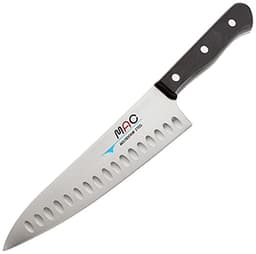
The hollow edge on a blade long enough to benefit
MAC Chef Series Hollow-Edge 8-inch
MAC's thin, light molybdenum blade is the one professional cooks quietly reach for — less flashy than a Damascus Shun, but famously nimble. The hollow-edge dimples reduce sticking on wet produce.
Read the MAC Chef Series reviewPrice as of October 21, 2026. #ad How we’re funded
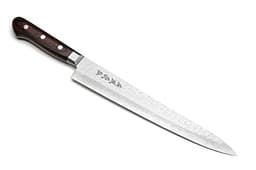
The Japanese answer to the same problem: a hammered face
Yoshihiro VG10 16-Layer Hammered Damascus Sujihiki 240 mm
A VG10 core under 16 hammered layers in the 240 mm slicer length — the Damascus sujihiki for people who will not pay boutique money. No hardness figure is published for it, which is the one thing we hold against it.
See it against the slicer fieldPrice as of October 21, 2026. #ad How we’re funded
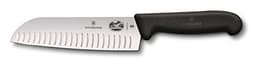
The cheapest way to try a Granton edge
Victorinox Fibrox Pro 7-inch Santoku (Granton)
The Fibrox chef knife's santoku sibling: soft, forgiving X50CrMoV15 steel, granton dimples to reduce sticking, and the same grippy handle — at a price that makes it the obvious first santoku.
See it against the santoku fieldPrice as of October 21, 2026. #ad How we’re funded
Frequently asked questions
What is a Granton edge?
A row of oval scallops ground into both faces of a blade just above the cutting edge. The name comes from the patent: America's Test Kitchen records that the hollows were 'patented in 1928 by what's now the Granton Knives Co. in Sheffield, England'. German makers call the same feature a Kullenschliff or hollow edge, and some Japanese makers call their version dimpled or fluted. They are all the same idea.
Does a Granton edge make a knife sharper?
No. The scallops are above the edge, not at it — sharpness is set by the apex and the thickness behind it, neither of which the hollows touch. Two knives with identical steel, hardness and edge angle will arrive equally sharp whether one has scallops or not. What the scallops change is how readily a cut slice lets go of the blade.
Do hollow edge knives actually stop food sticking?
Partly, and it depends on the food and the blade. The scallops break the suction between a wet, flat surface and the steel, which helps most with starchy or moist slices — potato, cucumber, zucchini, cheese, cooked meat. They do nothing for dry work like chopping herbs, and a thin blade with a polished face is already fairly good at releasing food on its own.
Is a Granton edge worth it on a santoku?
Probably not, and the one source that tested it agrees. America's Test Kitchen writes that on santokus 'we didn't find them necessary since these blades are short (6.5 to 7 inches) and are already razor-thin', and its winning santoku has no Granton edge. A short, thin blade spends little surface in contact with the food, which is the condition the scallops exist to fix.
Where does a hollow edge genuinely help?
On long blades doing long cuts. America's Test Kitchen found the hollows useful on slicing knives, where they reduce friction and help produce even slices — which is exactly the job where a wide, wet surface of meat is pressed against a long blade for the whole length of the stroke. Carving a roast, slicing a side of salmon, or cutting a block of cheese is where you feel it.
Do the scallops weaken the blade?
They remove material, which is partly the point: America's Test Kitchen notes 'the scallops make the blade thinner and lighter to help it slide through food' while 'maintaining some rigidity at the spine for control'. In normal kitchen use that is a benefit rather than a weakness. It is also a reason not to treat a hollow-edge blade as a prying tool.
Does a hollow edge change how you sharpen the knife?
Not in practice. You sharpen the bevel below the scallops, so the technique, the angle and the grit progression are identical to any other knife of the same type. The only long-term consideration is geometric: if a knife were sharpened back far enough over many years for the edge to reach the scallop row, the edge itself would become scalloped — which is the end of that blade's useful life, and is rare in a home kitchen.
Granton edge or a thinner knife?
A thinner knife, if you have to choose. Thickness behind the edge decides whether food separates cleanly or is split apart, and that is a bigger effect than surface release — a thick hollow-edge blade will still wedge a carrot. Buy the blade geometry first and treat the scallops as a tiebreaker between two otherwise identical knives.
Are hammered (tsuchime) Japanese blades the same idea?
Same purpose, different execution. A hammered tsuchime face carries dozens of small dimples rather than a row of oval scallops, and they break blade-to-food contact the same way. Japanese makers tend to use the hammered finish on clad Damascus blades where it is decorative as well as functional, so you are often paying for both at once.
Sources
- Why Do Some Knife Blades Have Hollows? — America's Test Kitchen (Cook's Illustrated) — The only testing-based account of hollow/Granton edges we could find from a source that actually ran the knives. It gives the origin — the hollows were 'patented in 1928 by what's now the Granton Knives Co. in Sheffield, England' — notes that 'Many sources claim the design prevents food from clinging to the blade' and then states a second purpose: 'The scallops make the blade thinner and lighter to help it slide through food' while 'maintaining some rigidity at the spine for control'. On santokus its testers were unconvinced: 'we didn't find them necessary since these blades are short (6.5 to 7 inches) and are already razor-thin', and its winning santoku has no Granton edge. On slicing knives it found the hollows useful, reducing friction and helping produce even slices (accessed October 20, 2026)
- Japanese kitchen knife — Wikipedia — Reference on gyuto/santoku/nakiri, single- vs double-bevel (kataba/ryoba) and edge angles (accessed July 21, 2026)
- The Difference Between WÜSTHOF Forged and Stamped Kitchen Knives — WÜSTHOF — Wüsthof's own account of both processes: forged blades start as a single piece of steel heated to over 2000°F and take 'over fifty-four manufacturing steps', hardened to '58 Rockwell'; non-forged blades are 'cut from a high-quality steel sheet using a precision laser' in 'thirty-five manufacturing steps' and run 'between 55 and 57 Rockwell' (accessed August 18, 2026)
- Knife sharpening — Wikipedia — Reference on edge angle, coarse-to-fine grit progression, and honing vs sharpening (accessed July 21, 2026)
- Shun Knives FAQ — Shun Cutlery (Kai USA) — Shun's own answers: 'Shun hardens VG10 and VG-Max steel to 60-61 Rockwell and SG2 to 61-62', 'Shun knives, for example, are sharpened to a 16 degree angle on each side of the blade', and on rods, 'Please do not use a diamond steel for regular honing. Diamond steels are for sharpening and will remove metal from your knife before it is necessary' (accessed August 28, 2026)
- How to Clean and Care for Your Knife — ZWILLING — ZWILLING's own care instructions: 'clean it by hand using lukewarm water, mild dish soap and a non-scratch cloth or sponge', dried with 'a plain dishtowel or microfiber cloth'; the dishwasher is ruled out for 'aggressive chemical tablets', 'high temperatures' and 'bumps and bangs with other objects'. On wooden handles: 'not dishwasher-safe and should only be washed by hand', with the wood 'regularly treating the wood with oil (e.g. linseed oil) or wax (e.g. beeswax)'. On storage, a knife needs 'its very own space away from other objects, so not simply thrown in the cutlery drawer' — a block, 'drawer organizers or protective sleeves' (accessed September 23, 2026)
Per-knife specs (steel, HRC, blade length, geometry) are read from each maker’s spec sheet or product listing and dated on the individual review cards above. “Not published” means the manufacturer does not state that figure — we flag it rather than guess.
Keep reading
How Thick Should a Chef's Knife Be?
The property that actually decides whether food separates — and why nobody publishes it.
Read the guideMAC Chef Series Hollow-Edge 8-inch Review
A hollow edge on a blade long enough to use it, reviewed on the published specs.
Read the reviewBest Santoku Knives
Where hollow and plain santokus sit side by side at the same prices.
See the picksBest Sujihiki Knives
The long slicers, where friction and release genuinely matter.
See the picksJapanese vs German Knives
Thin and hard against thick and tough, on published figures.
Compare themKnife Anatomy
Spine, bevel, heel and the rest of the vocabulary this page uses.
Read the guide