MAC vs Shun
Both handcrafted in Seki, both sold at roughly the same price, and each one publishes exactly the half of the spec sheet the other withholds. Which half you need decides the knife.
How this is funded: we earn a commission if you buy through our links, at no extra cost to you. As an Amazon Associate we earn from qualifying purchases. It never changes which knife we recommend, and we’ll tell you when we’d skip one. Full disclosure.
Shun tells you what the steel is and how hard it is. MAC tells you what shape the blade is ground to. Neither tells you both, and at this price they are the two knives people put in adjacent browser tabs and cannot separate. Both are handcrafted in Seki, Japan. Both use a single stainless alloy at the hard end of kitchen-knife practice. Both cost roughly the same money. The useful version of this comparison is therefore not “which is better” but which half of the spec sheet you actually need.
Here is the asymmetry, stated plainly before the table. Shun publishes, on its own site: VG-MAX steel, “60-61 Rockwell,” a “16 degree edge each side,” 69 Damascus layers, blade length, weight to the gram, handle length, and a limited lifetime warranty with free sharpening for as long as you own the knife. MAC publishes, on its own site: none of the above— no steel grade, no Rockwell figure, no edge angle, no thickness. The geometry figures everyone quotes for MAC come from its Chef Series marketplace listing, not from MAC: a “15-degree per side, double-bevel” edge and a “2.5mm starting stock” tapered “completely… from spine to edge.” We have checked MAC’s own TH-201 and PRO-31 pages and those fields simply are not there.
The decision table
| MAC | Shun Classic | |
|---|---|---|
| Steel | 'High-Carbon, stain-resistant, molybdenum steel' (listing) — no grade | VG-MAX core (Shun's own page) |
| Hardness | Not published by MAC anywhere | 60-61 Rockwell (Shun FAQ) |
| Factory edge | 15° per side, double bevel (listing) | 16° each side (Shun's own page) |
| Blade stock | 2.5 mm starting stock, fully tapered (listing) | Not published |
| Construction | Single steel, taper-ground | VG-MAX core, 34 Damascus layers each side (68 total; '69 layer') |
| Blade length | 8 in. (203 mm) | 8 in. (203 mm) |
| Weight | Not published | 6.7 oz (190 g) |
| Handle | Pakkawood, Western symmetrical | Ebony-color Pakkawood, D-shape, full composite tang |
| Made in | Seki, Japan ('100% Handcrafted by artisan knifemakers') | Seki City, Japan |
| Warranty | 25 years, non-transferable, original purchaser only | Limited lifetime, original owner, authorized dealers only |
| Sharpening service | None published | Free for life; $15 US shipping, ~2 weeks |
What the missing hardness figure actually costs you
Rockwell C is the one number that predicts how long an edge lasts and how it fails when it does. Harder steel holds a keen apex longer and chips rather than rolls; softer steel rolls rather than chips and comes back on a rod. Shun gives you the number, so you can reason about the knife before you own it.
MAC does not, at a price where its direct competitors all do — Shun 60-61, Zwilling 61 for Miyabi’s FC61, Tojiro’s DP documented by a specialist at 60 ±1. That is a real gap and we are not going to paper over it: with a MAC you are buying the grind and the reputation, and you will find out about edge retention by using the knife.
Two caveats keep this honest in MAC’s favor. First, a published hardness figure is a heat-treatmentclaim and nothing more — it says nothing about how thin the blade is, which is what you feel on the first cut. Second, the one MAC on this site that has a hardness number attached at all, the Chef Series hollow-edge 8-inch, is listed around 59-61 HRC — by the marketplace, not by MAC, which is exactly why we label it that way. Our hardness chart sets out what each band means when a maker does publish one.
What the missing thickness figure costs you
The same argument runs the other way, and it is the part most MAC-versus-Shun write-ups miss. Thinness behind the edge is what decides whether a dense carrot separates cleanly or splits ahead of the blade, and it is the property almost no maker publishes.
MAC at least publishes a proxy: 2.5 mm of starting stock, tapered completely from spine to edge. Shun publishes no thickness figure for the Classic line at all. It publishes a cladding count instead — 34 Damascus layers each side, 68 total, marketed as “69 layer” with the core counted — which is a number about appearance and stiffness, not about cutting. So Shun’s disclosure advantage is real on metallurgy and nonexistent on geometry. How thick should a chef’s knife be explains why starting stock is a weak proxy and still the best one on offer.
One degree of edge angle, and what it is worth
MAC’s published 15° per side against Shun’s published 16° each side is the closest two factory angles get on this site. In practice the difference is nothing: one degree is inside the variation your own hand introduces the first time you take either knife to a stone.
What matters is that both numbers exist, because an angle you know is an angle you can maintain. Most owners of most knives are guessing. With either of these you have a target: set the bevel on a 1000-grit stone, refine on a 3000 or 6000, and keep the angle consistent rather than correct to the degree. The angle guide covers holding it, and sharpeners for Japanese knives covers the kit. Both brands are hard enough that a ribbed steel rod is the wrong tool — Shun’s own FAQ goes further and warns against diamond steels for routine honing, because they “remove metal from your knife before it is necessary.” A fine ceramic rod is the right maintenance tool for either, and do Japanese knives need honing explains why.
The handle is the difference you will actually feel
Steel is where these two argue; the handle is where they differ in the hand. Shun fits the Classic with a D-shaped ebony-finish Pakkawood handle on a full composite tang. The D is subtly asymmetric, shaped around a right-handed pinch grip, and most right-handed cooks find it locks the knife into place. MAC fits a symmetrical Western-style Pakkawood handle, which is more neutral and less opinionated.
Two practical consequences. If you are left-handed, or the knife is shared, the MAC is the easier object to live with — our left-handed Japanese knives guide goes through how much a D-shape really costs a left-handed user. And if you have small hands, the Shun’s published 5.0 in. (127 mm) handle length is a figure MAC does not give you; best chef knives for small hands is built on exactly that kind of published dimension.
Warranty and service: the gap that is not close
This is the one dimension where Shun wins outright, and it is worth more than any spec line above if you are not going to buy a stone.
Shun carries “a limited warranty for the lifetime of the original owner” against manufacturing defects, and it will sharpen your knives free, for as long as you own them— you pay $15 US shipping and processing, with a roughly two-week turnaround. MAC publishes “25 years from the date of purchase” against defects in materials or workmanship, and no sharpening service.
Both sets of terms have teeth, and both exclude the thing people actually do to these knives. Shun: “Any use other than cutting (such as stabbing or prying) is considered misuse and abuse—and will void your warranty,” and “Use your Shun knives on meat and produce only. Do not use directly on bones, frozen food, or produce pits.” MAC excludes “accidental or incidental damage including broken or bent tips,” “staining or corrosion to the blade” and cosmetic chips from normal use, and names the foods to keep off the edge: “frozen items, bones, shellfish shells, hard squashes, hard cheeses, nut shells, blocks of chocolate, etc.”
The buying condition is the catch on the Shun side. Both the warranty and the free sharpening apply “to purchases made through our authorized dealers only,” and Shun states plainly that not every seller on a trusted marketplace is authorized and that no single visual feature proves a knife is genuine. Where to buy Japanese knives covers how to check that before you spend.
Sets: the TH-201 against the Classic 2-piece
If you are buying two knives rather than one, the comparison sharpens. MAC’s Chef Series TH-201 is itemized by MAC itself as the “TH-80 Chef series Chef’s Knife 8" with dimples” and the “TH-50 Chef series Paring Knife 5" with dimples.” Shun’s Classic 2-piece pairs the DM0706 8-inch chef’s knife with the DM0700 3.5-inch paring knife.
The difference that decides it is the second knife. A 5-inch blade is a small utility knife you will reach for daily; a 3.5-inch parer is an in-hand tool for a narrower job. The MAC pair is usually the cheaper purchase as well — compare the live prices above, because the gap moves — while the Shun set brings VG-MAX at a published 60-61 Rockwell and the free-sharpening service with it. Our under-$200 sets page currently leads with the MAC pair for that reason, and best Japanese knife sets has the wider field. MAC’s step up from there, the Professional Series PRO-31, adds the MSB-105 10.5-inch bread and roast slicer — and its own listing publishes neither the 15° angle nor a starting thickness, which is a fair illustration of how unevenly MAC discloses.
So which one
Buy the Shun Classic if you want the decision made on paper. VG-MAX at 60-61 Rockwell, a 16° edge each side, a published weight, a lifetime warranty and free sharpening for as long as you own it. It is the knife to buy if you will never own a whetstone, because Shun will maintain it for the cost of postage.
Buy the MAC if you want the thinnest blade you can get for the money and you are comfortable that the hardness figure does not exist. The Chef Series hollow-edge 8-inch is the MAC to make a primary knife; the Professional 6.5-inch santoku is the one that converts people to the brand, and the santoku roundup puts it against the field.
If neither answer is comfortable, the third option is the honest one: the Japanese shortlist includes knives that publish both halves of the sheet, and Tojiro vs Shun is where the same money question gets asked a tier lower.
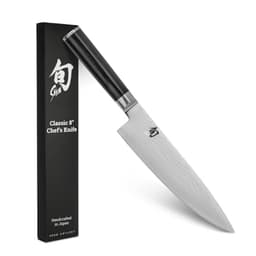
If the answer is Shun
Shun Classic 8-inch Chef's Knife
The knife most people picture when they think 'nice Japanese knife': a VG-MAX core at ~61 HRC under 34 layers of Damascus cladding, with a slim D-shaped handle. You pay for the finish, but the steel is genuinely hard.
Read the full Shun reviewPrice as of November 4, 2026. #ad How we’re funded
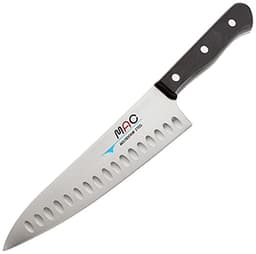
If the answer is MAC
MAC Chef Series Hollow-Edge 8-inch
MAC's thin, light molybdenum blade is the one professional cooks quietly reach for — less flashy than a Damascus Shun, but famously nimble. The hollow-edge dimples reduce sticking on wet produce.
Read the full MAC reviewPrice as of November 4, 2026. #ad How we’re funded
Frequently asked questions
Is MAC or Shun the better knife?
Neither is better, and the honest split is about information rather than quality. Shun publishes what the steel is and how hard it is — VG-MAX hardened to 60-61 Rockwell, with a 16 degree edge each side. MAC publishes what the blade's shape is — a 15 degree per side edge and a 2.5 mm starting stock tapered from spine to edge on its Chef Series — and publishes no steel grade and no Rockwell figure anywhere on its own site. Buy the Shun if you want edge retention you can predict from a spec sheet. Buy the MAC if you want the thinnest cutting feel and are willing to trust the grind.
Are MAC and Shun made in the same place?
Effectively yes. Shun's Classic line is 'Handcrafted in Seki City, Japan' per Shun's own product pages, and MAC's Chef Series listing states '100% Handcrafted by artisan knifemakers in Seki, Japan'. Seki is the knife-making city behind Shun, Miyabi and Tojiro as well. Same place, same tradition, different disclosure policy.
How hard are MAC knives compared to Shun?
Unknown versus 60-61 Rockwell. Shun's own FAQ states it 'hardens VG10 and VG-Max steel to 60-61 Rockwell'. MAC publishes no hardness figure for the Professional Series, the Chef Series or any of its sets — the steel is described only as a high-carbon, stain-resistant molybdenum alloy, which is a description rather than a grade. Where our MAC cards show a hardness range it comes from a marketplace listing, not from MAC, and we label it that way.
Which is easier to sharpen, a MAC or a Shun?
They are close, and the published angles put the MAC marginally ahead. MAC's Chef Series states 15 degrees per side and Shun states 16, so a MAC needs a hair less metal moved to reach the apex. Both are hard enough that a stone is the right tool and a grooved steel rod is the wrong one. Shun's own FAQ also warns against diamond steels for routine honing because they remove metal before it is necessary.
Does Shun's free sharpening make it the better buy?
It is a real and under-priced benefit, with real conditions. Shun states 'We will sharpen your Shun cutlery for free, for as long as you own it', with you paying shipping and processing of $15 in the US, and a roughly two-week turnaround. The condition is the important part: 'Free sharpening services apply to purchases made through authorized dealers only.' MAC offers no equivalent service, and its warranty is 25 years rather than lifetime and is non-transferable. If you will never own a stone, the Shun service is worth more than any spec on this page.
Is a MAC thinner than a Shun?
On the only figures published, yes, and it is MAC's whole proposition. MAC's Chef Series listing gives a 2.5 mm starting stock on the 8-inch chef's knife before the blade is 'completely tapered from spine to edge'. Shun publishes no thickness figure for the Classic line at all — it publishes the cladding count instead, 34 Damascus layers each side. Starting stock is not the same as thickness behind the edge, which is the property that actually decides whether food separates or splits, but it is more than Shun gives you.
Which handle should I pick?
This is the most physical difference on the page and it has nothing to do with steel. Shun's Classic uses a D-shaped ebony-finish Pakkawood handle on a full composite tang — subtly asymmetric, built around a right-handed grip. MAC's Professional and Chef lines use a Western-style symmetrical Pakkawood handle. If you are left-handed, or you share knives with someone who is, the MAC is the more neutral object. Our left-handed Japanese knives guide covers how much the D-shape actually matters.
Do MAC's dimples and Shun's Damascus layers do anything?
Both are smaller effects than their marketing implies. The dimples (MAC) and Granton scallops generally sit above the apex, so they cannot make a blade sharper; the one source we found that actually ran the knives concluded they help food release on long slicers and are unnecessary on short, already-thin blades. Shun's 69-layer Damascus cladding is a soft stainless wrapper around the VG-MAX core — it protects and stiffens, and the pattern is decorative. Neither feature is a reason to pick one brand over the other.
Which is the better buy as a two-knife set?
On published figures, MAC's Chef Series TH-201 — the TH-80 8-inch chef's knife and the TH-50 5-inch paring knife, both dimpled — because a 5-inch paring knife is closer to a usable second knife than a 3.5-inch one. Shun's Classic 2-piece pairs the DM0706 8-inch chef with the DM0700 3.5-inch paring knife and typically costs noticeably more, but it brings VG-MAX at 60-61 Rockwell and the free-sharpening service with it. Compare the two live prices above before deciding, because the gap between them moves.
Where should I buy either brand?
From an authorized dealer, and this matters much more for Shun. Shun publishes that no single visual feature proves a knife is genuine, that not every seller on a trusted marketplace is authorized, and that only knives bought from an authorized dealer are eligible for warranty service or free sharpening. Counterfeit MACs are far less of a reported problem, but MAC's 25-year warranty is also 'non-transferable and is valid only to the original purchaser', so the receipt matters either way.
Sources
- Shun Knives FAQ — Shun Cutlery (Kai USA) — Shun's own answers: 'Shun hardens VG10 and VG-Max steel to 60-61 Rockwell and SG2 to 61-62', 'Shun knives, for example, are sharpened to a 16 degree angle on each side of the blade', and on rods, 'Please do not use a diamond steel for regular honing. Diamond steels are for sharpening and will remove metal from your knife before it is necessary' (accessed August 28, 2026)
- Shun Classic 8-inch Chef's Knife — Shun Cutlery (Kai USA) — Shun's published spec for the knife itself: a 'VG-MAX' core in '69 layer Damascus' — described as '34 layers of stainless Damascus cladding each side (68 total)' — a '16 degree edge each side', an '8 in. (203mm)' blade, '6.7 oz (190 g)', an ebony-color Pakkawood D-shaped handle, 'Handcrafted in Seki City, Japan' and a 'Limited Lifetime Warranty'. No Rockwell figure appears on the product page (accessed August 28, 2026)
- Classic 7" Santoku (DM0702) — Shun Cutlery (Kai USA) — Shun's published spec for model DM0702: a '7 in. (178mm)' blade, 'Blade Steel VG-MAX' described as a 'Proprietary VG-MAX cutting core', a '69 layer Damascus' blade which the same page's feature list gives as '34 layers of stainless Damascus cladding each side (68 total)', a 'long-lasting 16° edge', a '5.0 in (127mm)' 'Ebony color Pakkawood' handle on a 'Full composite tang for light weight and perfect balance', overall dimensions of '1.9 in. H x 12.5 in. L x 0.8 in. W', a weight of '6.3 oz (179 g)', 'Country of Origin Japan' / 'Handcrafted in Japan' and a 'Limited Lifetime Warranty'. Listed at a Regular Price of $237.00 against a Special Price of $189.95 on the access date. NO Rockwell hardness figure appears on the page (accessed October 13, 2026)
- Classic 2-Piece Starter Set (DMS0220) — Shun Cutlery (Kai USA) — Shun's own page for the set names both knives — the 'Classic 8" Chef's Knife' (DM0706) and the 'Classic 3.5" Paring Knife' (DM0700) — and publishes the blade spec for them: 'VG–MAX' steel in a '69 layer Damascus' blade described as '34 layers of stainless Damascus cladding each side (68 total)', a 'razor-sharp, long-lasting 16° edge each side', 'D-shaped ebony-finished Pakkawood handles' on a 'full composite tang', 'Handcrafted in Japan' and a 'Limited Lifetime Warranty'. NO Rockwell hardness figure appears on the set page (accessed September 29, 2026)
- Warranty & Service — Shun Cutlery (Kai USA) — Shun's own warranty terms: 'Shun Cutlery from Kai USA Ltd. carries a limited warranty for the lifetime of the original owner', guaranteed 'against manufacturing defects in material and construction and to perform as advertised when properly used and maintained'. The exclusions are explicit — 'Any use other than cutting (such as stabbing or prying) is considered misuse and abuse—and will void your warranty', 'Use your Shun knives on meat and produce only. Do not use directly on bones, frozen food, or produce pits', and the warranty 'does not extend to normal signs of wear, rust, damage or breakage due to improper use, improper maintenance, accidents, loss, or theft'. It applies 'to purchases made through our authorized dealers only', and 'Kai USA will NOT honor any Kai or Shun branded products purchased from unauthorized sources with our limited lifetime warranty' (accessed September 15, 2026)
- Sharpening Service — Shun Cutlery (Kai USA) — Shun's own terms for the service: 'We will sharpen your Shun cutlery for free, for as long as you own it.' You pay 'shipping and processing' at '$15 for US, $25 for Mexico & Canada', 'Estimated turnaround time for mail-in warranty and sharpening services is 2 weeks', and 'Free sharpening services apply to purchases made through authorized dealers only' (accessed September 15, 2026)
- How to Spot a Fake Shun Knife — Shun Cutlery — Shun's own statement that no single visual feature confirms authenticity, that not all sellers on a trusted marketplace are authorized, and that only knives bought from an authorized dealer are eligible for warranty service (accessed August 13, 2026)
- Chef Series Set 2 PCS (TH-201) — MAC Knife — MAC's own page for the TH-201 set, which itemizes it model by model: the 'TH-80 Chef series Chef's Knife 8" with dimples' and the 'TH-50 Chef series Paring Knife 5" with dimples'. As with the CHEF-32, the page publishes NO steel grade, NO Rockwell hardness, NO edge angle and NO blade thickness. The Amazon listing for the same set does publish two of those: 'Blade Material: High-Carbon, stain-resistant, molybdenum steel' and 'Blade Edge: 15-degree per side, double-bevel', plus '2.5mm starting stock for Chef and 2.0mm for Paring' before the blades are 'completely tapered from spine to edge', '100% Handcrafted by artisan knifemakers in Seki, Japan' and a '25 year warranty against manufacturing defects' (accessed October 16, 2026)
- Professional Series Set 3 PCS (PRO-31) — MAC Knife — MAC's own page for the PRO-31 set, which itemizes it model by model: it 'Includes the best seller MTH-80 Pro Chef's Knife 8" with Dimples, PKF-50 Pro Paring Knife 5"' and 'the MSB-105 Pro Bread/Roast Slicer' — so all three knives are Professional series, unlike the CHEF-32 it replaced. MAC's MSRP on this page is $435.00, the same figure the live Amazon listing showed on the access date. As with every other MAC set page, it publishes NO steel grade, NO Rockwell hardness, NO edge angle and NO blade thickness. One figure on the page is inconsistent with MAC's own catalogue and we do not use it: the set page writes the slicer as 10 1/4 inch, while MAC's own product page for the same knife is titled 'Professional Series 10 1/2" Bread/Roast Slicer (MSB-105)' and the Amazon listing gives 10.5 inch — so 10.5 inch is the length this site states (accessed October 31, 2026)
- Warranty Information — MAC Knife — MAC's own warranty terms: '25 years from the date of purchase' against 'defects in the materials or workmanship of our products'. The exclusions are explicit — 'accidental or incidental damage including broken or bent tips', 'staining or corrosion to the blade' and 'cosmetic scratches, chips, or dents to the handle or blade that occur during normal use'. MAC names the foods to keep off the edge: 'frozen items, bones, shellfish shells, hard squashes, hard cheeses, nut shells, blocks of chocolate, etc.' The warranty is 'non-transferable and is valid only to the original purchaser' (accessed September 29, 2026)
- Japanese kitchen knife — Wikipedia — Reference on gyuto/santoku/nakiri, single- vs double-bevel (kataba/ryoba) and edge angles (accessed July 21, 2026)
- Rockwell hardness test — Wikipedia — Definition of the Rockwell C (HRC) scale used to state knife-steel hardness (accessed July 21, 2026)
Per-knife specs (steel, HRC, blade length, geometry) are read from each maker’s spec sheet or product listing and dated on the individual review cards above. “Not published” means the manufacturer does not state that figure — we flag it rather than guess.
Keep reading
Best MAC Knives
The MAC range on what is actually published — geometry, not metallurgy.
See the roundupBest Shun Knives
Which Classic to buy, when every blade shares one steel and one angle.
See the roundupMAC Professional Santoku Review
The MAC that converts people, examined on the little MAC publishes.
Read the reviewShun Classic 8-inch Review
The other half of this pairing, on Shun's own published spec.
Read the reviewShun vs Miyabi
Same city again, and the edge angle that separates them.
Compare themGranton Edge vs Straight Edge
What MAC's dimples can and cannot change.
Read the comparisonKnife Hardness Chart (HRC)
Where 60-61 Rockwell sits, and what buying without a figure costs you.
Read the chartBest Mercer Knives
The same published-versus-withheld question, one price tier down.
See the roundup